


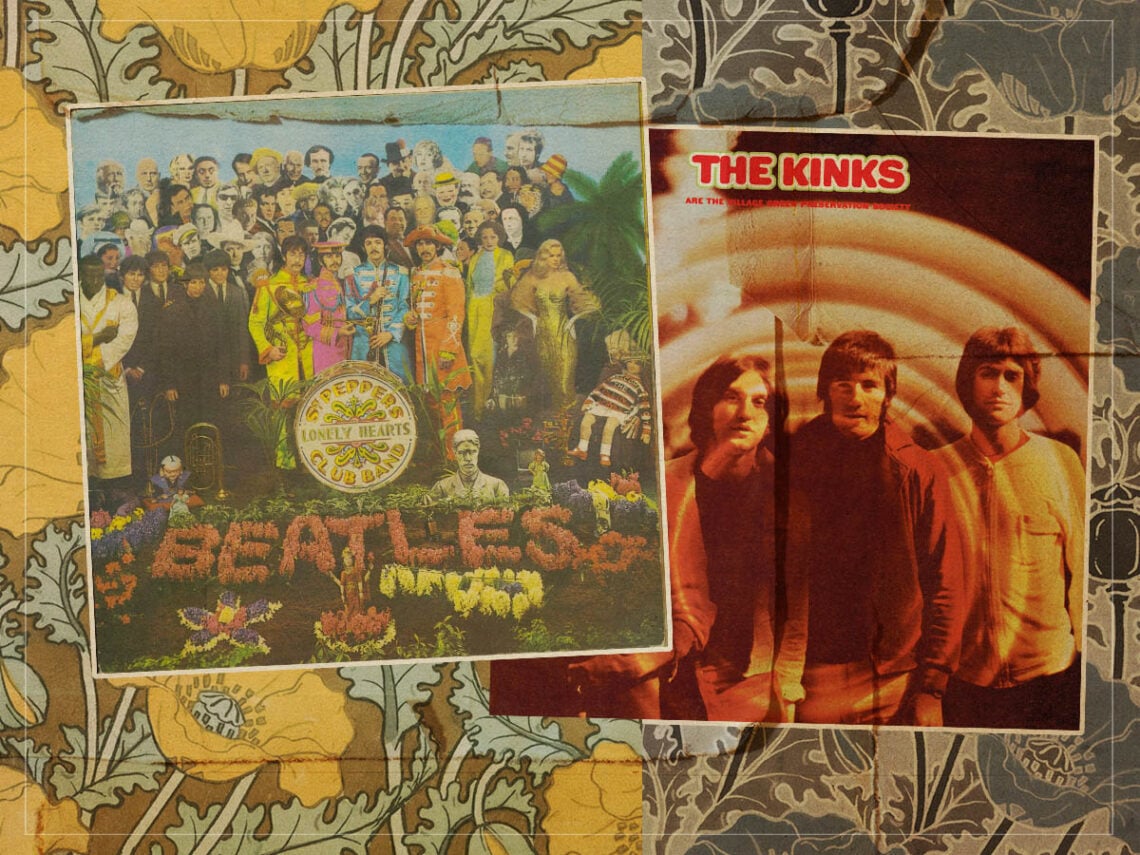
Sgt Pepper’s vs Village Green Preservation Society: the definitive concept album of the swinging sixties

A good album is capable of changing the landscape of music and art indefinitely. After The Beatles unveiled their stunning concept album, Sgt. Pepper’s Lonely Hearts Club Band back in 1967, pop music was never really the same again; the Fab Four changed entire perceptions of the album as a format, inspiring countless future artists to construct their own flowing narratives which stretched across an album’s tracklisting. One of the most inventive yet overlooked albums that came in the wake of Sgt. Pepper’s was The Kinks Are the Village Green Preservation Society.
Formed in 1963, around the same time The Beatles released their debut album, The Kinks built a reputation on energetic, youth-orientated R&B music. Closely associated with the modernist subculture, the Ray Davies-fronted group provided a strong voice for Britain’s angry post-war youth. Their pioneering use of distortion and amphetamine-fueled rock had a lasting impact on the face of both 1960s rock and later styles of punk and alternative rock. Inevitably, though, The Kinks would have to grow up at some point, and the release of their 1968 album The Kinks Are the Village Green Preservation Society saw them ascend from youthful rockers to profound artists.
In a similar vein, The Beatles had initially built an audience on upbeat pop songs aimed at the younger generation. Songs like ‘She Loves You’ were never going to be the most profound pieces of art ever created, but they made the Merseyside lads household names across the world. Before too long, though, Paul McCartney and John Lennon yearned for something deeper as songwriters. Choosing to completely reinvent both the band and their sound in the wake of the newly emerging psychedelic age, the group eventually landed upon Sgt. Pepper’s Lonely Hearts Club Band.
Given the legendary nature of both The Beatles and their 1967 album, Sgt. Pepper’s often dominates the conversation when it comes to the early concept albums of the swinging sixties, with The Beach Boys’ Pet Sounds being one of its only main rivals. Nonetheless, The Kinks managed to challenge the legendary reputation of The Beatles’ record, imbuing their 1968 album with a profound overarching narrative that challenged the album format while also offering deep social commentary on the state of England at the time.
The argument that is often made for Sgt. Pepper’s being one of the most important records of the 1960s is that it helped to inspire various other musicians to follow suit, creating similarly inventive records. However, if you look at their recording history, The Kinks began work recording ‘Village Green’, the album’s title track, three months prior to the release of Sgt. Pepper’s Lonely Hearts Club Band. You could easily assume, therefore, that this idea had been brewing in the mind of Ray Davies for some time before the mop-top Liverpudlians changed the game.

The Beatles certainly set the standard for concept albums with the release of Sgt. Pepper’s, but that does not necessarily mean they perfected it. Aside from the idea of The Beatles taking on alter-egos as the invented Lonely Hearts Club Band, and the LSD-infusion that permeates through the LP, the narrative of the album leaves a lot to be desired. In contrast, The Kinks’ offering uses a continuous narrative to draw upon a variety of songwriting themes, predominantly nostalgia, and the disappointing reality of the present day.
The Kinks Are the Village Green Preservation Society was Davies’ magnum opus, in terms of songwriting quality. Moreover, the diverse themes explored on the record allowed The Kinks to move away from their early reputation as adolescent rock rebels, becoming viewed as more mature and considered artists. It is worth noting that the record was largely a flop upon its initial release, but perceptions of it have certainly changed over the years.
Not only did Ray Davies construct a record unlike anything the musical mainstream had ever witnessed before, but he also provided some of the most profound social commentary of the era – so much so that many of the ideas encased in Village Green Preservation Society still resonate with audiences today, over five decades on from its initial release. It didn’t sell as well as Sgt. Pepper’s, and it rarely appears on lists of ‘the all-time greatest albums’, whereas The Beatles’ effort is a mainstay, but Village Green Preservation Society was just as important and revolutionary as Sgt. Pepper’s.
Ultimately, the debate over which record should be classified as the definitive concept album of the 1960s could wage on for years to come. On a purely objective basis, though, The Kinks’ Village Green Preservation Society should – at least – be held in the same regard as Sgt. Pepper’s for its revolutionary content.
Arguably, though, the album expertly crafted by Ray Davies has stood the test of time to a greater degree than Sgt. Pepper’s, given that its content still sounds incredibly fresh and reflective of modern-day England. The Beatles were an inarguably pivotal group in the development of rock and pop, but they never attempted a level of social commentary on the same plane as that of Ray Davies. It simply was not in their repertoire.

Never Miss A Beat
The Far Out Beatles Newsletter
All the latest stories about The Beatles from the independent voice of culture.
Straight to your inbox.