


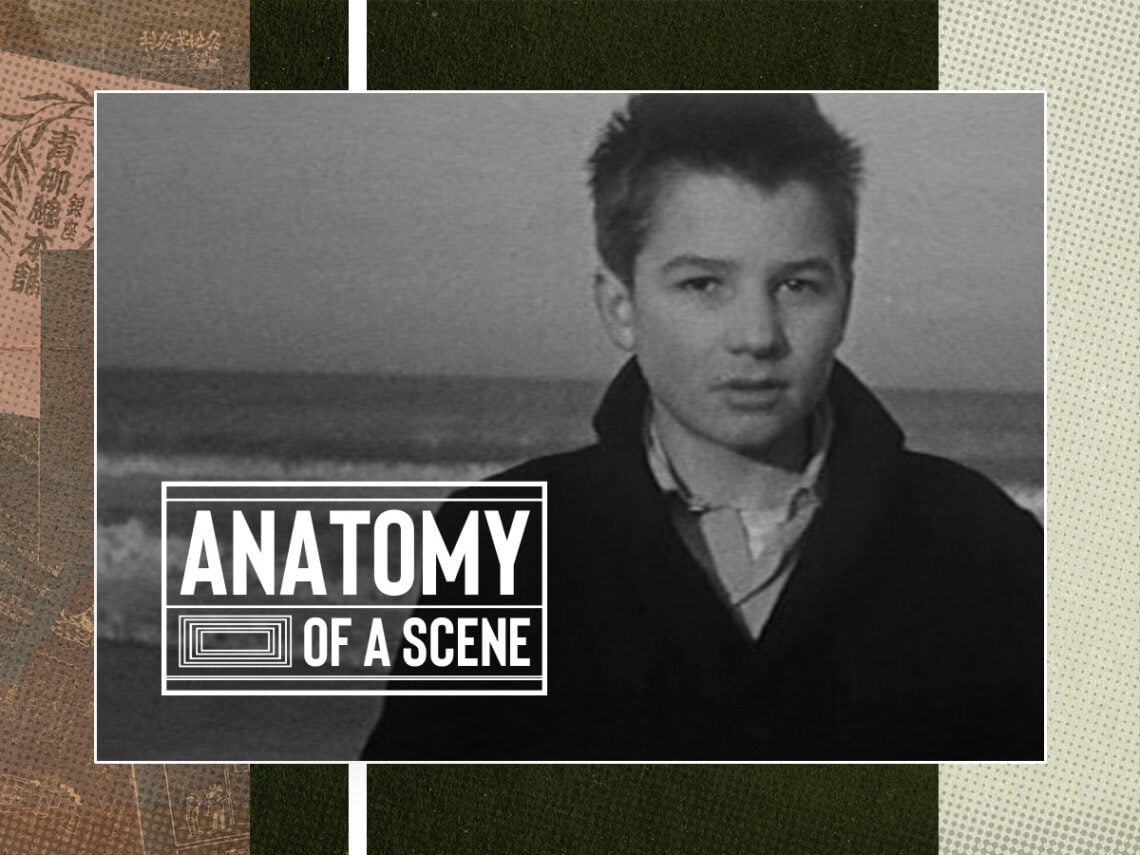
Anatomy of a Scene: Antoine runs to the beach in ‘The 400 Blows’

Francois Truffaut’s The 400 Blows remains one of the greatest depictions of childhood ever captured on film. A landmark entry in the French New Wave movement, Truffaut’s film follows the rebellious young schoolboy Antoine Doinel, who, despite his best efforts, constantly finds himself in trouble with his parents and teachers. The film was released in 1959 as Truffuat’s debut feature, earning him an Academy Award nomination for ‘Best Original Screenplay’.
The 400 Blows propelled Truffaut towards success, and he has since been recognised as one of the most influential directors of all time. Moreover, the film launched the career of Jean-Pierre Leaud, who reprised the role of Antoine in four more films with Truffaut and worked closely with other cinematic icons such as Jean-Luc Godard, Jacques Rivette, Pier Paolo Pasolini and Agnes Varda. As Antoine, he balances a mischievous nature with childish innocence and vulnerability, embodying a character that is, more than anything, lost. At the heart of The 400 Blows is an understanding that the authority figures surrounding Antoine misunderstand his behaviour – what he needs is love and support.
Truffaut is sympathetic to the complicated nature of youth as Antoine struggles to understand his place in the world. We follow the young boy as he gets in trouble at school, wanders around Paris with his best friend Rene, and eventually spends the night in jail after stealing a typewriter. Childlike wonder is underscored by the harsh realities of growing up, which Truffaut depicts with tenderness and honesty rather than cliched sentimentality.
The film uses many innovative cinematic techniques which came to define the French New Wave. Truffaut and his crew shot on location, often using handheld cameras which follow the characters around. He also uses techniques such as POV shots, jump cuts, long takes and freeze frames, with the latter two used prominently in the film’s final scene. The 400 Blow’s ending is one of its most influential and memorable moments, despite its ambiguity.
After Antoine steals a typewriter in the hopes of earning some money, he is apprehended whilst attempting to return it. He is taken to jail in a police van, which is one of the most heartbreaking scenes in the entire film, before spending the night in a cell with prostitutes and thieves. The young boy is taken to a juvenile detention centre by the sea, and a psychologist questions his behaviour. In this sequence, Leaud was asked questions by Truffaut behind the camera, giving answers that mixed the script with his own experiences. He talks naturally and openly, and for a moment, we forget that we’re not watching a documentary.
Throughout this scene, we feel an even deeper connection to Antoine, preparing us for the film’s perfect ending. Whilst playing football with the other children, Antoine manages to escape the school grounds and runs towards the ocean, which he has always been desperate to see. A long tracking shot follows Antoine as he runs through the rural landscapes that provide a striking change from the cityscapes he is familiar with. There is no music, only the raw sounds of his surroundings and Antoine’s breathing, adding an extra layer of realism to the scene.
Once he reaches the beach, Jean Constantin’s magical score kicks in, a similar piece to the one that plays during the film’s opening scene, only less upbeat and hopeful. We follow Antoine as he jogs across the sand towards the waves, and Truffaut forces the audience to accompany Antoine on his journey rather than cutting to the moment he reaches the water, as many Hollywood films would perhaps choose to do. When he finally gets to the sea, he stops to admire his surroundings before turning to face the camera. A freeze-frame is used to capture Antoine’s expression before the film fades to black.
Having witnessed the sea, one of his personal goals, he is now faced with the question of what to do next. Treated like both a criminal and a child, Antoine is stuck in limbo. The enormity of the sea prevents Antoine from escaping, leaving him trapped in the confines of childhood. The final image we see of his face expresses a mixture of relief, uncertainty, disbelief and confusion. By using a freeze-frame shot, Truffaut invites audiences to reflect on the young boy’s story, leaving us to use our own imaginations, no matter how positive or pessimistic, to decide where he’ll end up next.
