


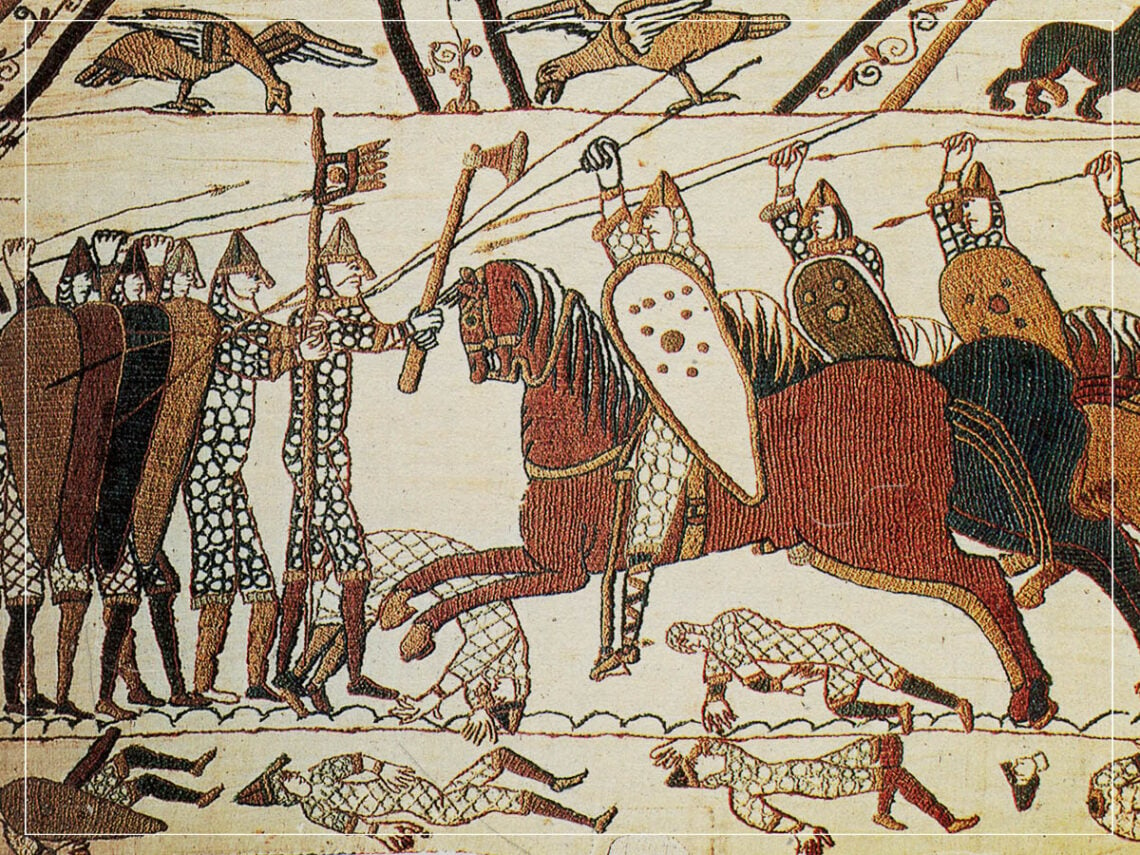
Was the Bayeux Tapestry the first-ever comic?

The Bayeux Tapestry is considered one of the most famous and recognisable historical documents in history. Sprawled out across nearly 70 metres of fabric, in stunning detail, is an entire catalogue of the past. Moving through reams of fabric and 58 scenes, the story of the Norman Conquest of England is told, charting the battle of Hastings from 1066 and the showdown between King Harold II and William of Normandy. It’s a visual text historians have long pored over, and soon enough, art historians joined them.
As well as offering future generations a full-bodied window into military, social and cultural history, it might just qualify as the first-ever comic, and a cursory glance at the Tapestry will confirm as much. Big text looms above battle scenes as supplementary commentary. While it might be in Latin and lack the comedic value of Dennis the Menace and cartoonish speech bubbles, it’s one of the earliest examples of text used to explain a scene’s significance. This is essentially what leads historians to consider it a pioneering example of sequential art.
Sequential art is a term coined by comic artist Will Eisner to explain why graphic art is structured in a specific order to convey information most simply. Its most prominent use in comics is in the chronological ordering of pictures and images, something the Tapestry used to significant historical effect. Scenes are divided by large trees, which is almost like a precursor to the boxed format of traditional comics.
Similarities are also drawn to film storyboards, which is a testament to the centuries-old emphasis on quality storytelling. Author George Wingfield Digby wrote that it was: “Designed to tell a story to a largely illiterate public; it is like a strip cartoon, racy, emphatic, colourful, with a good deal of blood and thunder and some ribaldry.” Bryan Talbot, the so-called “Father of British comics”, agreed, calling it the “first known British comic strip”.
What’s even more fascinating is that it doesn’t even come close to being the first example of what’s morphed into the comic tradition in ancient history. In Scandinavia, fragments of Tapestry have been found and dated to the ninth century, and monastic texts reference narrative-led fabric as early as 991. However, the most well-known, the Bayeux Tapestry, was not groundbreaking in the period it was created. It’s simply the one that survived best.
Going the way of future political offerings from the art world, it has been used as a propaganda tool in its time. Napoleon referenced it often and brought it to Paris to be displayed in the 19th century. Throughout World War Two, the Nazis also seized upon it as a useful tool, studying it intensely to supposedly demonstrate how German culture proliferated European culture. That the storied history of the Tapestry somehow resulted in the creation of the Garfield comics speaks to its timeless format.
See the comic strip in the video below.
