


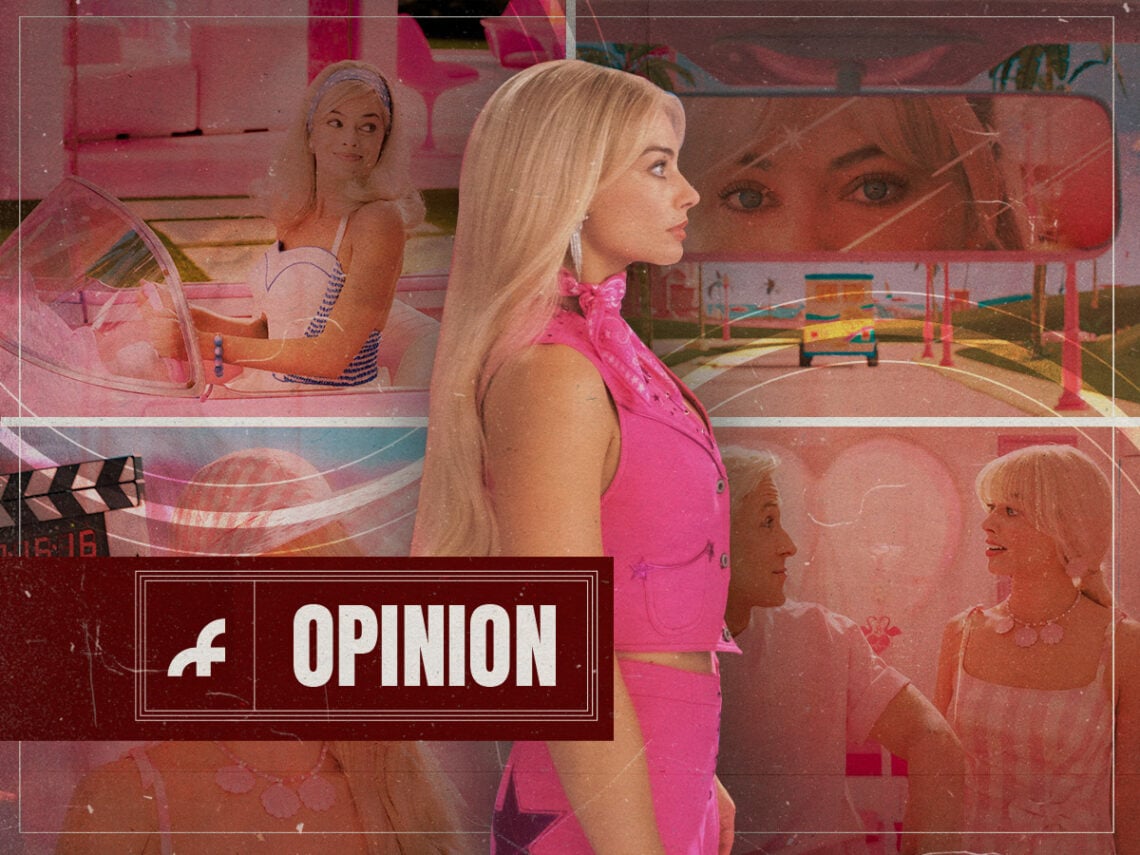
‘Barbie’: a capitalistic and contradictory studio exercise

During the run-up to the release of Greta Gerwig’s Barbie in 2023, it felt nearly impossible to avoid advertisements, stills, memes and merchandise relating to the film. Before it was even out in cinemas, special edition Barbie beauty products, clothing, and other easily disposable products were hitting the shelves. Not only was Barbie a cinematic phenomenon, but it was also a cultural and consumerist one.
Barbie dolls have been a staple of most young girls’ childhoods since the ‘50s. Whether you only played with them at a friend’s house, owned second-hand ones that had seen better days or received the newest variation of the doll every Christmas, most girls have had access to Barbie in some way or another. Of course, the dolls have long been criticised for their promotion of a specific kind of body – white, skinny, sexualised – but with Barbie the movie, Gerwig acknowledged these issues and presented us with an array of ‘diverse’ Barbies, such as one in a wheelchair, several marginally plus-size, and a few with darker skin.
Yet the fact that these few ‘diverse’ Barbies were still rather sidelined, and all were stereotypically beautiful, is one of the clearest signs that Gerwig’s film served to appease as many people as possible to make a profit, without dishing out anything revolutionary or disruptive to the status quo. The movie might include a Barbie in a wheelchair as a background character, but the film’s feminism does nothing to include the issues faced by disabled women, nor does it acknowledge other intersectional issues like class and race.
While it is something that Barbie does contain more than just skinny white dolls, you can’t help but feel as though the movie doesn’t actually care about serving up genuine feminist messages that explore the real struggles women worldwide face besides the surface-scraping ideas of ageing and beauty standards. These are still, of course, valid feminist issues that have plagued women for centuries, but the movie fails to even remotely dig into these issues with sufficient nuance or depth.
America Ferrera gives a speech that practically screams Oscar bait, in which her character, Gloria, reads out very obvious statements about womanhood, such as “you have to be thin, but not too thin” and “you have to never get old, never be rude, never show off, never be selfish, never fall down, never fail, never show fear, never get out of line.” Tell us something we don’t know.
While it is worth acknowledging that many viewers did resonate with this speech, it can be argued that Barbie doesn’t actually have its female viewers’ best interests at heart. Maybe Gerwig wrote the movie with genuine feminist intentions, but Warner Bros and Mattel certainly couldn’t care less about whether the film is truly feminist or not – they just want your money.
Artist Nam June Paik once said, “Bite the hand that feeds you – but not too hard”. This feels like the perfect encapsulation of Barbie. The movie highlights that patriarchy is bad and that women face pressures to look a certain way – it even criticises Mattel at times – but it never goes too far. The movie steers clear of completely alienating men (although many men were somehow offended by the film regardless) or properly lambasting Mattel, ensuring that the movie appeals to as many viewers as possible and retains Mattel’s status as a leading toy brand.
There are many moments where the movie tries to be self-aware, but it can’t hide the fact that it is just one big advertisement and money-making machine. Warner Bros used feminism as a tool to attract a large audience, pretending that Barbie is a genuine tale of empowerment designed with women in mind. In reality, Warner Bros knew exactly what they were doing, spending $150million on advertising – that’s more than the movie cost to make.

Upon the film’s release, every brand you can think of seemed to have a deal with Barbie, from cosmetic brands like OPI and NYX to companies like AirBnb and Burger King. Moreover, Mattel was revelling in increased sales of Barbie dolls and their accompanying accessories and outfits, even teasing the start of a Mattel Cinematic Universe.
Before Gerwig could take the helm, Barbie was going to be written by Diablo Cody, who penned movies like Juno and Jennifer’s Body. However, with the studio encouraging her to write a film so heavily tied to a pre-existing brand, she found the task too much pressure. She told GQ, “I heard endless references to The Lego Movie in development,” adding, “Ultimately, you’re selling toys. I mean, nobody really wants to delve deeper into the lore and mythos of Hungry Hungry Hippos. That’s not really an artistic exercise.”
The whole thing was one big marketing ploy designed to reel consumers in and make them spend their hard-earned money on everything from Barbie-printed tops from Primark to Barbie-themed candles, skincare products (even though the movie stresses it is OK to have cellulite!) and makeup. The movie’s flimsy feminist messaging was used strategically, and it is understandable that many audiences were attracted to the movie because of its ‘girl power!’ messaging.
Yet, feminism is not true feminism without intersectionality, as mentioned above, nor is it compatible with capitalism. Barbie seems to ignore the fact the people who make these products that the movie promotes (both in its narrative and through its extensive marketing) are predominantly women, with evidence finding that many of these workers for companies like Mattel and Primark are underpaid, overworked and abused.
It feels contradictory, then, to make a film that forms its narrative around the pressures placed on women and the problems with the patriarchy while ignoring the real women directly affected by the movie’s promotion of consumerism and shiny, risk-free feminism.
Sure, the movie was fun to watch, it had its humorous moments, and it made many female viewers feel proud of their identities as women. Yet, we cannot ignore the movie’s dangerous approach to feminism, its depiction of men as nothing more than silly and child-like beings (ignoring the fact that male oppression is more than eye-roll worthy, it can be incredibly dangerous), and its obvious fear of rattling the cage too much.
Barbie is a movie that wants everyone to be happy, but those really walking away feeling fulfilled are Warner Bros. and Mattel, stuffing wads of cash into their pockets from countless ticket and merchandise sales. Of course, Barbie can’t solve all female oppression; no film can, but it is worth discussing that this is a movie rife with contradiction that champions capitalism – the most repressive system in existence.
