


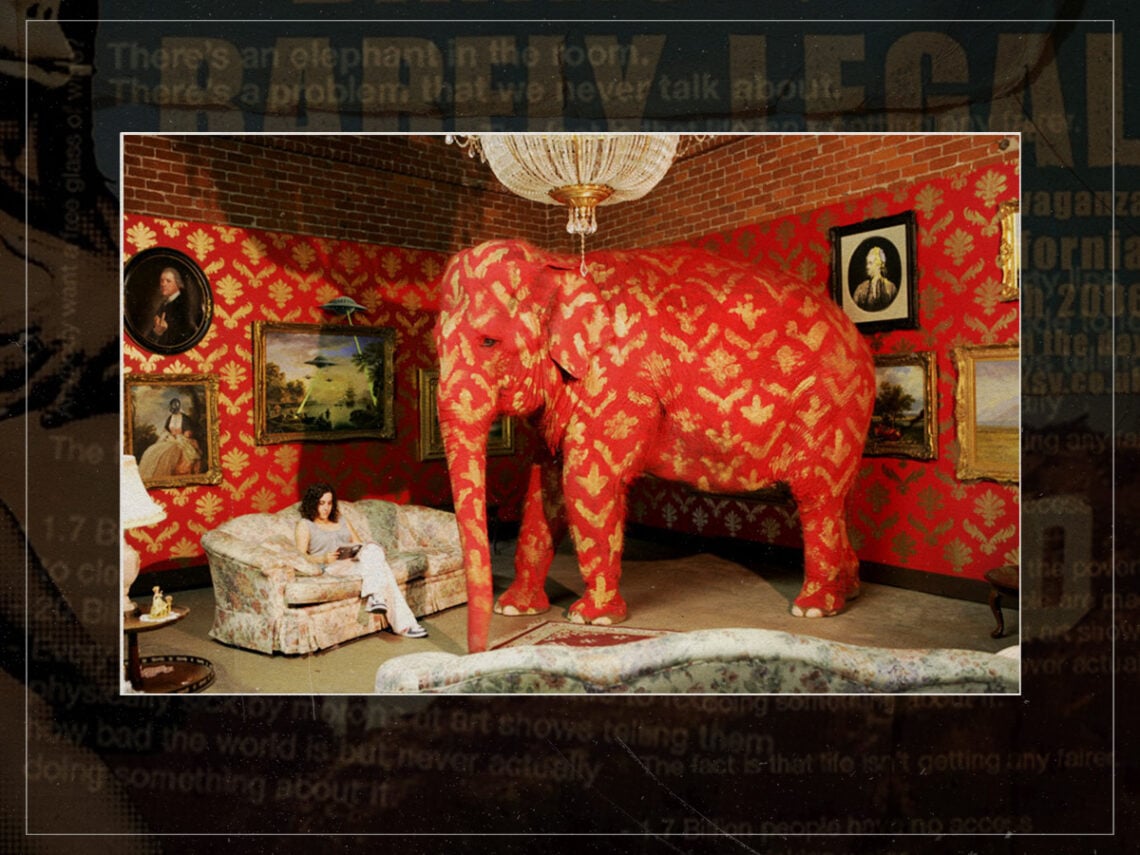
Addressing the elephant in the room: Banksy’s controversial painted-animal exhibit

“There’s an elephant in the room. There’s a problem we never talk about. The fact is that life is not getting any fairer. 1.7 billion people have no access to clean drinking water. 20 billion people live below the poverty line. Every day hundreds of people are made to feel physically sick by morons at art shows telling them how bad the world is but never actually doing something about it. Anybody want a free glass of wine?”
This is what guests who arrived for the opening night of Banksy’s exhibition, titled Barely Legal, saw written on the card received upon entry.
But Banksy was not joking. There was an elephant in the room, quite literally, roaming around in a pen. The exhibition, which was only revealed on the morning of the opening, on September 16th, 2006, promised a “three-day vandalised warehouse extravaganza”.
And boy was it an extravaganza. A real elephant, covered in bright pink and gold paint, mimicking the wallpaper of the exhibition, was all anyone could talk about. Despite the short notice of the exhibition, no one in Los Angeles was willing to miss such a spectacle. Curators, critics, collectors and celebrities, like Angelina Jolie and Brad Pitt, flocked to catch the show.
But what was it all about? According to Banksy, the enormous painted elephant, almost too large to fit in the room, thus creating an uncomfortable presence, was supposed to represent the inescapable problem of poverty that exists in plain sight, but one that people consistently choose to ignore. However, he pokes fun at the audience, other artists and himself in his welcome note, arguing that he disapproves of creatives who shove political artworks infused with social justice messages down the audience’s throats, but then chooses to do exactly that. Could he be making a point by contributing to this never-ending vicious cycle of performative activism in Hollywood?
The painted elephant caused quite an uproar, perhaps Banksy intended it to, but ultimately, the attention on it took away from the rest of the exhibition and the point of poverty itself. California public officials criticised Banksy for the “frivolous abuse” of the 28-year-old elephant named Tai, which had been loaned by a ranch and given permission to be exhibited by the Animal Services Department. But many people weren’t having it, specifically animal rights activists, who claimed that the paint being used was unsafe, and even illegal, and therefore should be rubbed off immediately and replaced with child-safe face paint.
Personally, I found this whole pallava quite ironic. If Banksy really wanted to address world poverty, painting an elephant was perhaps the wrong way to go about it. Yes, he definitely wanted to stir the pot, but perhaps not while being tied to allegations of animal abuse. His efforts seem counterproductive, as, with the act of exploiting animals to get his point across, he seemed to be doing exactly what many do in third-world countries: abusing animals for tourist attractions and financial gain. Think of camels or donkeys in the desert, for example.
In the end, years later, here we are still discussing Banksy’s elephant, but not much is remembered about the rest of the exhibition. The uproar of this massive mammal made us forget the whole point of the exhibit, which was to shed light on the issue of poverty routinely ignored. But we only chipped the paint on that.
