


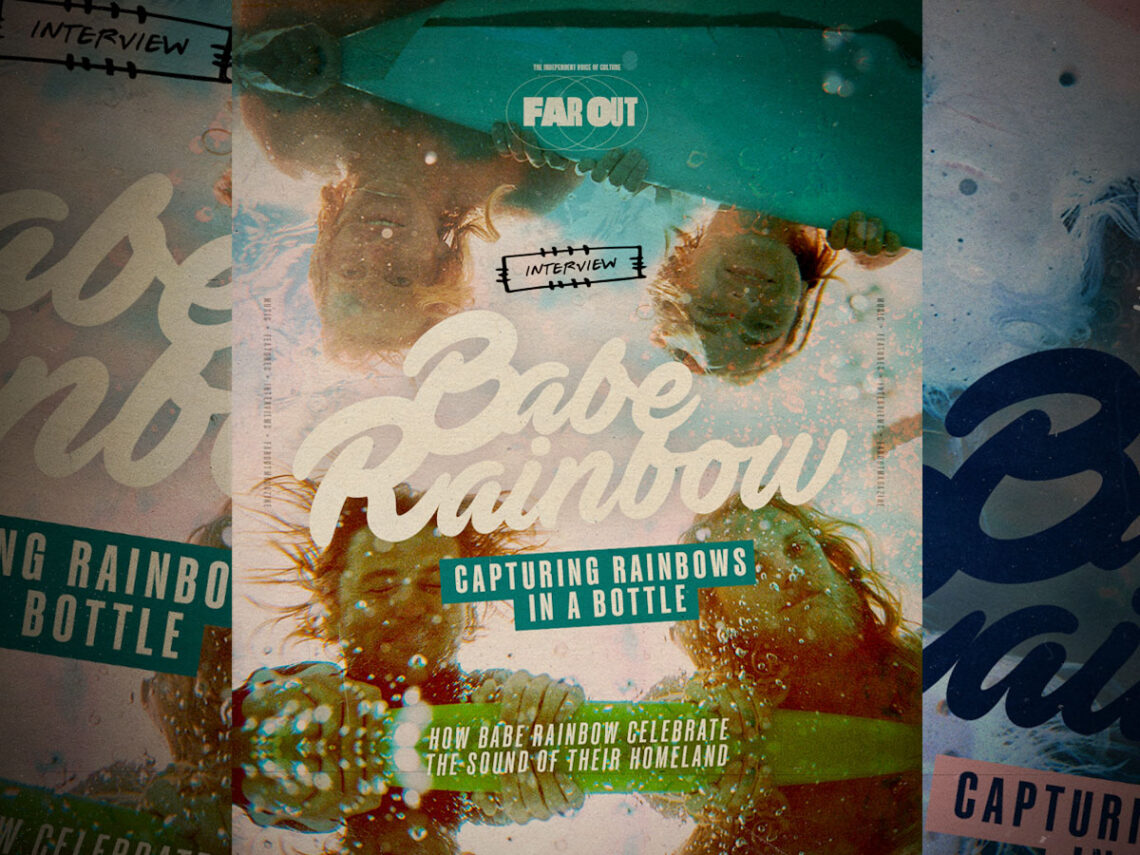
Capturing rainbows in a bottle: How Babe Rainbow celebrate the sound of their homeland

There’s something painfully deceptive about the sunshine in spring. Punctuating the sound of the kettle boiling up my morning brew are faint birdcalls that trick me into thinking warmer climates are on their way. It’s not until I thrust open my window with misplaced enthusiasm that I’m met with a chilling reminder that my sandals can remain firmly in the wardrobe. Somewhat dejected, I put on Babe Rainbow’s upcoming record Slipper imp and shakaerator, and by the second verse of their opening track ‘What is ashwagandha’, the sandals are back, and, this time, they’re accompanied by sunglasses.
“It’s really the essence of this area. It’s just like a beautiful countryside bathed in sunlight,” bassist Elliott O’Reilly tells me. Sometimes, connecting the musical output of a band to the location in which they are from can feel somewhat reductive and, at times, limiting. But in the case of Babe Rainbow, the two are inextricably linked because, as O’Reilly puts it, “We had it too good growing up here, so, it comes through.”
Ever since their self-titled debut album, they’ve been a perennial ray of sonic sunshine. Building on a psychedelic bedrock, they’ve incorporated multiple sensibilities into their sound while remaining concise all the way through. In between their debut album, they’ve explored different corners of their sun-drenched valley, be it country-rock on Changing Colours or jazz-rhythms on Today, but with Slipper imp and shakaerator, it feels as though they are back, clutching at the fertile roots of their native Byron Bay.
“As creative people, artists, musicians, whatever, that like the first work you put out into the universe feels really true to who you are as a band. And so, you’re always trying, like, we kind of try and try and get back there as much as possible,” O’Reilly explains. “So yeah, anything that just feels like a continuation of that is a good sign.”
No song indicates the truthfulness of this statement more than ‘When the milk flows’. It sounds as though Johny from ‘Johny Says Stay Cool’ has packed up his bongos and taken them to Berlin and returned to show his friends what he had learned. It has all the funk and liberation that made their first record so compelling but with a chaotic underbelly that could descend into outright psychedelia at any moment.

It’s a space the band occupy so well. Driven by Miles Myjavec’s air-tight drumming, the band explore every avenue of a jam session, breaking down tempos and letting go of primal ad-libs, all while showcasing an important sense of structural coherence. But the constant throughline is their ability to craft multiple master melodies on guitar and with vocals.
“Jack’s the guitarist; he’s just got a great sense of what the song’s going to be like just at the very beginning,” O’Reilly spells out. “So it’s just the way he plays music. It just brings it to life, and we kind of just pick up on that.”
Jack Crowther, or ‘Cool Breeze’ as he’s affectionately known, undoubtedly brings the sunshine to the band’s disposition, but its rays exist in Angus Dowling’s vocal melodies. “Angus does a lot of the work, but it’s a team effort,” O’Reilly continues, re-affirming the communal mantra that sits at the heart of the band’s sentiment.
He affords himself room to praise Dowling further: “He’s really good at interpreting people’s ideas and absorbing different things from other people. So, yeah, he’s like a sponge, and then he squeezes it out, and it comes out yummy”.
Despite O’Reilly’s obvious open-mindedness, which allows the premise of “yummy” music to be squeezed out of a sponge, he can’t help but laugh with excited curiosity when I said this latest album sounds the essence of Babe Rainbow has been distilled into a bottle.
But as someone who has eagerly awaited the release of every one of their albums since their debut, I can comfortably stand by it. It’s a record oozing with psychedelic soul and showcases every individual strength of the band. Myjavec is given free rein to up the tempo on whatever percussive instrument is within reach, while O’Reilly keeps the band firmly on track. All for Crowther and Dowling to paint with the colours of their melodic rainbow.
Perhaps it took a fan to squeeze that out of the band once more? On Slipper imp and shakaerator, the band enlisted the help of the prolific Stu Mackenzie of King Gizzard and The Lizard Wizard fame to help on production. “It’s so good!” Elliott simply replies when I ask about the effect of having him in the room. “He’s just a natural-born killer. So we’ve had a nice relationship with him the whole time we’ve been a band and pretty much the whole time they’ve been a band,” he expounds.
“He understands where we started and where we’re going. And he’s just doesn’t even have to think about it, he’s got it. So yeah, that was a huge bonus.” After a long introspective pause, which I thought would be bookended by some sort of dewy-eyed sentimentalism, O’Reilly finally said, “It’s pretty exciting, actually.”
Mackenzie’s impact on the record is plain for all to see. While the pulsing rhythm sections and breezy melodies are nothing more than a natural by-product of Babe Rainbow’s sunny disposition, Mackenzie is now on hand to deliver them with a peace sign in one hand and a devil horn in the other.
The sort of lo-fi production style we see so commonly used on Gizz records is injected into Slipper imp, adding a sun-drenched feel that presents the songs in the form of a sonic super-8 camera footage. “I think it suits Angus’s singing a lot, that style,” O’Reilly says, continuing, “I feel like that is a nice platform for his voice.”
In between their most recent record and their upcoming album, Babe Rainbow released a standlone single titled ‘Retrograde’. While it ultimately felt like a poppier landscape for their brand of psychedelic dream rock to live in, it spoke to something larger at play within the band.
Emerging from the long green grass of Byron Bay’s valleys, they traversed all four corners of the world, collaborating with Jaden Smith and exploring European sonic themes as they did so. It was one hell of a journey, that’s for sure, but the acceptance of a new retrograde brought with it something entirely nostalgic altogether.
When I asked O’Reilly the meaning behind the seemingly abstract album title, he tells me that it’s “a piece of machinery that we used to all operate on a farm where we grew up, where we started the band, and where we kind of wrote all of our songs back in the day. It’s just like this really crazy old tool that hasn’t changed for 50 years, that still does a great job.”
It feels like the dawn of the first morning after retrograde is beginning to rise. As the band wander barefoot back to the fertile soil upon which the slipper imp and shakaerator used to roam, its namesake album echoes through the valleys. But as they crest the hill and look towards the place where the band was just an idea, an army of devoted and open-minded listeners follow closely behind, ready to taste the rainbow.
