



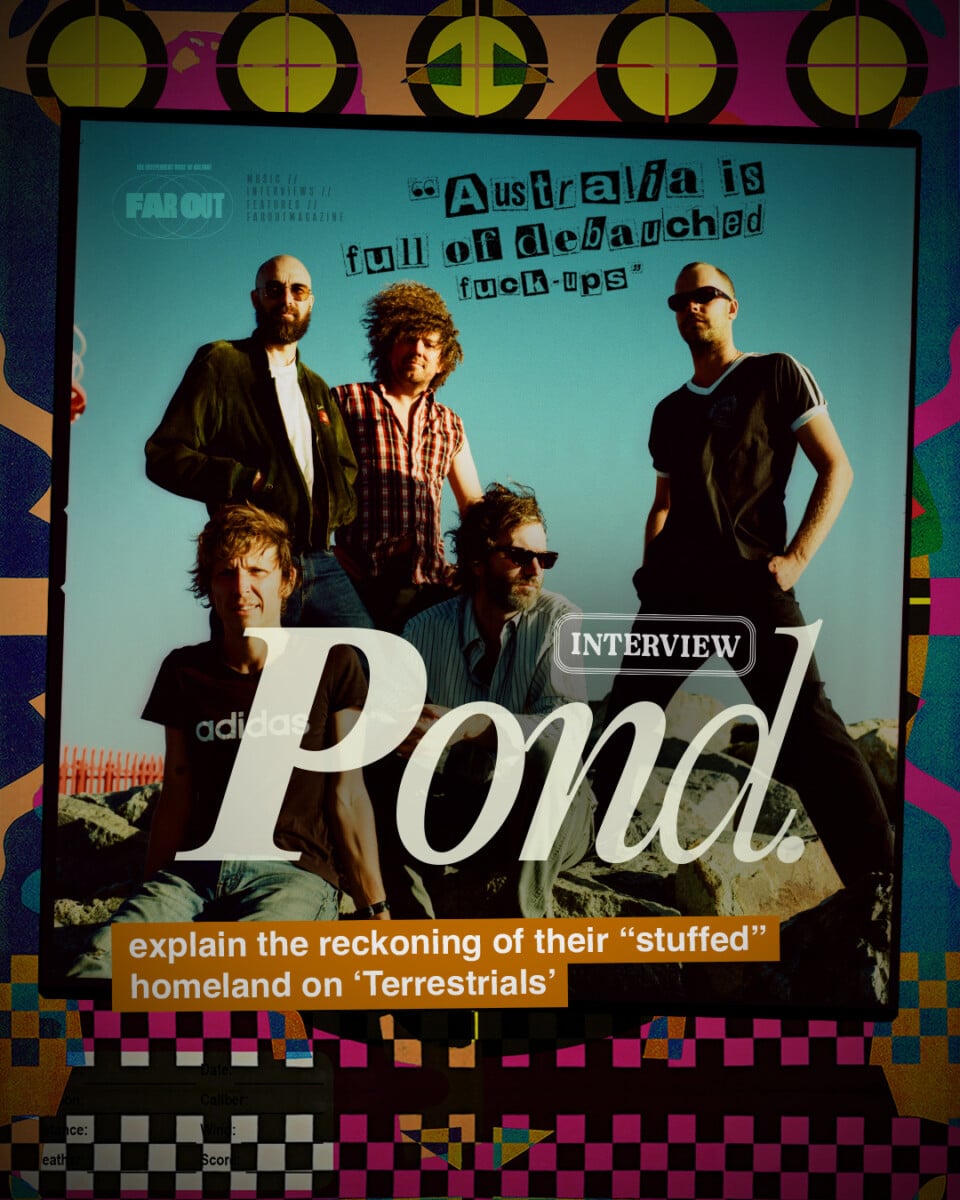
“Australia is full of debauched fuck-ups”: Pond explain the reckoning of their “stuffed” homeland on ‘Terrestrials’

Pond have written a psychedelic album, Terrestrials, about “the red soil of Australia and the people who walk around on it”.
It most certainly is not reminiscent of Men At Work’s ‘Down Under’ or even John Farnham’s ‘You’re the Voice’. It shakes its head loose from the burying sands of pop and captures a modern Australia rife with division and “unity that exists but is so often forgotten”.
Nick Allbrook formed Pond in Western Australia way back in 2008, along with his friends Jay Watson and Joe Ryan. In the years since, they’ve overseen changing eras, toured the world, been part of the sensation of Tame Impala, and established themselves as one of Australia’s leading bands, evidently sharpening their insight along the way.
With talons bared, the rolling riffs of Terrestrials might be as luscious as ever, but they tear into the issues plaguing Australia (and the world), along the way. “We’ve got a couple,” Allbrook says of the myriad problems afoot. “But I reckon having big, gross mining oligarchs controlling the parliament is pretty stuffed.”
In trademark chipper tones, he continues, “It’d totally be resolved if it was up to people, but I don’t think their jabba-the-hut-ass CEO’s will ever let that happen because we’d need to have a referendum, and we are pretty shit at those in this country. Because – and this brings us to the other bit, Rupert Murdoch and Kerry Packer control the media obviously – so, I don’t know, we’ve kinda done ourselves in with that, haven’t we.”
The international ramifications for that are obvious, whether you’re reading in Australia, Austin, or Auburn in East Riding, that oligarchical sentiment and bureaucratic resistance to change will resonate. But Terrestrial is a deeply Antipodean album, and that’s not just related to the familiar Aussie psych sound that Pond were fundamental in formulating. Unlike some of the unfortunate, platitudinous, punky, sixth-form poetry lyrics that have often blighted indie, Pond deal with specifics like the history and implications of their national day.
Australia Day is indicative of some of the issues facing the country. To some, it is cause for communal celebration, for others, it is a sour note of divisive commiseration. But from afar, it is clear that it’s the glaring exemplification of a nation deeply uncomfortable with its unreconciled past.
“It’s really complicated,” Allbrook admits, but he doesn’t stop at that hurdle.
“Sure, I love footy, hot Christmas and Cold Chisel as much as the next person, but fucking hell, can we not just have a bit of compassion for the people who got rolled in the process?” he asks. “Like, how is any country, any person, meant to have a healthy sense of identity or pride without reconciling with the horrors of the past. Nothing good comes from sanitising our inner worlds as people or as a nation.”
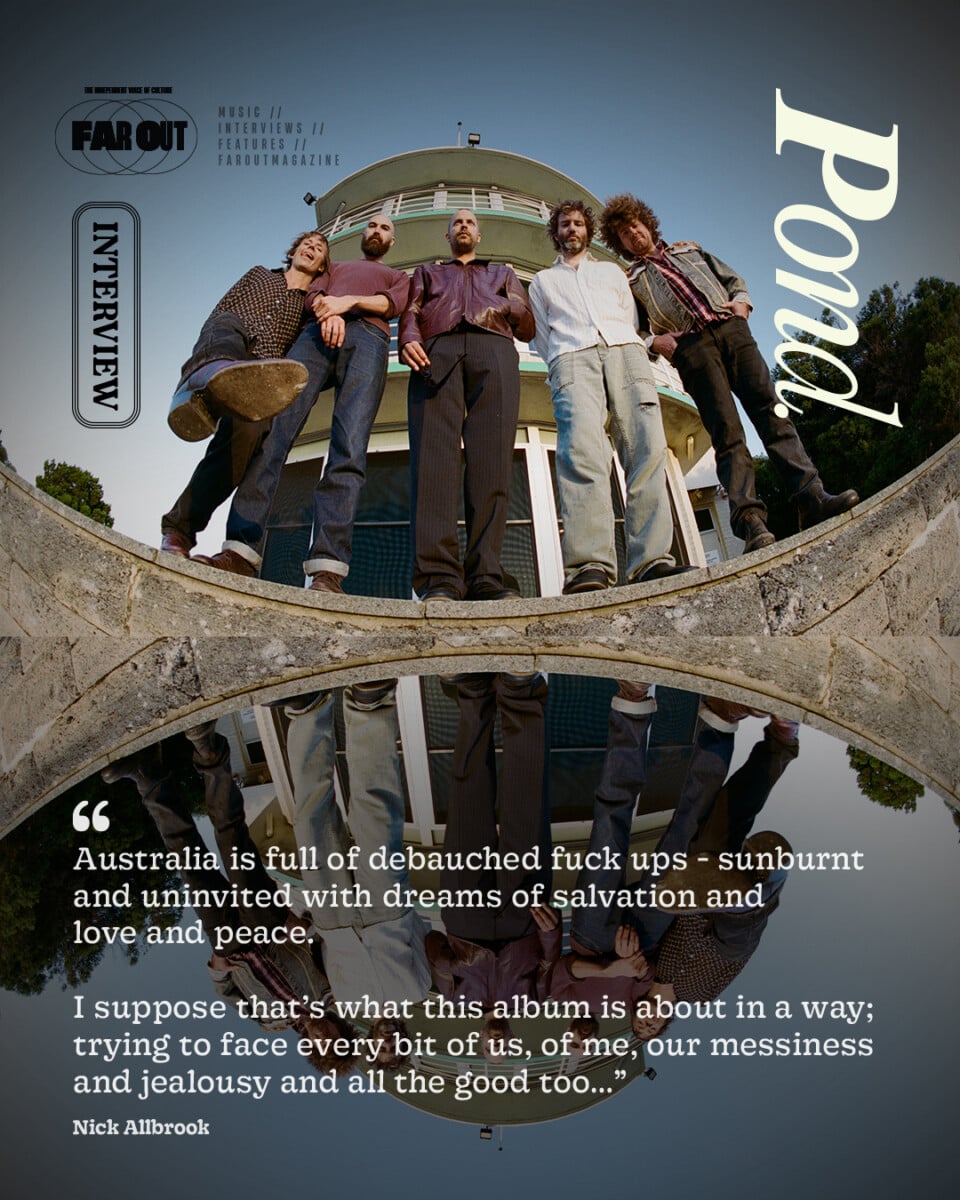
Without holding back, he adds, “Australia is full of debauched fuck ups – sunburnt and uninvited with dreams of salvation and love and peace. I suppose that’s what this album is about in a way; trying to face every bit of us, of me, our messiness and jealousy and all the good too…”
In fact, the album almost sounds like Australia Day itself, with its bells, whistles, harmony, dissonance and debates. It’s a day that “always feels really loaded,” Allbrook says, but it’s feeling ”more and more loaded every year.” He recalls that on the last ‘Invasion Day’ rally in Perth, someone threw a shrapnel bomb into the crowd that thankfully failed to explode.
“That would’ve killed multiple innocent people, Indigenous elders, children, MPs. This is the level of hate we’re dealing with now,” he soberly states. “Indigenous people would prefer we didn’t dance on the graves of their culture, language, ancestors, and instead of saying, ‘Fair enough, let’s move it to another day we can all celebrate’, some folks are so threatened by this prospect that they are moved to kill.”
Yet somehow, amid unexploded bombs and Allbrook’s righteous anger, Terristerials is also a record that is beaming. “I had so much rage and disgust to get out, but every time I find myself magnetised to hope.”
He’s far from afraid of the flowery implications of that. “It’s probably the only thing that can save us, isn’t it,” he muses, “Love and hope. I know I do a lot of angry shit talking sometimes, but in the end, even Kerry Packer is a disturbed child who desperately deserves love. He’s also a total cunt. Have you ever read Love’s Executioner? There’s a chapter about a client called Carlos who’s the most foul, perverted, rude piece of shit, but through patience and understanding, he finds redemption.”
Love’s Executioner is a collection of ten true case studies by existential psychiatrist Irvin D Yalom. It was first published in 1989. The story of Carlos, If Rape Were Legal, is at once the most repugnant and resonant in the whole book. Carlos arrives as a deeply unpleasant man, provocative, and seemingly incapable of empathy, but he is searching for peace as he comes to terms with his terminal illness.
Yalom came to believe that Carlos had mistaken his achievements and principles for his identity. Any criticism, therefore, however minor, felt like an existential threat because he had “stretched his personal boundaries to encompass”, well, everything. Yalom’s great challenge was to separate the man from the ideas he held and recognise that his convictions might be things he “liked, or did, or valued“, but were “not him, not his central being“.
In the context of Terrestrials, that speaks to the fact that alternatives are not ‘a threat’. The album should not be seen as a barbed attack, but a fig leaf. Maybe that’s why Pond have kept their message distinctly upbeat.
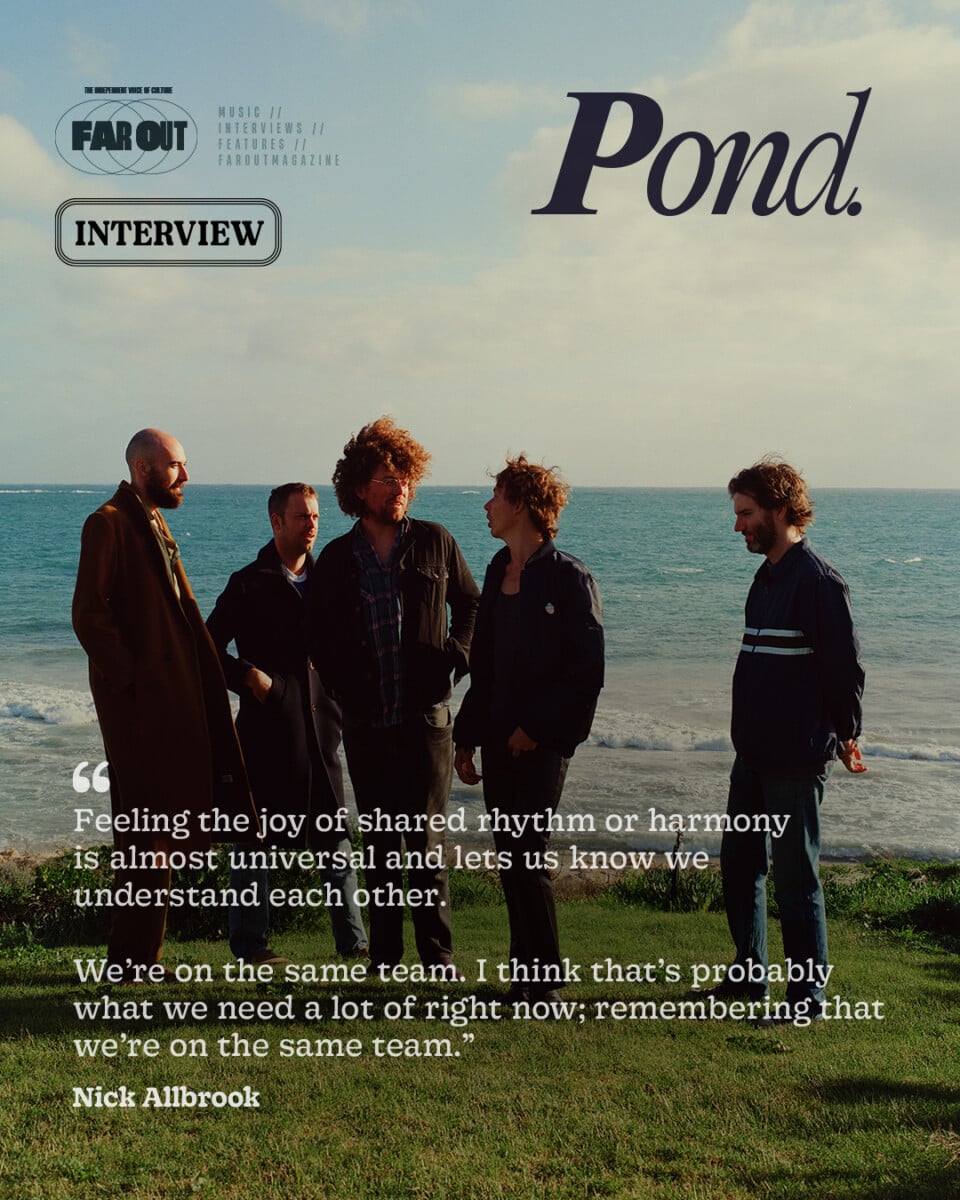
“Music is the connective fibre between people,” Allbrook argues with a soft question mark. “Feeling the joy of shared rhythm or harmony is almost universal and lets us know we understand each other. We’re on the same team. I think that’s probably what we need a lot of right now; remembering that we’re on the same team.”
This literary leaning of the album is also reflected in its influences. “I’m rereading Lives of the Saints by Nancy Lemann, and that is always a massive influence on the way I write,” Allbrook explains. “Just the open-heartedness, the repetition, the sentimentality, the sense of place, the tenderness with which she handles the spirits of gross debauched people.”
Now, 11 albums in, Pond look to do much of the same with perhaps their most meaningful record to date. For those who have followed since 2008, it is a precipice that might have seemed unexpected in those early days. So, what’s happened?
“There was a period there where I was writing about bees and whatever dumb shit came out of our mouths,“ Allbrook admits, “so I suppose we’ve come a long way.“
And he comically concludes in a way that neatly summarises the potent album and their potholed journey towards it, “I mean ‘Mick Manmoose’ is a banger, but it’s a far stretch from where we’ve landed. I reckon you do sometimes just feel compelled to write about this shit when it inspires so much anger. You’ve gotta say something.“
