


Auroville: unravelling the legacy of the largest 1960s utopian city

The utopian metropolis known as Auroville was once little more than a barren plain of red dust. But when Mirra Alfassa, a French-born mystic looked out on this strip of land just outside Pondicherry in India’s Tamil Nadu region, she saw something infinitely more beautiful: a community populated by spiritually enlightened individuals, whose township would be free from money, leaders, and laws. Today, Auroville is home to over 2,500 permanent residents, whose days are dedicated to inner discovery and the pursuit of human unity. But the way of life here is under threat – and not only from industrialists. With rumours of sexual assault, murder, and corruption casting ‘The City Of Dawn’ in an unflattering light, are the residents of Auroville finally beginning to wake from its founder’s paradisal dream?
Inaugurated in 1968, Auroville takes its name from Sri Aurobindo, a Cambridge-educated Eastern philosopher and campaigner for Indian independence, who established an Ashram in the region. In 1908, Aurobindo was imprisoned by the British for sedition and subsequently turned to Hinduism. In 1926, he retreated from public life entirely, spending his days locked away in confinement studying scripture. He died 26 years later, never having left his room. One of his most loyal followers, Mirra Alfassa, known as ‘The Mother’ to her followers, was charged with running the ashram in his stead. Over the next few decades, she slowly realised her dream of creating a new kind of community, a place where – in the dust bowl – brotherhood might bloom like countless Hibiscus flowers.
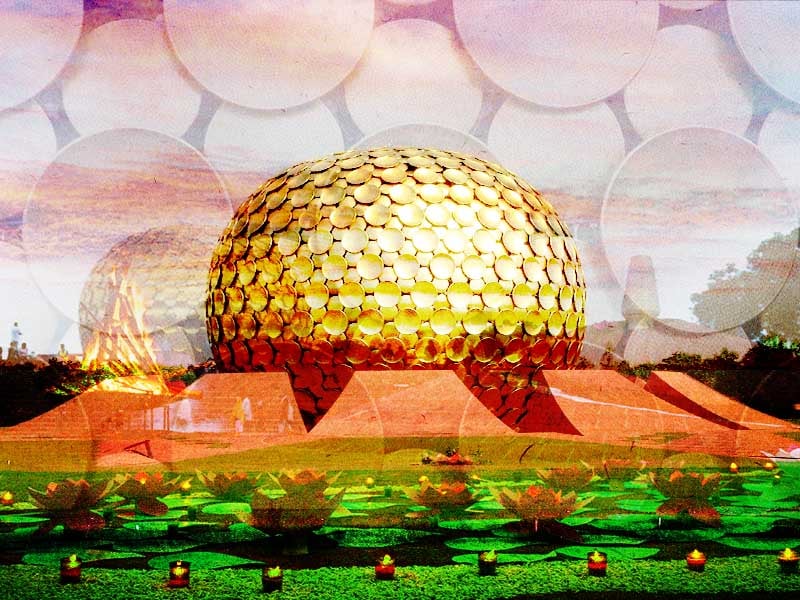
With the backing of UNESCO secured and the architect Roger Anger employed to draw up the blueprints for the settlement, Alfassa’s plan was underway. The pencil sketch she’d made for Anger portrayed a city divided into four quadrants. Each was dedicated to something different: culture, housing, industry, and the last to international pavilions. At the heart of this spiral of gardens, ivory buildings, and greenspaces, Anger suggested a giant golden sphere surrounded by twelve petals. This Geodesic dome, the Matrimandir, is the crowning jewel of Auroville and has served as a meditation hall for the throngs of North Americans and Europeans who, in 1968, began flocking to Auroville in an attempt to flee the cultural wasteland left in the wake of the countercultural era. They built their homes by hand, raising ramshackle shelters with the hope that, this time, they might find true spiritual liberation, and not some corny pre-packaged version of freedom sold for profit by America’s label bosses, film executives, and fashion designers. The founding principles of Auroville are as follows:
“Auroville belongs to nobody in particular. Auroville belongs to humanity as a whole. But to live in Auroville, one must be a willing servitor of the Divine Consciousness.
Auroville will be the place of an unending education, of constant progress, and a youth that never ages.
Auroville wants to be the bridge between the past and the future. Taking advantage of all discoveries from without and from within, Auroville will boldly spring towards future realisations.
Auroville will be a site of material and spiritual researches for a living embodiment of an actual Human Unity.”
Today, these principles are evidenced in Auroville’s commitment to organic farming, sustainable energy sources and building materials, and recycling. When the first visitors to the town arrived in the late 1960s, there was no water. Over the years, the trees planted by those individuals have grown into a verdant forest, which now ensures a water supply to Pondicherry and the surrounding area. None of that, however, has stopped plans to build a road through the very heart of the Auroville forest. On December 4th, 2021, local police, joined by a group of outsiders, began demolishing the Auroville Youth Centre – uprooting the surrounding trees with the help of JCBs and apparently assaulting the youngsters who were sleeping inside the building. Moved to action by this affront to their way of life, a number of residents staged a peaceful protest, several of whom, they later claimed, were also assaulted by the police. But perhaps the most surprising aspect of this story is that the construction of the new road was approved not by outside industrialists but by The Auroville foundation itself, sparking an existential crisis that threatens to consume the famed utopia once and for all.
The fissures between The Auroville Foundation and the town’s residents are underpinned by stories of sexual assault, corruption, murder. That’s to say nothing of the claims that the community exploits the local Tamil workforce. In 2012, for example, gang members from Kuilapalayam reportedly decapitated a local villager and threw the head inside the Town Hall. Then, there’s the case of Sydo, a young Dutch resident who was murdered on the outskirts of town by the men who were attempting to rob him. However, these stories, which characterise life beyond the symbolic boundaries of Auroville as brutal and violent, seemingly disguise the reality of life within the settlement.
Indeed, many residents of Auroville have noted that the idyllic veneer of the Utopian city disguises a dark reality -with very few steps having been taken to solve the soaring cases of sexual violence against women, while the question of who controls the money in this famously money-less society remains unanswered. But amid all of this, the residents of Auroville; those spiritual dreamers and creatives who left their homes to pursue a life of inner truth, seem determined to ignore the reality of Auroville, the same reality that haunts all of us: that our supposed freedom has dark and unexpected costs.
