


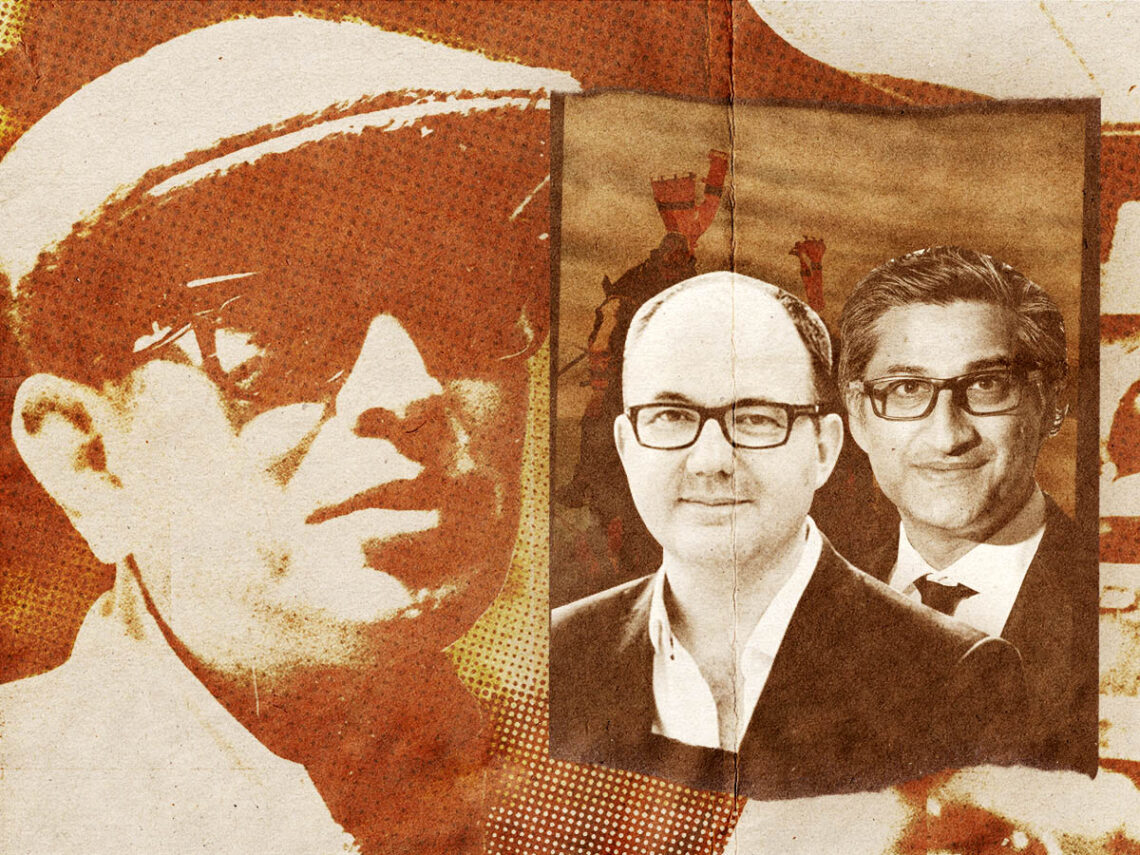
Far Out Meets: Asif Kapadia and Ian Haydn Smith honour Akira Kurosawa at the BFI

As a master of the poignant epic showcased in a bold and rich style, Japanese filmmaker Akira Kurosawa is one of cinema’s most treasured and vital artists. The director blessed the medium with an influential career that lasted over five decades, creating over 30 features that are cited as some of the greatest feature films ever made. Kurosawa’s style can be recognised by captivating and dramatic stories of the master-disciple relationship or the heroic champion, told through the visual execution of jump cuts and music or sound effects commenting ironically on an image rather than emphasising it.
The director’s films showcase how cinema is art, history, entertainment and a reciprocal influencer and reflector of cultures and societies. His imagery and movement echos paintings, and his thematic stories signal concepts of power, identity and societal values against grand historical backdrops. Thanks to his unmatched influence, Kurosawa is a filmmaker who is respected and honoured by many of today’s great directors, all looking to channel his style in their own artistry.
Asif Kapadia, the British filmmaker known for his trilogy of narratively driven documentaries Senna, Amy and Diego Maradona, is one of those that exhibits an admiration for Kurosawa’s artistry. With Ian Haydn Smith, author of Selling the Movie and Cult Filmmakers, Kapadia is working on the BFI’s Kurosawa season, celebrating the legacy of the legendary filmmaker. Kapadia and Smith aim to share his genius and artistry with the world by showcasing the filmmaker’s best works. These titles include the masterpiece Seven Samurai, the Shakespearean adaptation Ran, and Kurosawa’s international breakthrough Rashomon. I recently had the fantastic opportunity to sit down with Smith and Kapadia to discuss their intentions behind the BFI event, their love for Kurosawa, and their thoughts on where he stands within the landscape of global cinema.
With a wealth of topics to get through during what felt like a looming set timeframe for our Zoom meeting, I asked Smith to outline his and Kapadia’s definitive goals when approaching such a historical and artistic-driven programme. Their work aims to showcase how cinema is an art form meant for the big screen, with Kapadia hoping this programme will prove how “cinema will outlive streaming“.
After showing his knowledge of Kurosawa’s ups and downs during his career, Smith reveals how they intended for the programme to celebrate the director’s more underrated works and visions. “We decided to look at themes that are prevalent throughout his work and sort of break things up so people might be watching a very early film with a much later film,” he shared: “It’s encouraging people not to just focus on the samurai films”.
“I think that’s the two really key things: trying to champion films that are lesser known. And also not for people to just go in and watch the big period epics,” he adds, explaining that “many of the real pleasures in Kurosawa’s work are showing Japan. So our desire was to try and do things in a way that mixed all that up.”
The Amy director then shares his history with the BFI Southbank, lovingly recalling “being lucky enough to see some of the greatest world cinema but also meeting filmmakers”. Kapadia was then approached by Jason Wood, the creative director of the BFI, and asked if he’d be interested in curating a programme for the Kurosawa season. A passionate appreciator of his work, the director admits: “I’m not pretending to be kind of an authority on the Kurosawa. But I am a filmmaker who’s a fan, who has been inspired by him, who’s still learning. And so the chance to see them on the big screen, and to play a small part in presenting, makes me really proud… I want to see them as I’m a fan. I want to see them on the big screen. Many of them I haven’t seen big”.
During the interview, Smith named Yojimbo as his personal favourite, believing that the movie defines the director and his cinematic vision. Released in 1961 and starring Toshiro Mifune, Tatsuya Nakadai, Yoko Tsukasa, Kamatari Fujiwara, and Atsushi Watanabe, the samurai movie follows a drifter who arrives in a small town where crime lords battle for status and supremacy, with two men hoping to recruit the rōnin as a bodyguard.
Yojimbo greatly influenced American cinema, most notably the western genre, which interestingly later inspired Kurosawa himself, with images of the western becoming a trademark of the director’s work during the 1950s and ’60s. Due to his knowledge of visual storytelling, Smith immediately cites how Kurosawa employs what would later become the western trope of a distinct and significant heroic character instantly coming into the story as our protagonist. “It sets up the character straight away. It sets up the situation in the next moment,” the writer shares, “And it just doesn’t stop”. Leading star Toshiro Mifune, who plays the drifter Kuwabatake Sanjuro, is introduced as the lone hero in the form of wide framing, now an iconic staple of the great American westerns.

Smith also shared his contextual knowledge that Kurosawa’s film also found inspiration in American literature, showcasing the filmmaker’s love for all art forms across the globe. “There’s the influence that it was loosely based on two novels by Dashiell Hammett,” he explains. “And then it was obviously adapted by Sergio Leone and much later by Walter Hill.”
These two novels that exist as Kurosawa’s source for the plot include the 1942 film noir classic The Glass Key, directed by Stuart Heisler, an adaptation of Hammett’s 1931 novel of the same name. The classic crime film tells the story of a crooked politician being accused of murder by a gangster. There have been many comparisons between Yojimbo and Hammett’s 1929 novel, Red Harvest, about a private investigator who investigates several murders amid a labour dispute in a corrupt Montana mining town. Hammett himself was inspired by the Anaconda Road massacre, a 1920 labour dispute in Butte, Montana, a mining town. “There are all these influences back and forth, but as a standalone, it’s extraordinary,” Smith adds as he expands on Kurosawa’s ability to transcend written material by adapting it for cinema under his artistic vision. “And in terms of acting, it created the modern-day hero, the kind of silent, stoic anti-hero character as seen in The Man with No Name“.
The debate of what constitutes cinema falls swiftly into the interview, as I mention how acclaimed American filmmaker Martin Scorsese once said: “The term ‘giant’ is used too often to describe artists. But in the case of Akira Kurosawa, we have one of the rare instances where the term fits.” After asking for a response to such a statement, Kapadia shares his agreement and follows through with his outlook on how cinema inspires what comes after it, as shown in Scorsese’s work. He states: “A lot of the directors will have seen a Kurosawa film. And you learned to do action; you’re also going to watch other action films. And the stunning filmmaker, you know, there is a history and a line.”
“Kurosawa took from Western literature and adapted it and interpreted it and made it Japanese, and people took it from Japan and made it Italian,” Kapadia continues. “Other people make it very American. It’s art and culture; you take something and make it your own. You hand it back, you put it out there, and someone else takes it. I’m glad people are still going to the cinema.”
This idea of filmmaking transforming into an immortal creation through this cycle of inspiration and artistry helped me put the finger on what it is about cinema that I, and so many others, adore. It can bring so much for other people without them realising it. This cycle can derive from one isolated scene, such as Smith’s example of Kurosawa’s adaptation of Hamlet (The Bad Sleep Well): “It’s got an opening sequence. It’s 20 minutes long. And it takes place at a wedding. And it’s about corruption, about business. It’s about the collision between the personal, the family and the business world…that’s exactly what Francis Ford Coppola did for the opening of The Godfather, and that’s brilliant.”
Another effective technique Kurosawa exercised in his work was assembling his own cinematic team with whom he worked on several projects. The director oversaw and was involved with nearly all stages of film production, accentuating his status as a dedicated and passionate artist. He formed his own creative family, known as the ‘Kurosawa-gumi’, which included the cinematographer Asakazu Nakai, the production assistant Teruyo Nogami and the actor Takashi Shimura.
As a further extension of the author’s knowledge of the filmmaker, Smith picks up on this contextual fact and aligns it as another reason why Kurosawa is an essential guide for cinematic lovers. “This is a director who builds up not just an army of exceptional craftspeople, but an ensemble that he would go back and work with time and time again, whether it’s composers or cinematographers,” Smith explains. “He had one production designer over most of his work. He would work with a select group of young writers and actors.”
“It’s like, ‘I know I trust exactly what that person does. And so I’m going to continue to work with them,'” he adds: “The obvious contemporary example is Martin Scorsese working with his editor”.
