


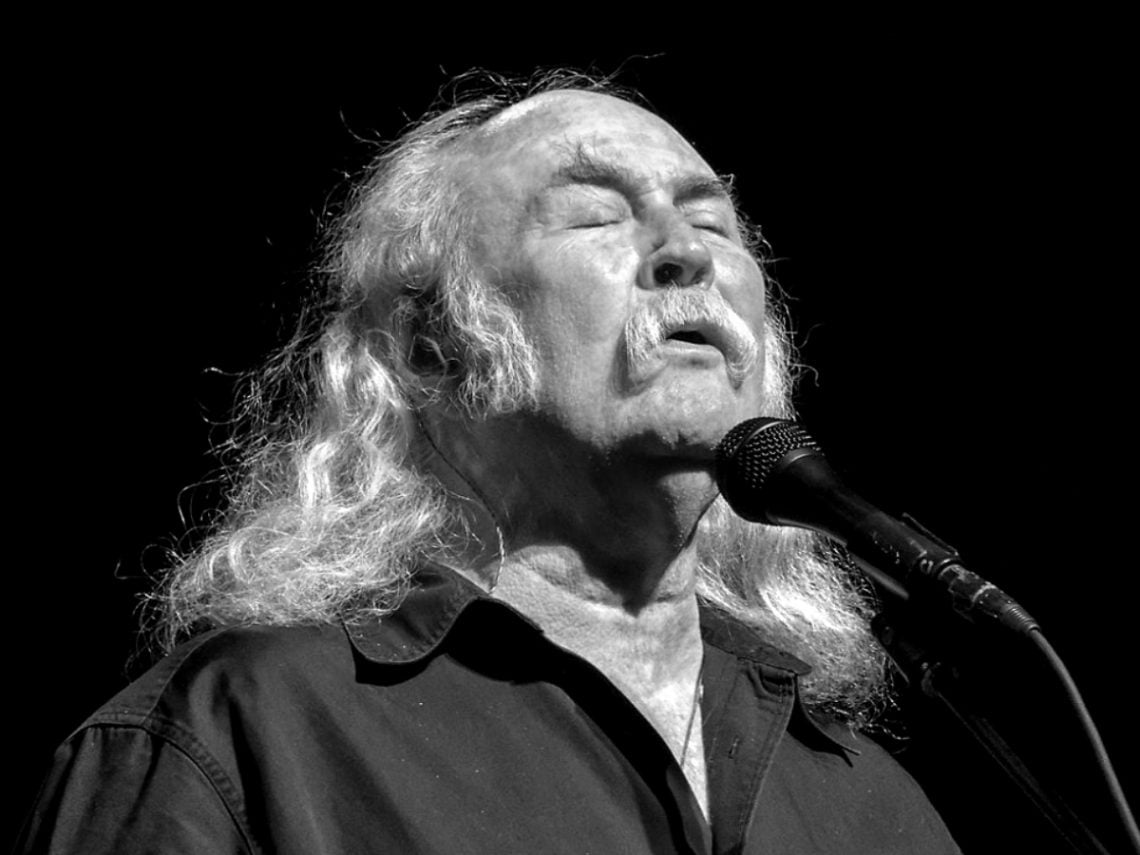
The artist that almost made David Crosby quit music: “He was a terrific inspiration”

While music is an art form rather than a sport, there is still a level of competitiveness. Artists often look over their shoulders at their perceived rivals, ensuring nobody is set to steal their place. Although David Crosby wasn’t fiercely competitive in nature, one singer almost made him find a new occupation.
In the music industry, carving out a unique space is essential, and for Crosby, achieving this was far from an overnight success story. He first captured public attention with The Byrds, but this came only after a failed solo career and extensive time spent immersing himself in the Chicago and New York music scenes. His time living in Greenwich Village didn’t make him a star, but it was a formative experience that pushed him to refine his craft and grow as an artist.
Like Bob Dylan, Crosby moved to the iconic Greenwich Village folk scene with little more than his acoustic guitar and a dream of making it big. However, unlike Dylan, Crosby had to wait longer for his breakthrough. It wasn’t until he returned to Los Angeles and co-founded The Byrds that everything finally clicked, setting him on the path to success.
Speaking to Rock Cellar in 2017, Crosby reflected upon his life in New York: “I was a young, not quite starving folkie in Greenwich Village, working in the basket houses. That’s where you sing a set and then you pass a basket. If you did a really good job, you might be able to get that piece of pizza for dinner. Maybe. And you gotta be really good to get it.”
Before forming The Byrds, Crosby had swapped the Californian sun for the bright lights of New York. It was home to Greenwich Village, which was the only place to be for musicians in the early 1960s. Crosby was confident in his own abilities, believing he possessed the skills to go to the top. He regularly played folk clubs alongside Chicago native Terry Callier in a duo, but success evaded them.

Crosby naively believed nobody in Greenwich could match him as a songwriter and performer before Bob Dylan crushingly brought him down to earth. Shortly after arriving in New York, Crosby began to hear whispers about Dylan, which intrigued him incredibly. However, he soon grew to regret this decision, and it nearly made him give up on his aspirations to make it in the music industry.
The singer-songwriter also told Rock Cellar of his earliest memories of Dylan, recalling, “OK, so I hear about this guy Bob Dylan, gonna play at Gerdes Folk City. And everybody was talking about him. I didn’t know why. So I snuck in, got in close there, and the first reaction I had was very egotistical: Well, shit, I can sing better than that! And then I started listening to the words. And I nearly quit right then.”
Thankfully, Crosby didn’t quit. Instead, he challenged himself to improve. Dylan set a new high bar for him, which the singer-songwriter found humbling. He added: “The guy’s such a good poet. He’s such a good poet, holy shit, is he a good poet. And I was pretty stunned. I walked out of there very confused, because I knew I could sing better and I knew that I just had to up my game about words a thousand percent. He was a terrific inspiration to me in the sense that I knew I had to become a much better poet. And so I tried my best to do that.”
In 1965, Crosby’s band The Byrds had Dylan to thank for their first number-one single, ‘Mr. Tambourine Man’. Therefore, their careers will forever be intertwined, and Crosby remains thankful for the lesson in humility he was taught by witnessing Dylan perform in Greenwich Village.
Crosby wasn’t the only figure who considered waving goodbye to the music industry due to Dylan’s talent. The Minnesotan musician left almost the entire Greenwich Village scene quaking in their boots and quickly rose to the top of the ladder with his now-legendary performances. Ultimately, Dylan has always existed in a league of its own, with everybody else having to settle for living in his shadow.

Never Miss A Tale
The Far Out Bob Dylan Newsletter
All the latest stories about Bob Dylan from the independent voice of culture.
Straight to your inbox.