


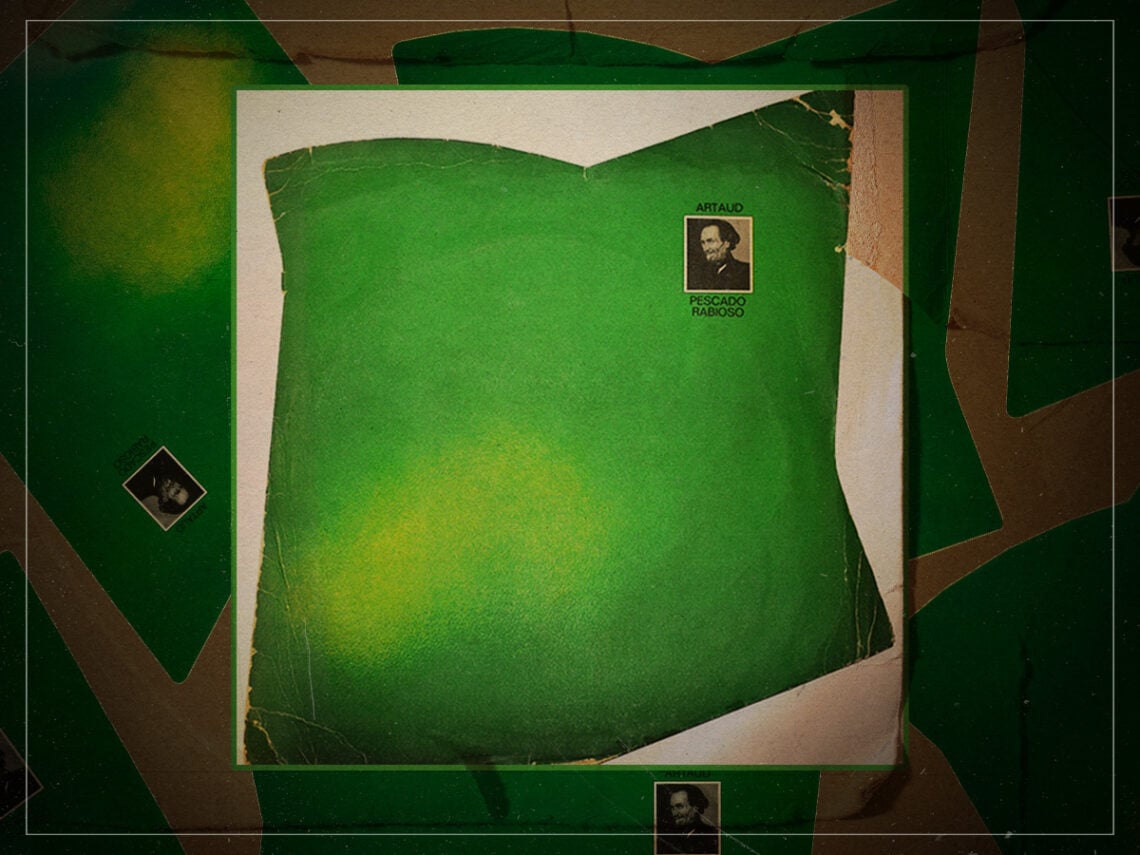
‘Artaud’: Argentina’s greatest rock album and its infamous “irregular trapezoid” packaging

I don’t know about you, but being someone who is precious about their record collection, it becomes something of a disaster when someone tampers with my neatly ordered shelves of vinyl.
It might be that you’ve allowed someone else to pick out a record to play, and they’ve ended up returning it to the wrong location (sinful), or it might be that a record has been handled improperly (treacherous). But what happens when the artist themselves is responsible for ruining the uniformity of the shelving unit? Do you pin the blame on them and bemoan the fact that they’ve chosen to release an LP on 10” vinyl that gets lost among the catalogue of records that are two inches bigger, or do you enter a personal crisis whereby you have to question your entire methods of cataloguing a collection in the first place?
One such record that had become the bane of any collector’s life came courtesy of Argentine art rock act Pescado Rabioso, with the release of their third and final album, Artaud in 1973. The record is a stunning amalgamation of prog-laced blues and psychedelic folk, created largely by the band’s leader, Luis Alberto Spinetta, after he had effectively called for the disbandment of the group. However, despite being one of the most important Spanish-language rock albums ever released, its unusual packaging overshadows any such accolades.
Stamped in a greenish-yellow hue, Artaud’s sleeve instantly stands out in whatever situation it finds itself in for its irregularity of a trapezoid existence. If you’re rifling through a record collection, you’re of course going to notice its jagged edges against the rest of the uniformly square records you’ve been accumulating. Even if you’re only listening to it digitally, it still sticks out on a screen because of its aggressively oblong nature.
It’s a peculiar-looking record, and that’s perhaps why its allure is so strong. When something is irregular and breaks the norm, any curious mind is going to want to know more, and given that this would be Pescado Rabioso’s final and greatest outing as a project, why not try to grab attention towards it with an unusual cover?
However, the packaging of Artaud is more than just a simple stunt and ploy for attention, and is instead an integral part of the entire project as it was intended to be consumed. First of all, its name, Artaud, is in honour of the French avant-garde artist, poet and philosopher Antonin Artaud, and the small portrait in the top right ‘corner’ is of the man himself.
The colouration of the sleeve is also related to Artaud’s work, referencing a quotation from a letter written by him that posited: “Are not green and yellow each of the opposite colours of death, green for resurrection and yellow for decomposition and decay?” One can assume from this that the meaning behind choosing this colour combination is that the work of both Artaud and Pescado Rabioso will live on, but their time of creation has ceased to be.

The unusual shape, on the other hand, was a choice made by Spinetta and designer Juan Gatti, who was known in the 1970s for providing artwork for many other acts in the same Argentine rock sphere. Agreeing that the sleeve ought to challenge artistic norms, Gatti claimed that he wanted to create “a disturbing and uncomfortable object, something that annoys”.
Given that one is meant to nail the article to a wall like a painting, or at least to have it on display, this is perhaps the most annoying they could get with creating a record sleeve, and yet it still has this aforementioned alluring quality.
Not only is its exterior a piece of head-scratching avant-garde art, but the contents of the album itself is a peculiar work that evokes both Latin rock, blues fusion and Beatles-esque experimentation, even going as far as to juxtapose samples of ‘She Loves You’ with the sounds of a baby crying on ‘A Starosta, el Idiota’. The album’s centrepiece, ‘Cantata de Puentes Amarillos’ is a suite that lasts nine minutes and takes the listener on a journey through various moods, while closing track ‘Las Habladurias del Mundo’ is a climactic rock freakout befitting the end of any project.
While having an unusual appearance on face value, and being an annoyance to record collectors everywhere for how it doesn’t fit neatly on shelves and is prone to having scuffed corners, Artaud ought to take pride of place in any collection not for how strange it is, but for its outright uniqueness as a work of art. The music heard is as genuinely challenging and thought-provoking as the sleeve suggests, and ultimately, it works as a perfect tribute to its namesake for how it pushes the boundaries of art in multiple ways.
