


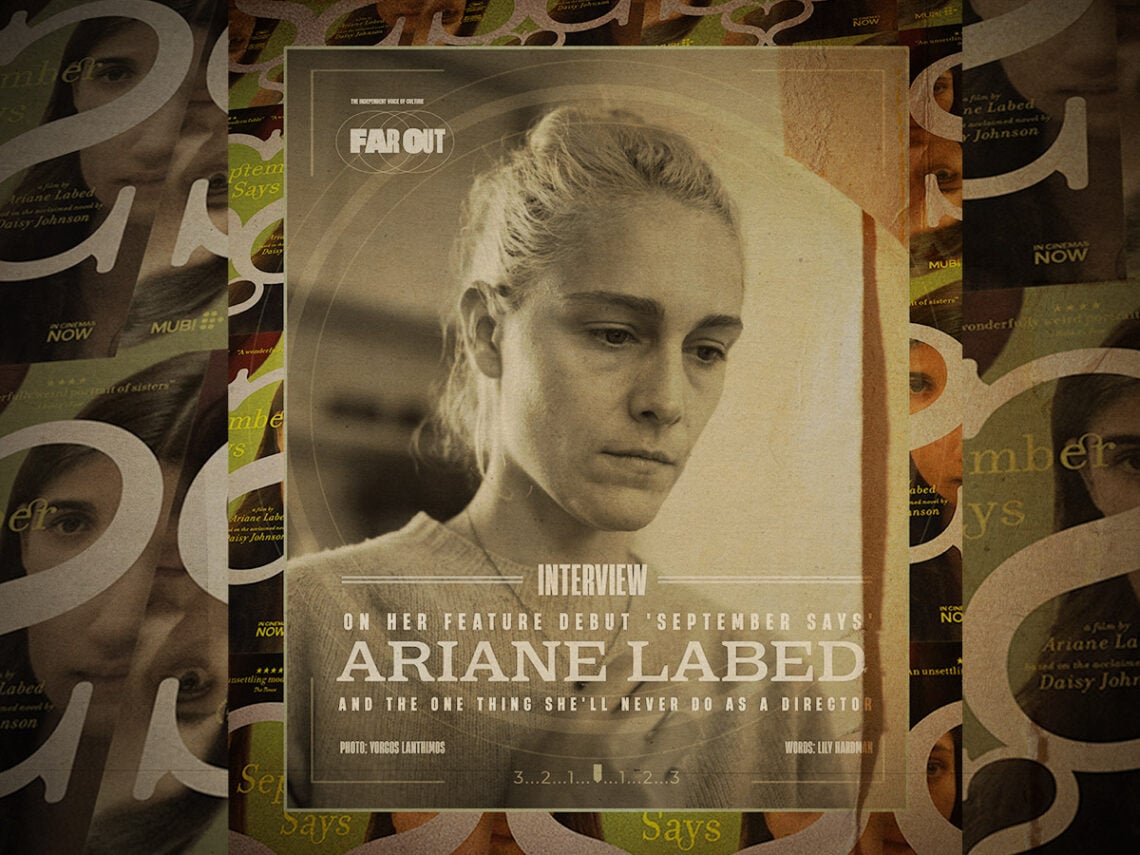
Ariane Labed on her feature debut ‘September Says’: “It’s a matter of trying to find my own voice”

Ariane Labed doesn’t like thinking of film as a director-driven medium. “I really cherish the idea that cinema is a collective form of art,” she says during an interview with Far Out about her feature directorial debut, September Says. “I really want to emphasise that,” she continues, “Because sometimes we forget it somehow.”
It is perhaps this distaste for the grandiose (and often patriarchal) idea of the director as ‘auteur’ that prompted her to begin her movie with an unmissable reference to Stanley Kubrick. Two teenage sisters dress up in various costumes, at one point donning the identical dresses of the twins in Kubrick’s The Shining. For Labed, this opening was key to unlocking her artistic freedom as a director, quickly acknowledging and dispensing with past filmmakers and finding her own way.
“Yeah, he used to be a master,” she says of Kubrick, “But also an asshole… For me, it was like, ‘Here it is,’ and then try to find something else. It was a bit arrogant of me, but I had the need of doing that for my first film, I think.”
September Says is a dark coming-of-age tale about two sisters whose close bond turns increasingly sinister. September (Pascale Kann) and July (Mia Tharia) were born just ten months apart, but their relationship is built on an imbalance. September regularly tests her sister’s loyalty by ordering her to do things, such as eating a whole jar of mayonnaise or slitting her own throat. They live with their single mother, Sheela (Rakhee Thakrar), who is facing her own demons, and as the film progresses, it’s clear that something is lurking beneath the surface. When the girls are forced to leave school after an incident, Sheela takes them to a family cottage on the remote Irish coast, and strange occurrences begin to blur the lines between reality and nightmares.
Labed began her career as an actor, winning the Volpi Cup for ‘Best Actress’ at the Venice Film Festival in 2010 for her first feature as a performer, Athina Rachel Tsangari’s Attenberg. Such a debut would be tough to match, but in her first feature as a director, Labed brings impressive ease and confidence to the screen and suggests a bright future behind the camera.

She attributes some of the confidence that is so palpable on screen to the author Daisy Johnson, whose 2020 novel Sisters forms the basis of the story. When Labed approached her about collaborating on the adaptation, Johnson declined. “She told me that she was really interested in another artist’s point of view on her own work,” Labed says. “Instead of, you know, having control of it. And she gave me absolute freedom on changing plot, characters – whatever I wanted to change, which was very liberating. I think that’s what gave me the assurance that I could actually make it my own.”
The first and necessary creative liberty that Labed took was channelling Johnson’s text into something visual. For this, she leaned into her background as an actor and dancer, organising rehearsals for the three lead actors to develop their characters through movement. Instead of working on backstories or mining the script and novel for clues about the character’s personalities and motivations, Labed brought in a collection of sounds. Birds, gorillas, and puppies were the reference points for the actors, and they improvised with movement until they found their own familial dynamic.
The result is a relationship between the sisters on-screen that feels almost documentary-like in its authenticity. September and July share a wordless language that is specific and unique to them, just as the relationships of all close siblings are. There is a sweetness and tenderness about it, but that intimacy can quickly become weaponised to horrible ends. September’s hold over July seems at first to be a simple dynamic of the older sibling asserting dominance over the younger, but as her demands grow more violent, it is clear that the movie isn’t just a coming-of-age story but a mystery.
“I really work on the situations of the scenes and try to explore them with rhythm and animality”.
riane Labed
Labed blends family drama with surreal tension and, eventually, elements of horror, landing on a breathtaking final shot in the wilderness of the Irish coastline that is both assured and restrained. It subverts the usual pattern of movies that fall flat in their third act and is the strongest moment of the whole film. As before, the director is quick to credit her collaborators for this moment, calling out her cinematographer, Balthazar Lab, for finding a way to get a shot that she believed was technically impossible. “Technically, for me, [the final shot] was a bit abstract,” she says, “But I trusted in him. And it happened.”
When devising the overall look of the film, Labed looked outside of cinema for references, turning to the photography of Justine Kurland and Joanna Piotrowska. “Working with contemporary photography really helps me develop an aesthetic and an approach that makes more sense to me,” she explains. “Probably because, you know, it’s a matter of trying to find my own voice but also trying not to be overwhelmed.” These influences are apparent in the film, with many shots looking like painterly tableaus that tell their own stories within the story.
When it comes to her future as a filmmaker, Labed is clear: she plans to continue acting and directing, but not together. “I really don’t want to direct myself,” she says. “I think my desire of directing comes also from the fact that I want to look at something and not be looked at. There’s no way I would enjoy acting in my own film. It doesn’t even cross my mind. I know some actors do it, and they do really well, [but] I don’t know how they do that.”
Being a director also feels more revealing to her in a way. “I feel even more naked presenting my film, showing it to people than when I’m acting, and I’m naked in the movie,” she says, laughing. “Because this way, you know, not showing myself allows me to show way more about myself. There are so many things that are very intimate in those three characters that directly come from my own experience, and I can do that if I’m [acting] it… The fact that it’s not me on screen, it becomes even more intimate and more honest.”
September Says is now playing in select theatres throughout the UK and Ireland.
