


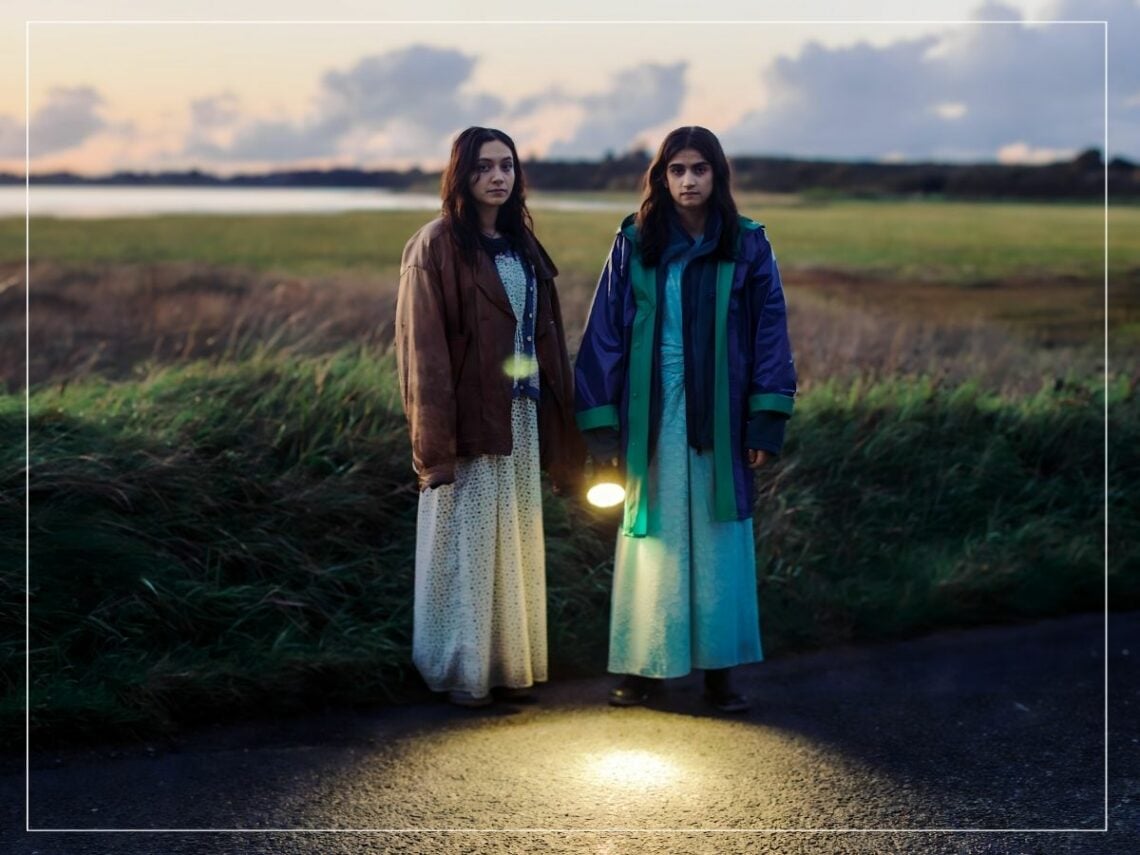
‘September Says’ review: An eerie tale of a poisoned sisterly bond

Towards the end of Ariane Labed’s feature film debut, September Says, two teenage sisters stand facing each other in a small kitchen. “September says kiss your hand,” the older one instructs. The younger sister kisses the back of her own hand. “September says dance,” she continues, and the younger girl begins to dance. They giggle and move together. It’s innocent enough—until September’s demands begin to escalate. “September says slap me”. “September says cut yourself or you lose a life.”
Born just ten months apart, September (Pascale Kann) and July (Mia Tharia) are no strangers to this game. It’s a cornerstone of their poisoned dynamic, a symbol of their intense closeness and acute imbalance of power. They live with their single mother, Sheela (Rakhee Thakrar), a fashion designer who shares a wordless intimacy with them that still can’t break through the scar tissue of their bond.
At school, July is ruthlessly bullied, often physically, and Summer is her saviour. At home, that protection comes at the cost of autonomy, with September demanding uncompromising loyalty. “If one of us had to die and we could choose which one, would you die in my place?” she asks at one point. “Yes, of course,” July responds. “It would be me”. When an incident at school forces both girls to stay home, Sheela takes them on a getaway to the family cottage on the grey Irish coast, where their relationships begin to unravel.
Based on Daisy Johnson’s 2020 novel Sisters, September Says debuted at the Cannes Film Festival last year in the Un Certain Regard section. It is no ordinary family drama, directly referencing Stephen King and Shirley Jackson and conjuring a twist that is clearly inspired by the razor-sharp codas of a Jackson short story. For a coming-of-age tale about siblings, it is deeply unsettling. Even before the surreality sets in, a sense of darkness and cruelty has already seeped into your bones.
Labed, who has acted in films like Alps, Attenberg, and this year’s The Brutalist, shot the movie on both 16mm and 35mm film, changing the aspect ratio when the family escapes to the countryside. There is a sense of timelessness about September Says, not just in the graininess of the film or the scarcity of smartphones, but in the feeling that an unspoken past is haunting the present and that the dynamic between the sisters exists in a wider context.
The final act is not entirely satisfying, and there is a jarring and completely unnecessary voiceover in one scene that is alienating to say the least. The big reveal is parsed out in a thin strand of foreshadowing that is sometimes too indirect to hit with the impact it deserves. While the section as a whole might be a bit of a letdown, however, the final scene – and the final moment in particular – is masterful, a precipitous bit of punctuation that leaves you breathless.
Visually, Labed shows a skill for generating emotion that exceeds even seasoned filmmakers. There is a quiet assurance to her style that is neither showy nor safe. She even makes a row of bathroom stalls look positively Kubrickian in their colours and composition. The actors are excellent across the board, especially Kann, whose ability to switch from tender to threatening is chilling.
This is a slow-burning film, both quiet and unnerving. It may struggle to find an audience with its unconventional take on the coming-of-age tale and its subtle rather than full-throttle approach to horror, but it is successful in walking its own path and heralds an exciting new directorial talent.
