


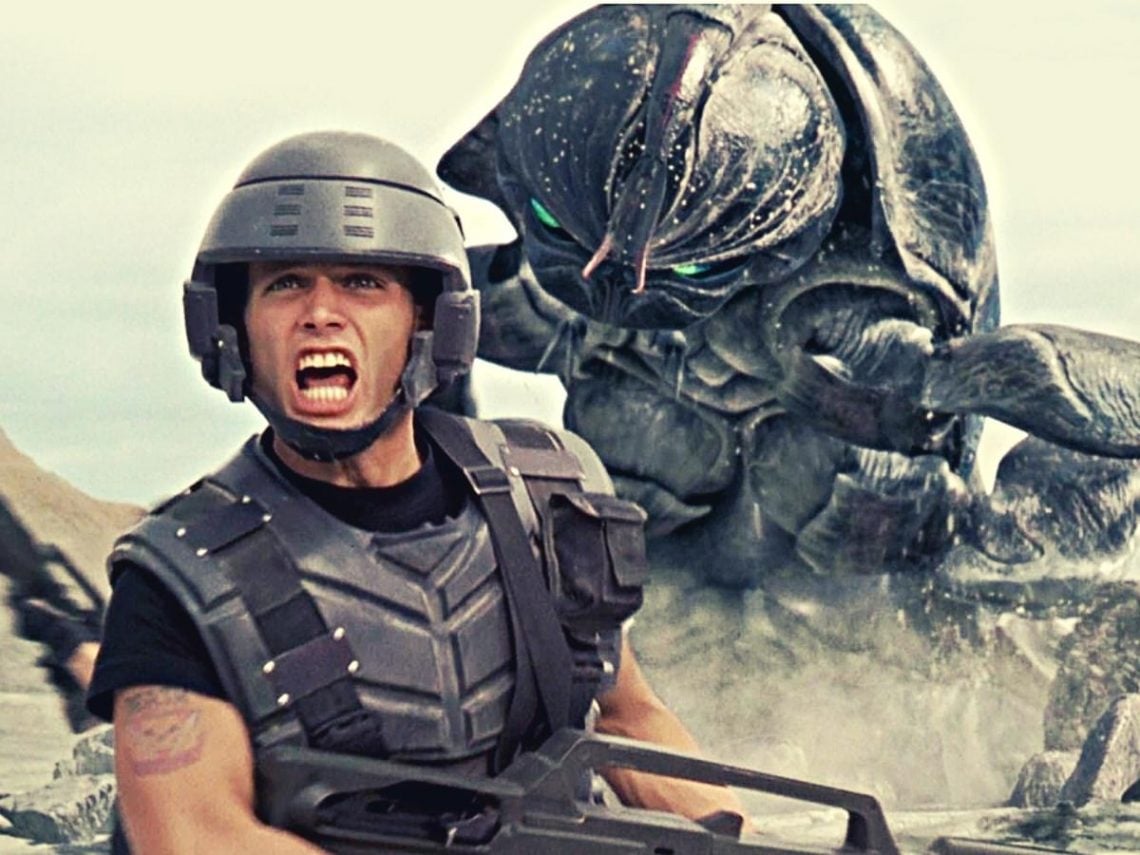
The anti-fascist leanings of Paul Verhoeven’s ‘Starship Troopers’

There’s always been an element of social satire to the science fiction movies of Paul Verhoeven, including RoboCop, Total Recall and Starship Troopers, and when it came to the latter movie, released back in 1997, the Dutch director made it his personal mission to mock right-wing and fascist attitudes, although such satire seemed to go right over the heads of some critics and audience members.
Based on Robert A. Heinlein’s 1959 novel of the same name, Starship Troopers takes place in the 23rd century and has Casper Van Dien plays a young teenager who, along with his closest friends, joins the military of an Earth world government to take part in an interplanetary war with a dangerous alien race of giant arachnids.
In an interview with Empire, Verhoeven had once spoken of the anti-fascist intentions of Starship Troopers and how he wanted the film to be a satire of the right-wing. When the director set about reading Heinlein’s novel, he found that he could only read about two of its “boring” chapters and asked screenwriter Edward Neumeier to tell him the story instead.
“It’s a very right-wing book,” Verhoeven said before noting that he thought he “at least partially succeeded in commenting” on the kind of fascist beliefs that he found in Heinlein’s source text. “It would be eat your cake and have it,” the director explained. “All the way through, we were fighting with the fascism, the ultra-militarism. All the way through, I wanted the audience to be asking, ‘Are these people crazy?'”
Satire runs amok in Starship Troopers, particularly with fascist dictatorships as its target. For instance, the movie’s fictional advertisements vastly glorify the nature of war and show how military propaganda and recruitment commercials seem appealing to impressionable young people before they are shown the true horrors of conflict, just as Johnny Rico does.
Heinlein’s novel was often viewed as an endorsement of such militaristic views, which some criticised as being fascistic. Verhoeven had sought to subvert such leanings with his film adaptation and mock them through his depiction of the Federations’ dystopian regime. However, not everyone who saw the film upon its release really got its satirical outlook.
In the Empire interview, Verhoeven explained how he was “accused” by the Washington Post of being “neo-Nazi”, which he found to be “tremendously disappointing”. The director explained, “They couldn’t see that all I have done is ironically create a fascist utopia” before noting how, in England, the film seemed to be marketed correctly.
“I remember coming out of Heathrow and seeing the posters, which were great,” Verhoeven added. “They were just stupid lines about war from the movie. I thought, ‘Finally, someone knows how to promote this.’ In America, they promoted it as just another bang-bang-bang movie.” Considering the fact that Verhoeven’s previous sci-fi efforts like RoboCop and Total Recall featured satirical elements, especially in their fiction adverts, it’s a surprise that the satire of Starship Troopers was missed by some critics and audience members.
Still, in retrospect it’s clear that Verhoeven’s 1997 effort is a critique of right-wing rhetoric and fascist propaganda with its mocking of an authoritarian military state. Verhoeven had, after all, grown up in Nazi-occupied Netherlands, so only a fool might have argued that he wanted to espouse such views in his films, but sadly, there seemed to be a handful of fools knocking about in the late 1990s film criticism circles.
