


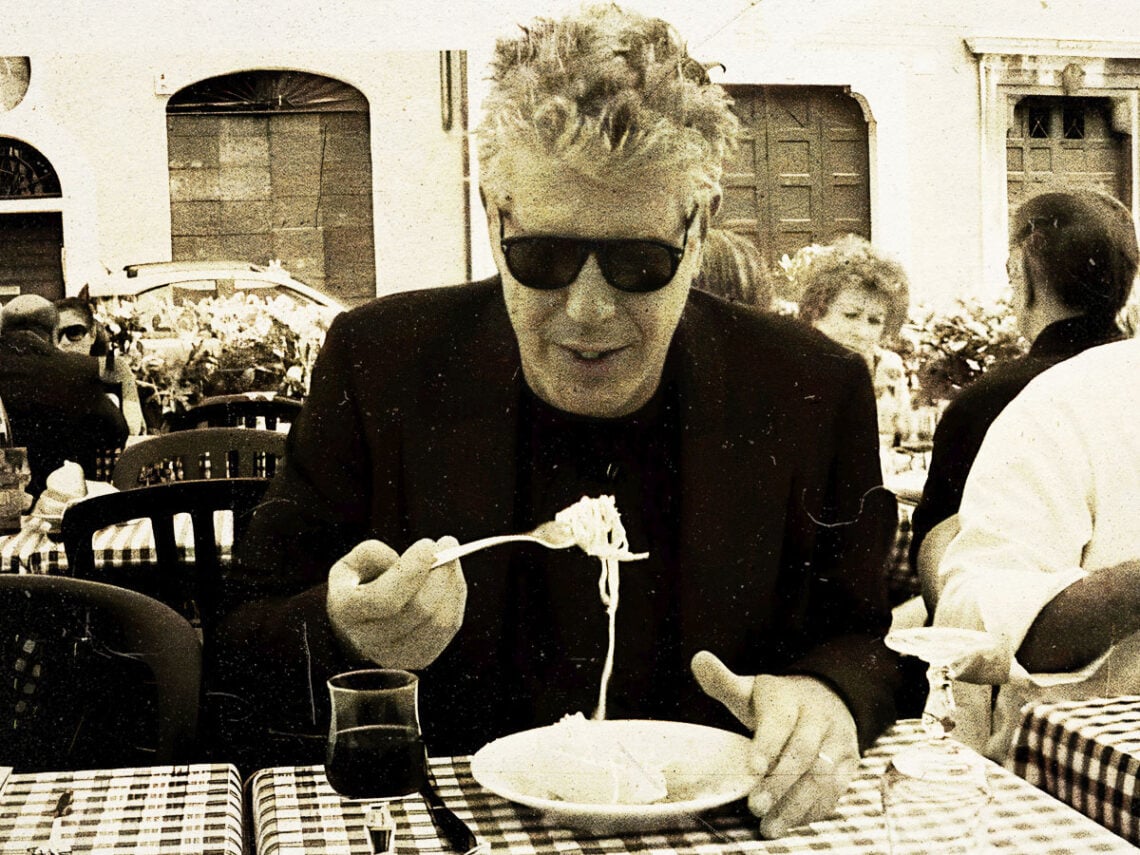
When Anthony Bourdain crowned the country with the world’s greatest cuisine: “Without hesitation”

“What nicer thing can you do for somebody than make them breakfast?” – Anthony Bourdain (1956-2018)
As a sullen teen who felt he was sheltered from the cutting-edge of culture in a plush New Jersey suburb that his struggling family could barely afford to live in, Anthony Bourdain hungered to get out there in the happening world.
However, as he hurled himself into the hustling life of heaving kitchens, he did so with a monkey on his back. Addictions plagued him from the get-go, and he fiercely endeavoured to overcome them and enjoy life. In shedding this bedevillment, he paired his love for dining with a literary outlook, striking gold and a new lease of life with the travelling realisation that the way to grasp the world’s heart is through its stomach.
However, his tour diary was more akin to George Orwell’s Down and Out in Paris and London than some highfalutin fancy guide to caviar coteries. In true counterculture fashion, he shunned elitism and sampled what really made the world tick.
He even stated the following about death row meals: ”When we ask ourselves and each other the question, what – if strapped to a chair, facing a fatal surge of electricity – would we want as that last taste of life, we seem to crave reminders of simpler, harder times. A crust of bread and butter . . . Poor-people food.”
For him, the secret ingredient to a good meal was simply passion. ”Bad food is made without pride, by cooks who have no pride, and no love. Bad food is made by chefs who are indifferent, or who are trying to be everything to everybody, who are trying to please everyone,” he said. ”Bad food is fake food… food that shows fear and lack of confidence in people’s ability to discern or to make decisions about their lives.”
And he says nowhere in the world does this better than the mix of studious care and excitable spicing that the Japanese afford their fresh cuisine. Speaking about Matt Goulding’s book Rice, Noodle, Fish: Deep Travels Through Japan’s Food Culture, Bourdain said: “I don’t know if you know this but I’ve found that if you sat at a table with eight or nine of the worlds best chefs – from France, Brazil, America, wherever – and you asked them where they’d choose if they had to eat in one, and only one country, for the rest of their lives, they would ALL of them pick Japan without hesitation. We both know why.“
In fact, he even went on record saying that if he could live anywhere in the world, it would be Tokyo. He told Maxim in 2017: “If I had to agree to live in one country, or even one city, for the rest of my life, never leaving it, I’d pick Tokyo in a second. I went to Tokyo the first time, and my head kind of exploded. I compared it to taking my first acid trip: Nothing was ever the same for me. I just wanted more of it,” he added.
He’s not alone. Strangely, there is a keenly observed phenomenon known as post-Japan depression that might sound like a Queens of the Stone Age album title, but is, in fact, the acute reverse culture shock many experience when returning from a trip to the Land of the Rising Sun. Perhaps the absence of stunningly fresh food made with near religious pride plays into that.
When Bourdain visited for Parts Unknown, he wrote in his field notes: “For those with restless, curious minds, fascinated by layer upon layer of things, flavours, tastes and customs, which we will never fully be able to understand, Tokyo is deliciously unknowable.” Yet, there is comfort to be found in its ineffable charm, too.
The conclusion of Bourdain and countless travellers before him was that Japan simply had things right, and the labour of love that their food amounts to was evidence of that. “The attention to detail, the perfectionism, the concentration on what are the most fundamental elements of beauty, pleasure, and relaxation,” Bourdain mused, that’s what makes it so unanimously celebrated among those in the know. It is the Revolver of cuisines.
