


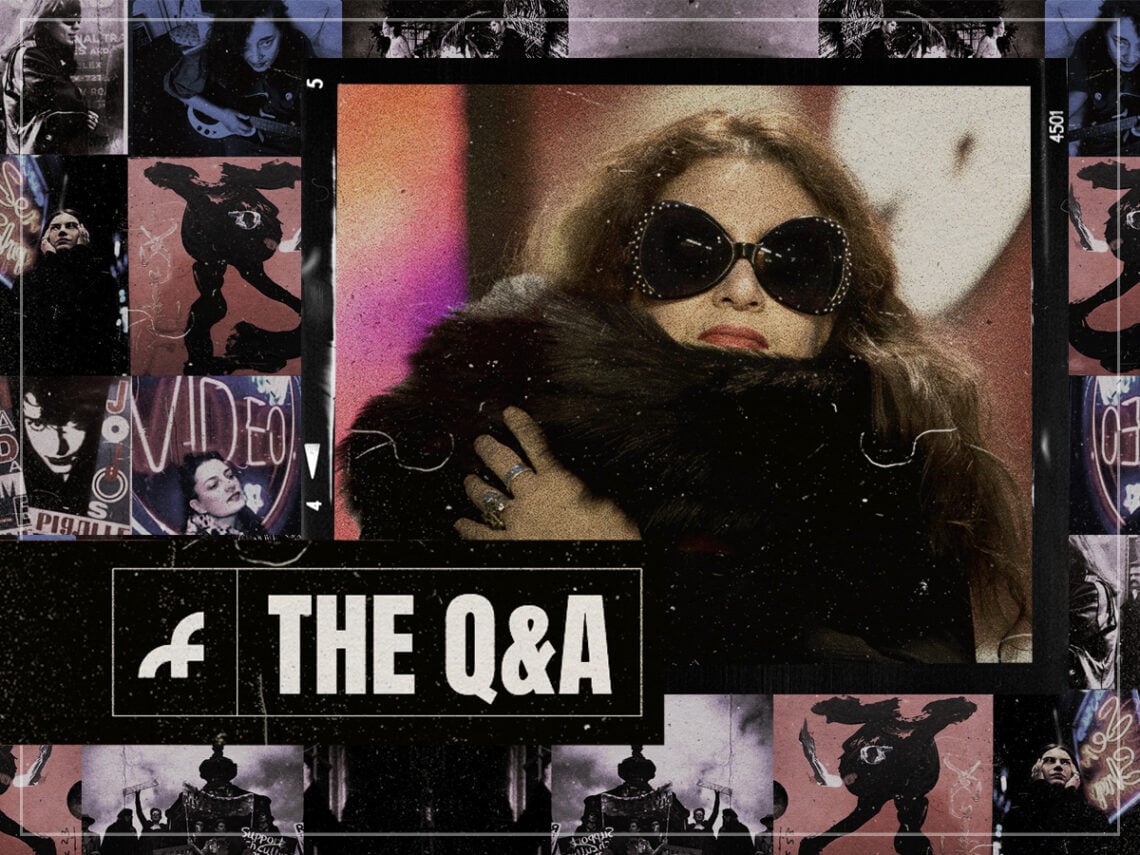
Anne Pigalle discusses Ecstase, Madame Sex, and the magic at the heart of Soho

In the best way possible, speaking with Anne Pigalle is like searching for a needle in a haystack. Her anecdotes are a labyrinth of narratives within narratives, and before you know it, you’re onto another enchanting topic entirely. Perhaps this is the reason why many people in her life always tell her she should write a book — or three. The idea that Pigalle has seen it all isn’t a ruse. She really has, and the best part? She’s far from done yet.
“I’ve been through a lot, and I’ve done a lot of stuff, but this is my time now,” Pigalle asserts, and I believe her. Not only is she known as ‘the last chanteuse‘, but her knowledge and insight are like a glimpse into a world you can only imagine. Rising from the ashes of the post-punk movement, Pigalle’s situation is unique. Firstly, being a French woman and relocating to England came with its fair share of challenges, but the musician tackles hurdles with all of the grace and grandeur of a thick-skinned Parisienne.
“I’m still the only female singer to have been signed to a British label,” Pigalle tells me as if it’s as mundane an achievement as having made a trip to the local corner shop that morning. Make no mistake; Pigalle knows the mark she’s made, but her endearing French ‘cool’ exterior is evident. When she delves into her past, the wisdom comes through in her warmth. “I had a girls’ band, but we never really did anything,” Pigalle explains, “Then I realised I was the only one serious about this”.
“At the time,” she continues, “you saw all these kinds of French punk bands, but they never really had a great impact. It seems to be trending now, but at the time, the [French] punk bands were not really so big.” Pigalle oscillated between France and England, which meant she witnessed what the scene had to offer first-hand. “In France, you had this big punk festival, which got a lot of English bands and a lot of American bands to come over, and it was a huge thing because that was really before punk became successful here in England”.
Attempting to narrate Pigalle’s story will inevitably fall short of the vivid tapestry she weaves with her own words. Therefore, I had the privilege of engaging in a conversation with her to uncover the core of her experiences and to unveil her significant contributions to the ever-evolving music scenes in which she played an essential role.
Anne Pigalle on the magic at the heart of Soho
Far Out: How did you first get involved in music and art?
Pigalle: “When Punk happened, I grabbed a guitar and created an all-girls band that was mostly for fun. I started to go to gigs at an early age and was hanging in a music shop every day after school was also the home of a rock and roll label called Skydog. I was more serious about it than I thought, which eventually led me to become a singer, take matters in my own hands and move to England. I wanted things to happen, not just in my bedroom (or in my dreams!) but out there in the real world. Therefore, I needed to take control of the creativity myself.
“As for art, that came a lot later on. I wasn’t encouraged by teachers at school, that’s for sure. I had a few partners who were photographers, filmmakers, and painters who inspired me a lot and one day, it all exploded after a rough break-up. I needed this medium to satisfy another side of my creative expression. It’s also very therapeutic, and I can lose myself for hours in the processes, especially painting. It started with the self-portrait polaroids that I also painted, then painting, then film-making. To my surprise, I did well as a visual artist, but now everyone thinks they’re a visual artist.
“I think the importance of music has to come back, as there’s too much superficial imagery is on show. I love interviewing people too, you never learn enough, like in my latest project about Soho, The Soho Connection. It’s hard to stay humble when you want to give so much. I keep on learning.“
What is your earliest memory of falling in love with music?
“When I heard the zither playing on the intro of The Third Man, the film starring Orson Welles, I rushed from the kitchen to the living room where the television was, and it conjured and crystallised all the sense of danger, mystery and adventure a child like me would want to experience in their future life. Embracing the unknown, embracing life, experiencing love. So, that’s the way things were going to go.“
Can you recall some aspects of your most esteemed creative processes?
“The recording of Everything was a bit like if an AI had taken over my brain and my songs. The bulk of it was fairly averagely recorded in south London; then the tapes got transferred to Sarm Studios, where a bunch of engineers would compete to prove who could be the biggest geek. It was a fairly cold experience, and even Trevor Horn later said that the original demos I had delivered were far better than the album itself.
“ECSTASE, on the other hand, was a great once-in-a-lifetime experience, and you can hear it in the music. It was a very organic, fluid experience, even if I did have to record it three times to get it right. The first time I went to record it, it was in Boston with my then-pianist Aaron Cahill and part of Leonard Cohen’s team whom I knew from LA: Leanne Ungar and Bob Metzger. They’re both great people, but unfortunately not receptive to the Edith Piaf songs that I would play them.
“I recorded it again in Italy in a second effort with a friend I had previously worked with, but the results were not satisfying. So, I had to produce it by myself in the end while raising money with an online fundraiser that allowed me to buy some equipment and record it at home. Some of these songs I had written during my travels in America, and ECSTASE was originally meant to be a semi-autobiographical musical film directed by Donald Cammell, but after he passed away, I could not continue with the project until I decided to record the songs by themselves.
“Madame Sex and L’Âme Érotique took very little time to record as I wrote it while recording it. This CD is DIY, and every cover is hand-painted individually. I kept the price low for an original piece of artwork so people could experience the art and the music together. I am very proud of these two albums as they are the true sides of me as a creative musical artist.“

You’ve explored many genres, from pop to chanson to punk: how do you approach experimentation in your music?
“The only truly experimental album is Madame Sex and some live performances. I approach musical genres in the same way [David] Bowie did: you can say it’s a mixture of cabaret and rock culture where I have forged my own style.“
How did working with Michael Nyman shape your artistic vision?
“Michael Nyman was lovely to work with, as was David Cunningham from the Lounge Lizards, who produced the piece. It was a one-off experience; it was his project before I had anything to do with ZTT (Records). Then [Nyman] wanted to release the track on one of his albums, which ZTT refused for some reason that I still can’t understand. I hadn’t realised they owned me even though I’m a human being, not a slave and definitely not a subject but a free citizen, and even though this recording was prior to my involvement with them, thank god those days are over.
“You make some mistakes when you’re young and don’t speak the language of the country you live in very well. My life has become so much richer since. I don’t mean financial riches, obviously. A good producer should know music is about respecting musicians foremost and the people you work with not just money and ego; we all need food and housing, but great music is based on the sharing of the soul. These are the real riches.
“Unfortunately, today’s teachings have lost the plot. Hence, the malaise most people are suffering from at the moment. I mean, my dad played with Sidney Bechet in Paris. That was the Jazz Revolution. I grew up with the punk revolution. The fair-light revolution doesn’t come close. Music is soul food. Michael Nyman had to record the song again with Dagmar Krause… Judge for yourselves.“
What drives your fashion choices, and what does avant-garde mean to you in your image?
“I don’t really think about it, and it happens spontaneously and organically, first and foremost, as a need to articulate something meaningful to me and perhaps more pompously to the world. My language is the language of love, which can include anger and frustration, so all my visuals are emotionally driven.
“Both my mother and grandmother worked in fashion, so maybe there is an element of the subconscious that enters there. When I paint, I let the brush speak for itself with no hidden agenda, no preconceived plan. The way I dress is the same; it’s the spur of the moment. It’s what I think is fun or interesting. Perhaps that’s why I have had some influence because we all want to feel free”.
In terms of what you call ‘magic’ at the heart of Soho, can you put into words what this is, feels like, or how it came about?
“Magic is a phenomenon that cannot be explained. It’s something behind your control, or some weird coincidence perhaps. I am interested in the esoteric and the supernatural. Some things cannot be explained, certainly not the power of love. The journey of life does include some choices, but mostly the power to learn and correct the mistakes that we make. That seems important to me. It was no coincidence that someone like Donald Cammell should come into my life, or was it?
“And so many manifestations of the strange have happened to me. I call it alchemy. I am interested in white magic to fight the dark forces. Isn’t that what is needed right now? Soho has it. Perhaps it’s based on the fight for freedom and Bohemia, like the 40,000 self-proclaimed first immigrants and Huguenots in the 1700s who landed between Spitalfields and Soho and who brought along all their culture and knowledge. Freedom is the centre of it all. Only freedom makes magic happen and vice versa.“
Given the history of Soho and it’s comparison to areas of Paris, what does ‘Pigalle’ mean to you?
“Pigalle is where I grew up in Paris. Before it became the red light district, Pigalle and Montmartre were the districts where the artists lived. Pigalle is where the first ever Cabaret Le Chat Noir was created in 1881 with the attendance of the most influential artists of the time who shaped the modern art world, like Satie, Bruant, Lautrec and later Picasso. Pigalle and Soho have a lot in common; they are both based on freedom, survival, and the idea that man should enjoy himself.“
Pigalle is now entering a thrilling new phase in her career. To keep abreast of her upcoming endeavours, be sure to visit Anne Pigalle’s website and her Bandcamp.
