


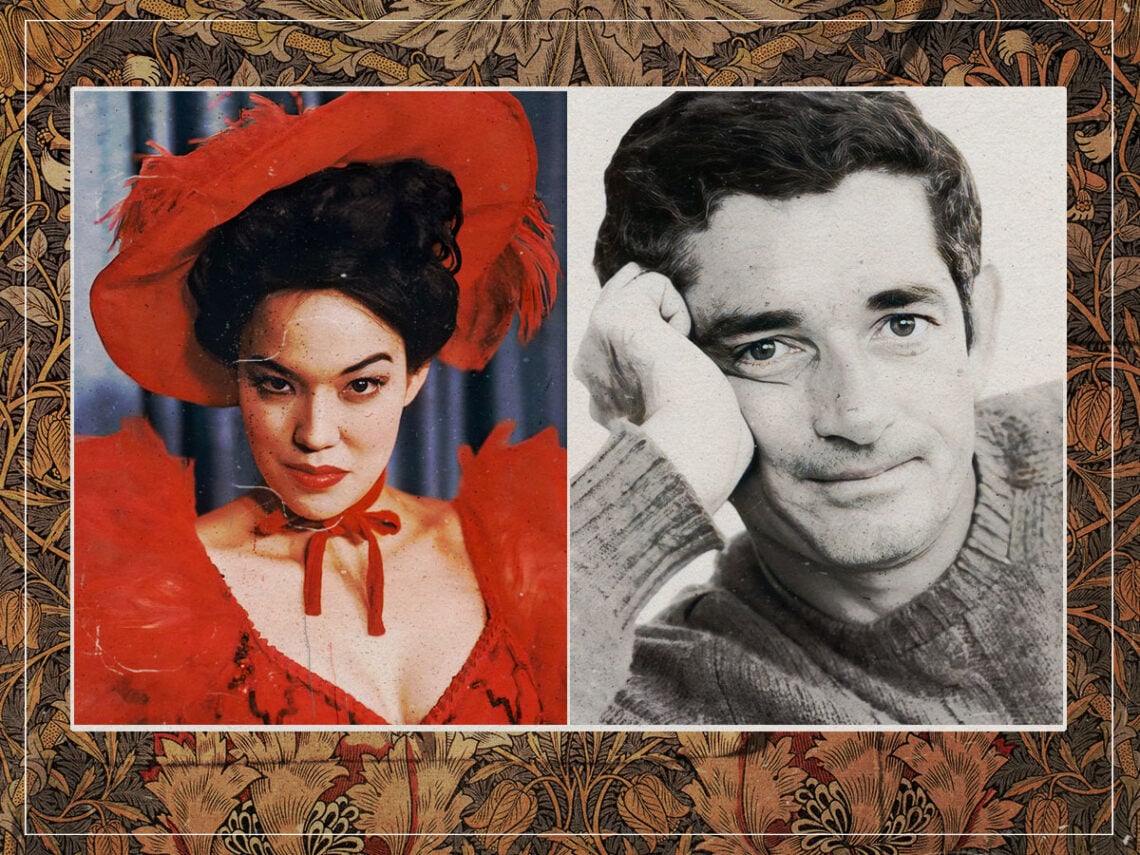
Anna Biller explains how Jacques Demy influenced her work

It is rare for a director to have complete creative control, yet Anna Biller is a true auteur, taking everything from directing to costume, set design, and music into her own hands. With a distinctive vision, Biller has crafted two feature films and several shorts, which have earned her a dedicated cult following.
Her most well-known work is The Love Witch, starring Samantha Robinson as Elaine, a woman who may or may not have murdered her husband. She moves into a new apartment with the desire to find true love, embarking on a journey of witchcraft, sex and murder. The movie’s rich visuals draw you into a completely unique viewing experience, defined by a camp sensibility, vintage aesthetics, Technicolour and a blurred line between fantasy and reality.
Her debut feature, 2007’s Viva, was also an incredibly singular piece of work, challenging and satirising notions of female sexuality during the 1960s, an era of supposed sexual revolution. All of Biller’s work echoes decades like the 1960s and ‘70s, a time when cinema was rapidly developing. In an interview with A Rabbit’s Foot, she stated, “There’s so much bleakness and nihilism” in modern cinema, whereas her aims are to pay homage to a time when filmmaking was more fun, revelling in “pleasure”.
One of her biggest inspirations is Jacques Demy, who emerged in the French New Wave era with movies like Lola, The Umbrellas of Cherbourg and The Young Girls of Rochefort. The latter two are candy-coloured musicals, and while they aren’t always glaringly optimistic, they possess unashamedly bold visuals that are a joy to experience. However, Biller has been most inspired by Donkey Skin, one of Demy’s most bizarre projects.
It stars Catherine Deneuve as a princess who must marry her father following her mother’s death. Horrified by the idea, she is instructed by a fairy godmother (Delphine Seyrig) to escape the kingdom by using the skin of a donkey as a costume – which actually works. Many musical numbers ensue, including one condemning incest, and the princess luckily ends up marrying a prince (whom she is not related to).
The wedding scene is gorgeous, from its extravagant outfits to the bright set design, which contrasts with the white costumes. Biller loved this scene so much that she used it as the basis of her wedding sequence in The Love Witch.
Talking to Criterion, she explained the influence of Demy’s film on her work. Explaining that upon first seeing it as a 16-year-old, it “changed my whole life”, she added, “I think the formula Jacques Demy uses, which is combining this beautiful, magical fairytale world with very dark and very realistic psychological material is something I use as template for my own work.”
The anachronistic nature of the costume design also impressed Biller upon first watching Donkey Skin, such as the “perfect 17th-century costumes but with giant fake plastic jewels sewn on”. This inspired Biller to make a “certain logic” in her movies, explaining that this subsequently allows you to “do anything”, as best reflected in The Love Witch, where reality and fantasy seem to coexist in a world with no fixed era.
Inspired by Demy’s dedication to working on such projects at a time when realism was increasingly being considered the main, most truthful mode of cinema, Biller argued that the director “gave me permission to make the kinds of films that I make today”.
