


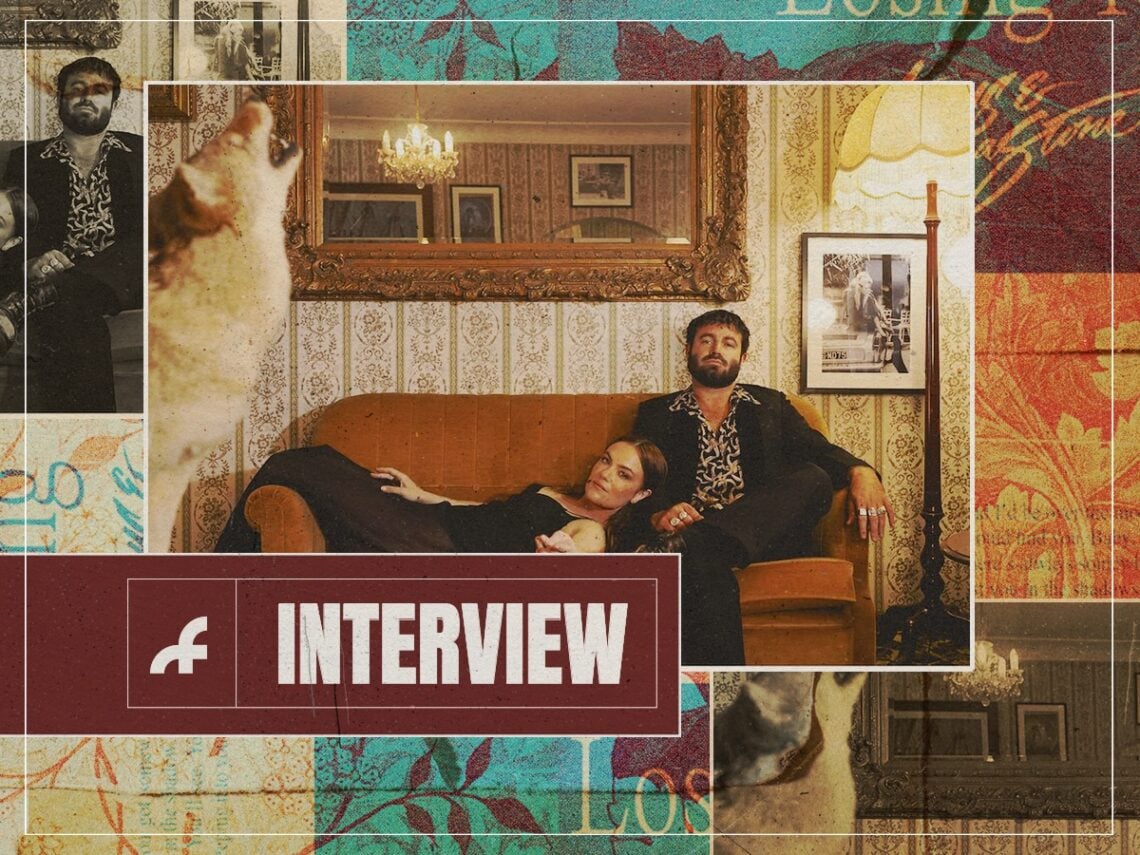
Angus and Julia Stone: “Our way of protesting is with love”

No matter the musical adventures that Australian sibling duo Angus and Julia Stone traverse during their time apart, they eventually return home to one another. While Angus has found great success in recent years as his alter-ego Dope Lemon, and Julia has asserted herself as a star in her own right with 2021’s Sixty Summers, there’s a unique alchemy that only occurs when they combine.
The duo’s new album, Cape Forestier, released on May 10th, marks their first studio LP together in seven years and is a welcomed comeback. The record sees the Stone family offer a celebration of love and return to their blissful roots to provide an optimistic album that washes over the listener like the sun of a bright summer’s day spent in Sydney’s Northern Beaches.
The Stone siblings have embarked on two vastly different routes leading up to their homecoming on Cape Forestier. Nevertheless, the roots of their story begin at home, thanks to their father, a local wedding singer who brought them up on a diet of icons that forged his children on their current path.
Angus and Julia began as separate entities before bringing their talents together on the open-mic circuit. While a lot has changed since they were cutting their teeth, Far Out catches the pair in a reflective mood over Zoom from Switzerland following a stripped-back performance in Zermatt, which reminded the duo of those early performances.
Angus explains how he “hadn’t played live for a long time in this format, where it’s stripped back”. However, the new tour aims to capture the same intimacy that sparks their records. The run of dates is appropriately called the ‘Living Room Sessions’, and although they are set to play huge rooms like London’s Royal Albert Hall, they plan to make the historic venue feel like a night at their family home.
Julia remembers that “when they started”, they adopted a “sit down” approach because that’s all they knew from the local scene before acclimatising to expectations. After many years of conformity, Angus and Julia are back performing in familiar, comfortable surroundings, as it’s “such a nice way to present this record,” she explains.
The minimalist method doesn’t solely relate to their cosy live shows; it’s attached to everything they do. With close to six million unique monthly listeners on Spotify alone, Angus and Julia could have opted for an expensive studio approach for their latest LP, but that would have come with risking the very ingredient that makes them such a compelling act.
Instead, rather than teaming up with a star-studded producer like Rick Rubin as they have previously, they decamped to Angus’ idyllic Sugar Cane Mountain Studios in New South Wales. The studio is a setting tailored perfectly to their musical needs, fitted with artefacts that have played a pivotal role in shaping them artistically.
“He’s been passed down some of the instruments from our family home; he has the piano we grew up with and we all learned to play on. We were writing these songs in the living room at his house, but it’s also now this amazing studio,” Julia dotingly recalls.
When making Cape Forestier, they were lost in the music-making process. After the album was completed, it dawned on Julia that they worked in precisely the same manner as when they “made Chocolates and Cigarettes (2006 debut EP) back at dad’s house when we were 19 and 21, it just felt really natural and easy to go to that place.”
The full circle moment wasn’t a calculated plan to reignite a lost spark, with Angus and Julia preferring to roll with the punches. While it was a coincidental tactic, it allowed the brother and sister pairing to tap into the side of their artistry, which kickstarted their love affair with songwriting in the first place. Most of Cape Forestier is original material; it also includes a cover of the Bob Dylan classic ‘I Want You’, a subtle nod from Angus to his father for infecting his childhood with the musical messiah.
“When we grew up, our dad was a wedding singer, and we were exposed to a lot of the greats, Joni Mitchell, Bob Dylan, Neil Young, Janis Joplin, and all those incredible artists,” Angus says. “I think growing up with all that has been essential; it put the DNA into what we do and the way we’ve grown with music.”
However, back when they were kids and first uncovered songs like ‘I Want You’, they were none the wiser it was a Bob Dylan creation, with Angus amusingly revealing, “For a long time, we thought our dad wrote all those songs, and then we had a funeral for that idea because we figured out he was playing in a covers band.”

The environment they grew up in was a blessing for which they are grateful as Julia adds, “Dad was in Backbeat (covers band) before we were born, so when we were little, we’d see them rehearsing in the house, and mum used to get up and sing with them sometimes. We had two parents who were always really into music, and for us, it normalised expression and performance. It was so normal for someone to start singing and not be embarrassed.”
While they were both comfortable with performing, as teenagers, they didn’t grow up singing together like the Von Trapp family. First, they attempted to go it alone before fate brought their talents together.
Casting her mind back two decades, Julia explains how she travelled to South America after finishing school. Upon returning home, she felt directionless while Angus had started writing and performing songs regularly, finding a modicum of success.
With no job and little else to do, she offered up her services to help him with harmonies as a show of support as labels had begun to express interest in his talent. “I had shown him ‘Wasted’ and a couple of other songs, and he said, ‘Why don’t you sing one of your songs?’ And so I started singing, then we grew from there, and a label initially offered Angus a record deal, and then they said, ‘Do you want to do a deal with the two of you, two for the price of one?’,” she reminisces.
The situation was born out of pure circumstantial happenstance, and if Julia had gone to college rather than travelling, it would have never occurred. Thankfully, the stars aligned upon the perfect vehicle for their musical abilities to flourish thanks to their shared influences and family ties, making it a match in heaven.
Angus poignantly says of their philosophy that has bled into every project from Chocolate and Cigarettes to Cape Forestier: “I think life opens up doors when you’re flying the way you meant to, if you let things be, and don’t force (it). I think it’s really important. People took notice that it was a labour of love, and we weren’t searching for it.”
Almost all musical projects begin as a labour of love, but after two decades, they often evolve into soulless enterprises that exist purely for money-making exercises. Thankfully, this isn’t the case for these two, and likely never will be.
The mindset that led to their decision to unite remains present on Cape Forestier. While it’s not overtly political, there is a profoundness across the body of work; as Angus states, “With what’s going on in the world at the moment and the way people are being treated, I think the most important thing is to give back is love, which is natural for us. Back in the day, when people used to protest, they’d be very descriptive about what they were talking about, and our way of protesting is with love.”
The Dylan cover, a composition recorded impromptu after Angus started strumming it while the duo were sat on the couch, encapsulates the tender spirit of Cape Forestier. The album, filled with warmth, transports the listener to the snugness of their living room and feels akin to a late-night conversation with cherished company. It may not be a recipe for solving world peace, but love can conquer all.
Cape Forestier is out now through PIAS. Angus and Julia Stone are set to play the Royal Albert Hall in London on May 28th.
