


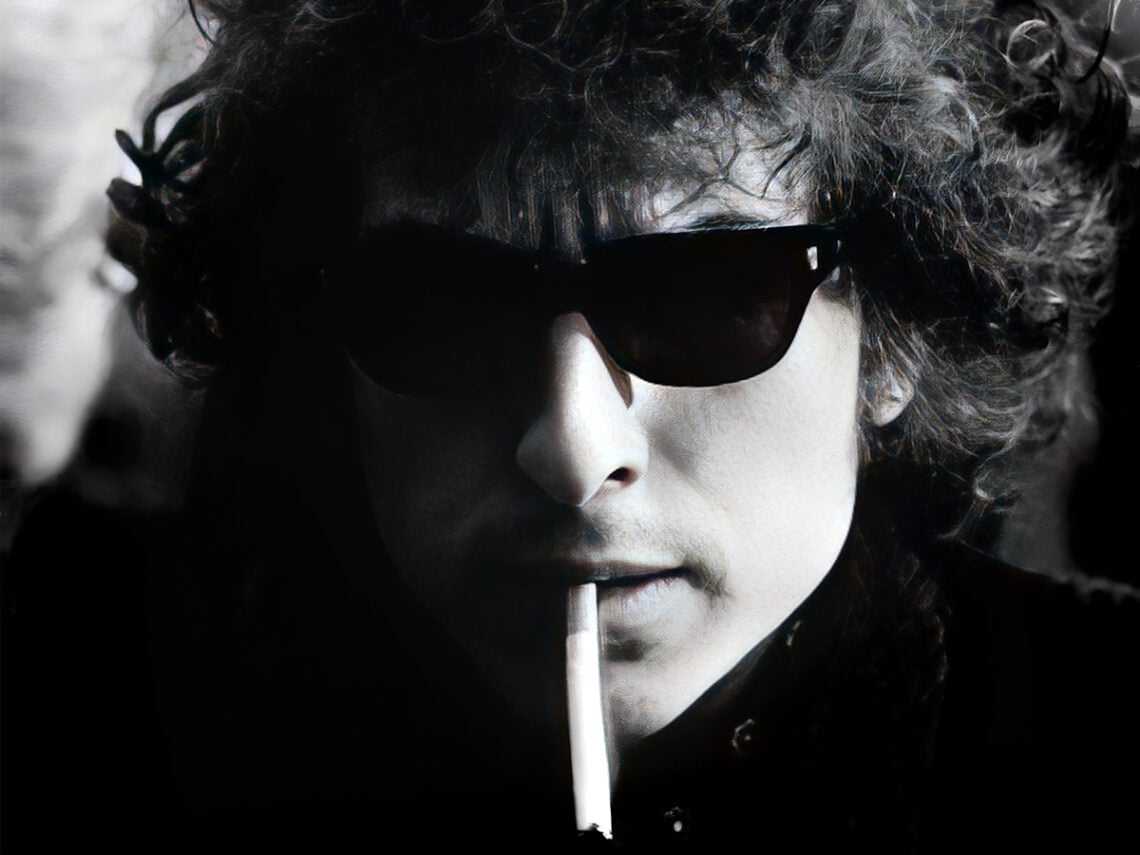
‘Angelina’: the darkest lyrics of Bob Dylan?

Throughout a career that stretches over 60 years and 40 studio albums, Bob Dylan has become known as one of the defining songwriters of all time. Whether through his own unique voice, in covers of his music, or through songs that he wrote for other artists, Dylan’s words never fail to pierce the crux of emotion and question a thought process. Often using the strophic form and heavily driven by poetry, the writer’s endless elegies cover everything from the topical and the political to the romantic and the otherworldly.
The breadth of Dylan’s lyrical style and narrative base is remarkable from early protest songs to later moody balladry. One key example of the growth of his writing comes when drawing lines in the sand between ‘Farewell Angelina’ and ‘Angelina’, two tracks that appeared in 1991 on The Bootleg Series Volumes 1—3: Rare & Unreleased.
‘Farewell Angelina’ was initially written for Dylan’s 1965 album Bringing It All Back Home, but Dylan instead gave the song to Joan Baez, his partner at the time, as the title track of her sixth album. ‘Angelina’ was then written for Dylan’s 1981 record Shot of Love, but again was dropped from the track list, eventually appearing—like the former cut—on the bootleg compilation in the early 1990s. While ‘Farewell Angelina’ opts for folky acoustic guitar as its musical pillar—a norm for ’60s-era Dylan—‘Angelina’, produced alongside Jimmy Iovine, sees the songwriter take to the piano. It’s a far more grand and textural composition, yet staccato and sparse.
Blending surrealism with religious imagery and Biblical references, ‘Angelina’ features some of Dylan’s most brooding lyrical ideas, as he seems overawed by a scent of impending doom. The identity of the song’s subject is much debated, with some arguing that Angelina could be a planet or a country, or indeed a woman. What feels clearer, though, is the cloud of darkness that hangs over the writer, an unusual characteristic among Dylan’s wider lyrical reflections.
Themes of destruction and anguish trickle through the lyricism; in reference to Revelation 6:8 in the Bible, he says, “I can see the unknown rider, I can see the pale white horse.” It’s an allegory of death, spoken as a matter of fact, as vivid as it is piercing. The line that proceeds it is similarly harrowing, as Dylan documents: “I see pieces of men marching, trying to take Heaven by force,” a damning description of mankind that insinuates greed and tyranny.
“Blood dryin’ in my yellow hair as I go from shore to shore,” Dylan sings, a suggestion that he isn’t talking about himself, considering the brunette nature of his own hair. It’s a mysterious, eerie image, a character searching for an unknown answer, a reflection of the hopelessness that Dylan manufactures across the ten stanzas. As it nears its end, Dylan concludes the track with one final morose stanza: “Beat a path of retreat up them spiral staircases // Pass the tree of smoke, pass the angel with four faces // Begging God for mercy and weepin’ and moanin’ in unholy places.”
All told between beautiful pauses for the simple hook—the repeated “Oh Angelina” ringing out atop serene, sentimental instrumentation, a gorgeous juxtaposition to the lyrical mood—these grizzled, Gothic descriptions show a different facet to Dylan’s songwriting. Although by no means avoidant of life’s darker ideas and characters across his discography, ‘Angelina’ feels as sombre as anything he has shared. Perhaps that’s why it was omitted from Shot of Love, despite being a superior song to much of the album’s relatively weak track list (not in his mind, though). Perhaps not—we’ll likely never know. One thing is for sure, though, ‘Angelina’ is a devilishly good song.

Never Miss A Tale
The Far Out Bob Dylan Newsletter
All the latest stories about Bob Dylan from the independent voice of culture.
Straight to your inbox.