


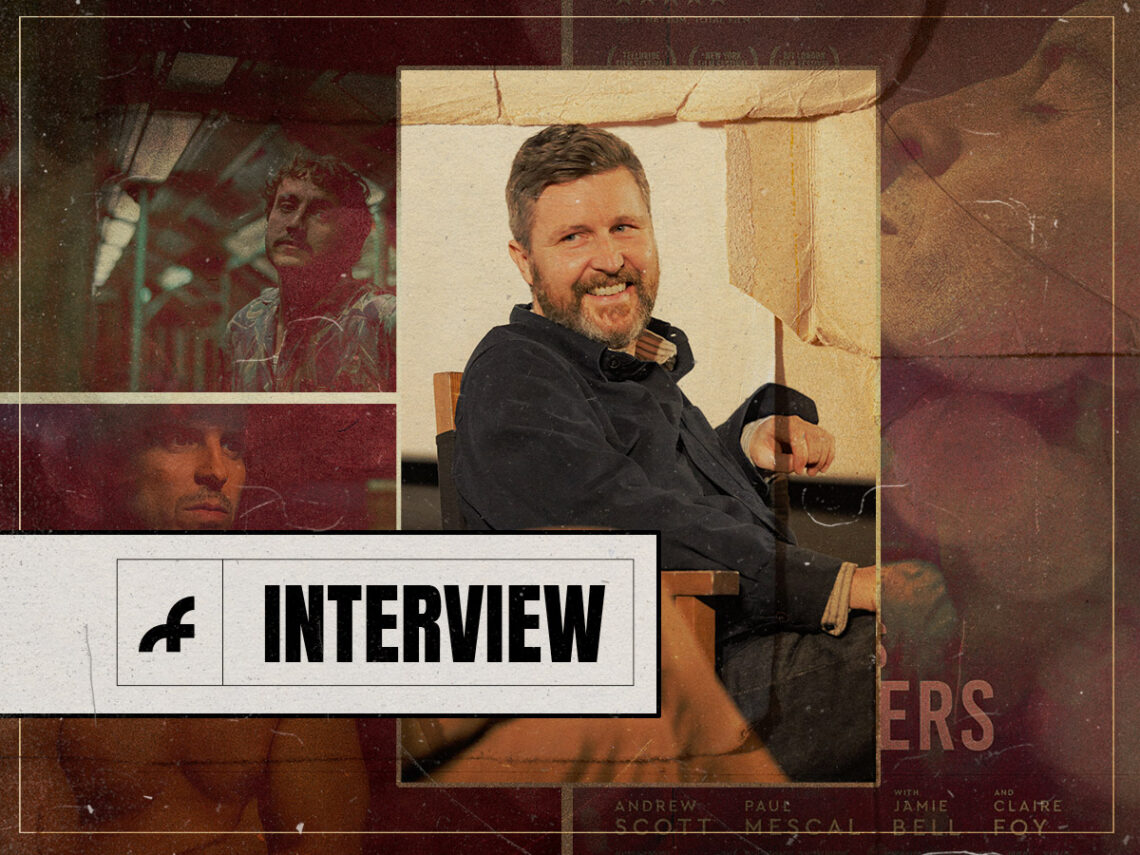
Andrew Haigh talks love, loneliness and loss in ‘All of Us Strangers’

The love stories of British filmmaker Andrew Haigh aren’t the kind of Hollywood romance flings that will have you wanting to toss your partner into bed; rather, they are the kind of anxiety-provoking films that keep you awake at night fixated on the ceiling. Exploring how love can enhance your life but also how it can torment you in times of loneliness, Haigh’s clear interest in the search for self and the fantasy of true love culminate in All of Us Strangers, his latest feature that treats wistful sorrow as spectral manifestations.
Such gothic apparitions are treated as ghouls in Taichi Yamada’s original novel Strangers, but in Haigh’s adaptation, they are no scarier than your mother asking if you ‘want more tea’. “That idea of meeting your parents again is so fascinating as a central idea, and I’m sort of confused, it’s not been done more often,” Haigh says of the central concept, “So, I took that idea, and then it was like, ‘Okay, how can I make this personal to me.’”
Partly inspired by Haigh’s own experience dealing with his father’s dementia and the eventuality of revealing his sexuality to him once more, All of Us Strangers tells the story of Adam (Andrew Scott), a screenwriter penning a tale about his childhood who, upon revisiting his childhood home, finds their ghosts occupying the space as if they’d never passed away at all. Understandably, he refrains from revealing this to his newfound lover, Harry (Paul Mescal), seemingly the only other occupant of the towering apartment block on the edge of London.
Once Haigh had stripped away the more fantastical elements of the novel and added the gay romance, “it sort of unlocked everything” for the filmmaker, “’Ah, okay, I can now talk about queerness in relationship to family, I can talk about essentially the trauma of growing up gay in the 1980s, and I can associate it and wrap it up with another trauma which for Adam in the story was the loss of his parents”.
It was a “knotty and fascinating” writing process, especially as it was penned during the Covid-19 pandemic, with this sense of isolation and existential vulnerability seeping into the film like a steady stream of city smog. Extraordinarily timely, its themes seem like a direct moral antidote to the contemporary epidemic of loneliness, with Haigh being wary of his film’s efforts to solve this phenomenon.
“It is about trying to connect, trying to know people, getting them to know you, being compassionate to each other. That is what love is about,” he eloquently exclaims, “When you are a parent to a child, you have desperate compassion for that child, you want to understand that child. Really, that’s the same in romantic relationships, too. That is what a romantic relationship, if it’s successful, is, because you feel deep compassion for that person, and you don’t want them to be alone”.

This isn’t the first time these themes have arisen in his filmography either, with ruminations of abandonment and vulnerability bubbling beneath the surface of everything from his breakthrough 2011 romance Weekend to his Oscar-nominated 45 Years. “I am so well aware that everything I’ve done, even the things that might not seem like they are related, are related,” he admits, even linking the BBC drama The North Water to his feature films under one central interest in complex characters searching for a morsel of stability.
Undoubtedly, it’s Weekend that shares the most likeness with his latest movie, with the humble indie film being the last time Haigh last made an explicitly gay romance, telling the story of two men in Nottingham who fall in love after a chance encounter. “I knew this film was always going to be in conversation with that film,” Haigh states, well aware of the similarities, “But it’s 11 years later, and everything has changed in 11 years for queer people. So much has changed, and in a weird way, there’s a lot of new things to talk about and discuss, but at the same time, the central feeling is similar”.
“Adam is feeling the same separation from the world that Russell feels in Weekend,” Haigh adds, drawing parallels between the leads in All of Us Strangers and 2011’s Weekend, “That in itself is interesting to me, that time can move on, that everything can change, but you can still feel trapped in a feeling unless you can go back and unpick why you have that feeling inside you”.
Untangling such a network of complex emotions about one’s troubled past is no easy feat, but the music so often acts as the remedy to this bewilderment, allowing everything to seemingly make sense, if just for a few minutes. This is a comfort for Adam throughout All of Us Strangers, where the likes of the Pet Shop Boys and Frankie Goes to Hollywood become figurative family members, giving weight and comfort to his every emotion.
“I can still now listen to music from the late 1990s, and I can suddenly feel like I’m in a club again. I can feel it,” Haigh expresses with wistful investment, “And a song from when I was a kid, I can suddenly know what it was like to listen to that in my bedroom. And you know, those were songs that I cared about when I was young, and most of them were written into the script”.
Used as some sort of therapy throughout the movie, Haigh took great care as to what songs did and didn’t make the cut, focusing largely on 1980s pop music: “The great thing about pop music is that it reflects and articulates ideas and complicated emotions that people can’t always express. I think that’s why teenagers and kids love pop music because it expresses ideas that they can’t express yet because they’re not old enough to and they’re not wise enough to”.

As Adam utters in the film, “It doesn’t take much to make you feel the way you felt back there again,” and with every cinematic flourish of Haigh’s wand, he proves this beyond doubt, effortlessly dragging the protagonist and audience back to a different time and place entirely. The visceral meditation on adolescence has already enchanted critics the world over, with Haigh’s film being recognised at the Bifas, where it walked away with the lion’s share of prizes, the Golden Globes and the forthcoming Baftas.
“I’m not craving awards,” he modestly admits, “But we won at the Bifas and that was really nice to have won there. I’ve been in British Independent Film for quite a long time, and I’ve never won anything at the Bifas, so it felt like it felt special”. Haigh’s tune may indeed change if he was to be given a nod in a major category at the Academy Awards, but he asserts, “You want to be in the conversation because it means that people hear about the film and it’s very hard when you make an independent film for anyone to actually know about it. You’re constantly battling to try and get it into the ether”.
Regardless of the potential of awards recognition, Haigh’s film has already profoundly captured the ethereal sense of contemporary loneliness that shrouds the zeitgeist, bottling a mood not too dissimilar to Charlotte Wells’ wondrous 2023 debut Aftersun. An odyssey of love that spans generations, Haigh’s sombre drama pulsates with a genuine hope for human connection, protesting the differences that keep so many of us apart.
Given his fondness for love stories focused on characters learning to find themselves before falling for anyone else, it’s likely that Haigh’s next project won’t stray too far from this path. “I would love to make a musical,” he admits, with this being somewhat unsurprising given his perfectly timed needle drops throughout his filmography, yet his desire to make “a massive apocalyptic disaster film” is a little more off-brand.
Still, in the same vein as Mike Leigh’s 1993 Palme d’Or nominee Naked, whose apocalyptic musings have made the film an iconic piece of British filmmaking, it’s certainly not outlandish to see Haigh’s recent movie as part of the same thematic genre. “That’s my apocalyptic end of the world movie,” he jokes when the idea is broached, yet in all the film’s delicate sadness and hopeful plea in the face of catastrophe, it’s now hard to see it as anything but.
