


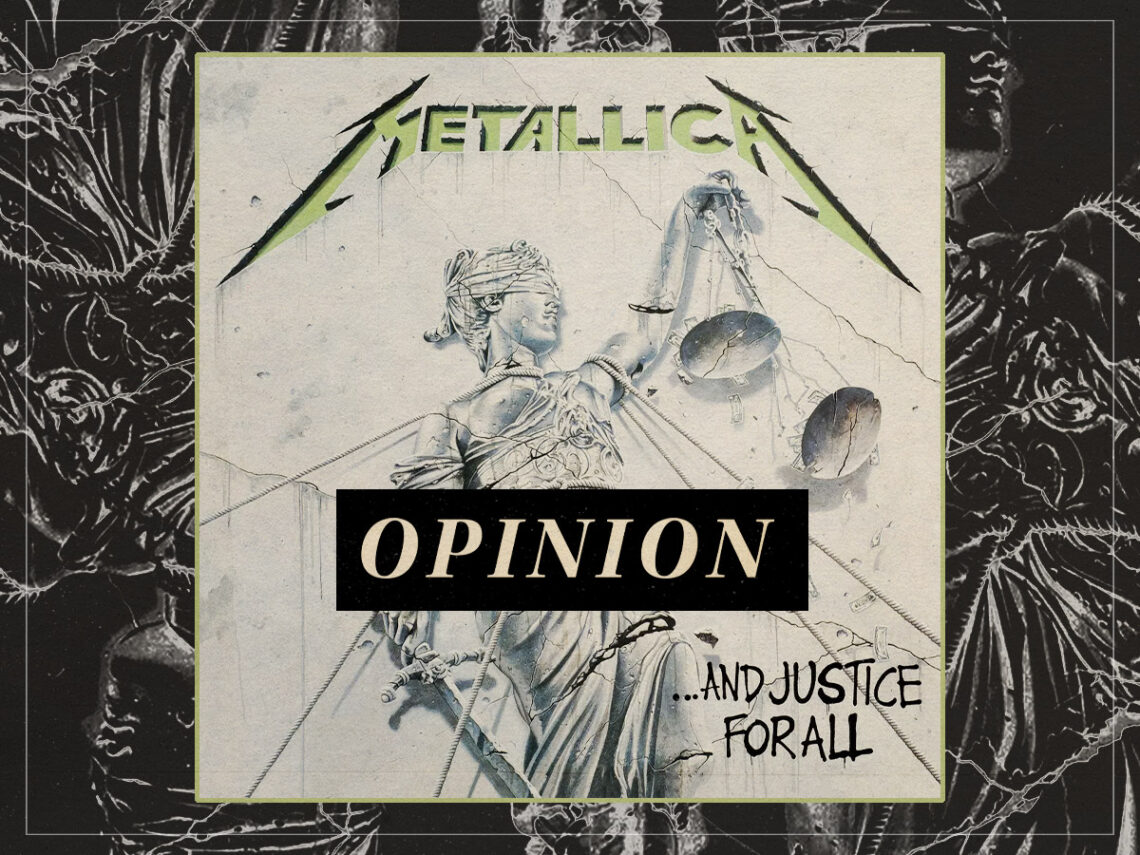
Hear Me Out: ‘…And Justice for All’ is still Metallica’s best album

After you dig your way to the bottom of the numerous jokes and jabs at the album’s overall production quality and infamous lack of bass guitar, you will find nothing but praise for Metallica‘s fourth studio album …And Justice for All.
Released in 1988, the record is fueled by political themes, exploring the horrors of war and conveying intense emotions of guilt and rage. While the band infamously lost the Grammy for ‘Best Hard Rock/Metal Performance Vocal or Instrumental’ to Jethro Tull in 1989, there is no doubt among their diehard fanbase that they deserved the critical acclaim and commercial success for that record.
…And Justice for All was the first full-length release from Metallica that featured newly-acclaimed bassist Jason Newsted, who had replaced the late Cliff Burton following his tragic death in 1986. Newsted was featured on the band’s 1987 EP The $5.98 EP—Garage Days Re-Revisited, but this record would be the first time listeners would hear what Newsted was bringing to the stage for a band who were, at the time, one of heavy metal’s most prominent rising stars.
In their early years, Burton was a monumental driving force for Metallica, and his death still hits hard for listeners. While he was not physically present for the recording of the record, it is the last of the band’s albums to feature songwriting credits from him. They wrote the instrumental track ‘To Live Is to Die’ as a tribute to the bassist, using previously recorded riff demos and lyrics that Burton had written.
The album stands out in Metallica’s catalogue in the same way Back In Black holds such a legacy spot for AC/DC. After facing unprecedented tragedy, both bands continued to rise in the rock scene, with each of them becoming some of the most famous and highest-selling groups of all time.

Nevertheless, …And Justice for All is their greatest album not just because it is decorated in the memory of Burton, but it is an expression of how the band rose above immense adversity, turning rage into something musically complex and darkly beautiful. Even guitarist Kirk Hammett has said that the album is one of the most difficult to play in the discography, featuring relentlessly hard-hitting tracks such as the title song, ‘Dyers Eve’, and ‘The Frayed Ends of Sanity’.
Opening with ‘Blackened’, the album immediately sounds brutal and dangerously cathartic. Then, several tracks later, listeners find ‘One’, a song that begins mournfully but soon builds up and erupts into something completely unheard of in metal music at the time.
An album like …And Justice for All perfectly sums up Metallica’s approach to music. Since their early years playing throughout their local Bay Area and being active participants in the rising thrash metal subgenre, the band were vocal about always doing things their own way.
When fans scolded them for signing to a major record label with the release of Master of Puppets in 1986, when critics discouraged the long, nearly ten-minute tracks featured on …And Justice for All, or when they received harsh critique for their blues rock-inspired sound on 1996’s Load and Reload a year later, Metallica never shied away from writing music for themselves, always making what they wanted to hear. It was this fearlessness and authenticity that made them one of the highest-selling musical artists of all time.
This album not only showed the world the insane musical talent of each band member, through James Hetfield’s sorrowful songwriting and Hammett’s impeccable guitar solos, but it also became one that signified the band as a force to be reckoned with. It paved their way to ultimate superstardom, something they would officially achieve with their critically acclaimed self-titled album, more commonly referred to as The Black Album, which they would release in 1991.
…And Justice for All is, without a doubt in my mind, Metallica’s greatest effort. It shows what the band was capable of personally, musically, and lyrically. As they plumbed newfound emotional depths, the record allowed the group to shine in a novel light for a body of work which conveyed pain, hurt, and sorrow, all while delivering something hitherto unattempted or mastered in modern music.
