


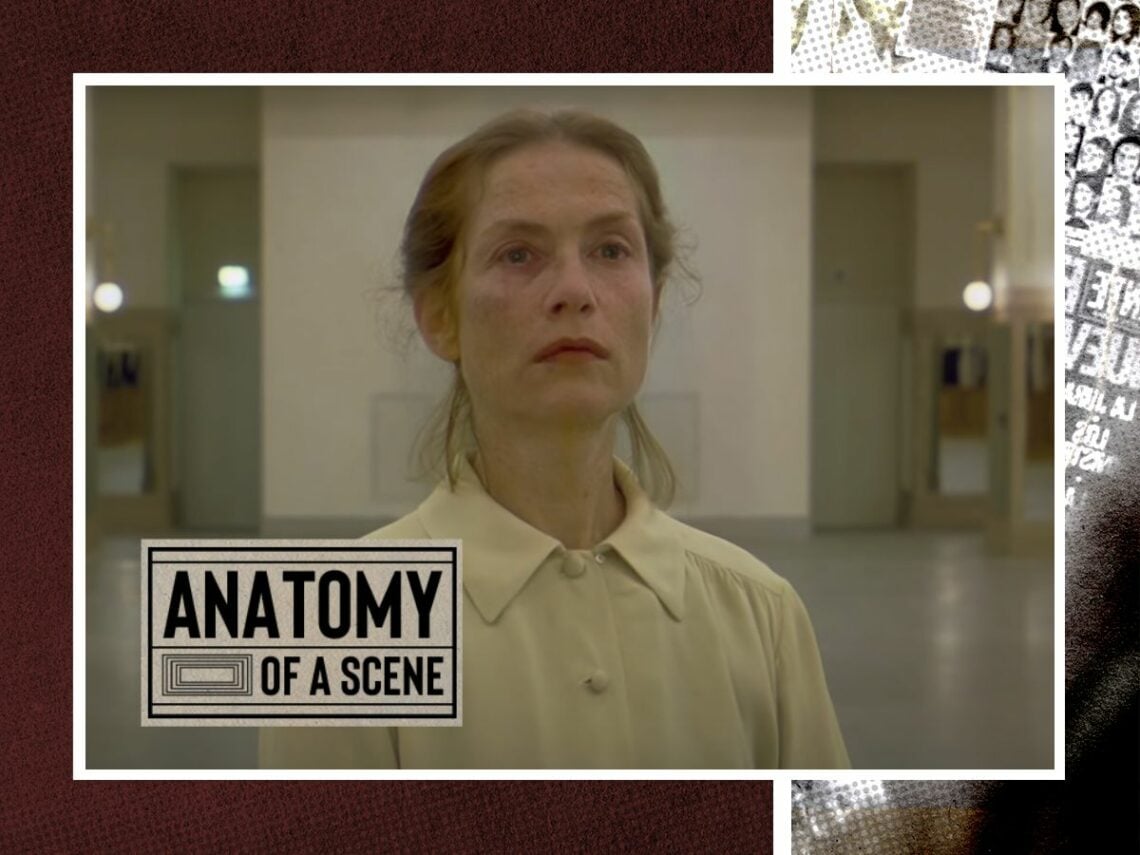
Anatomy of a Scene: the shocking ending of ‘The Piano Teacher’

The films of Michael Haneke are known to shock and divide audiences, dating back to his debut feature, The Seventh Continent, which follows a seemingly ordinary middle-class family as they secretly plot something tragic. The Austrian director’s next feature film, Benny’s Video, was even more startling, cementing Haneke as a filmmaker unafraid to push cinema’s boundaries and explore the violence buried closer to society’s surface than we’d like to think.
Haneke continued his reign as one of cinema’s most divisive figures in 1997 when his psychological horror film Funny Games caused one-third of the audience to walk out at its Cannes Film Festival screening. Four years after Funny Games, he released The Piano Teacher, one of his most critically-acclaimed films. Using Elfriede Jelinek’s novel of the same name as a starting point, Haneke created a psychosexual masterpiece with Isabelle Huppert giving the acting performance of a lifetime.
The film follows Huppert’s Erika, a piano teacher who lives with her overbearing mother, taking the definition of sexual frustration to an entirely new territory. When she meets Walter, a younger student, the pair begin a sadomasochistic relationship defined by outright abuse, culminating near the film’s end with Walter beating and raping her. In the meantime, Erika engages in bizarre behaviour such as genital mutilation, voyeurism, paraphilia and violence towards her students.
Haneke’s film is a marvellous study of desire and fantasy, with Erika’s deepest, darkest desires turning into nightmares when Walter actually acts them out. The Piano Teacher is both disturbing and heartbreaking. It’s about a traumatised and lost woman whose vulnerabilities are taken advantage of in the most heinous way. This abuse erupts into an act of violence at the movie’s climax.
At the end of the film, Erika stabs herself in the chest in the empty foyer of a concert, confusing and shocking many viewers. Yet the ambiguous closing scene works so well, encapsulating the film’s exploration of the effects of achieving our desires. Haneke achieves such an effective end sequence by building up to the shocking moment with precise tension.
Following Erika’s letter detailing the fantasies she’d like Walter to enact, he appears at her house, where he beats and rapes her. Bloodied and bruised, Erika is found by her mother before Haneke cuts to the next day, where our protagonist is fetching a knife from the kitchen and sliding it into her bag. The director forces us to question what she’ll use the weapon for. Perhaps to seek revenge on Walter? However, this is a Haneke film, and giving Erika a somewhat happy ending would be out of the question.
Instead, we see Erika and her mother arrive for the concert, in which she is filling in for one of her pupils. Crowds of sophisticated concert-goers swarm through the foyer as Erika approaches one of her other pupils. The camera retains its focus on Erika as she moves, the people in the background morphing out of view. Despite her pupil telling her that he is excited to watch her play, she maintains a stern expression, failing to reply to his complimentary statements.
Whilst Erika engages in a brief conversation with Anna, a pupil she injured earlier in the film, it is apparent that her mind is elsewhere, her eyes searching in the distance, presumably for Walter. Finally alone, Erika finds an empty stairwell to linger in, and we’re treated to a point-of-view shot of the front doors, anticipating Walter’s entrance.
The camera cuts back to Erika’s face, utilising a claustrophobic close-up of her vacant stare as she paces forward. Then a tight close-up of the back of her head is used, initially blurring the identities of those she is approaching before the camera quickly changes its focus to reveal Walter making his way into the auditorium. As if nothing had happened the night before, Walter walks past with a smile and says, “My respects, Professor. I can’t wait to hear you play.” Haneke’s gaze lingers on the back of Erika’s head, yet we know that she will still be eliciting the same stare as she watches him walk away.
A prolonged shot of Erika’s hopeless face emphasises the utter destruction the previous night’s events have wrecked on her mental state. Her desires, now realised, have not fulfilled her – quite the opposite. As soon as her fantasy was made real, it was no longer a fantasy. Instead, it became a nightmarish culmination of her fears and frustrations, highlighting the ambiguous nature of our desires, which can never truly be satisfied.
With one quick grimace of emotion, Erika stabs herself in the chest as tears form in her eyes, allowing the blood to blossom through her blouse without giving her injury a single glance. She approaches the camera and leaves the building, striding out of frame, leaving us to decide her fate. Haneke lingers on the front of the building, and cars pass, oblivious to her incident. Whereas the passing cars depict a functioning society, Erika’s character showcases the obscenity, violence and repression that can manifest in anyone, even the most modestly-dressed, respectable-looking women.
