


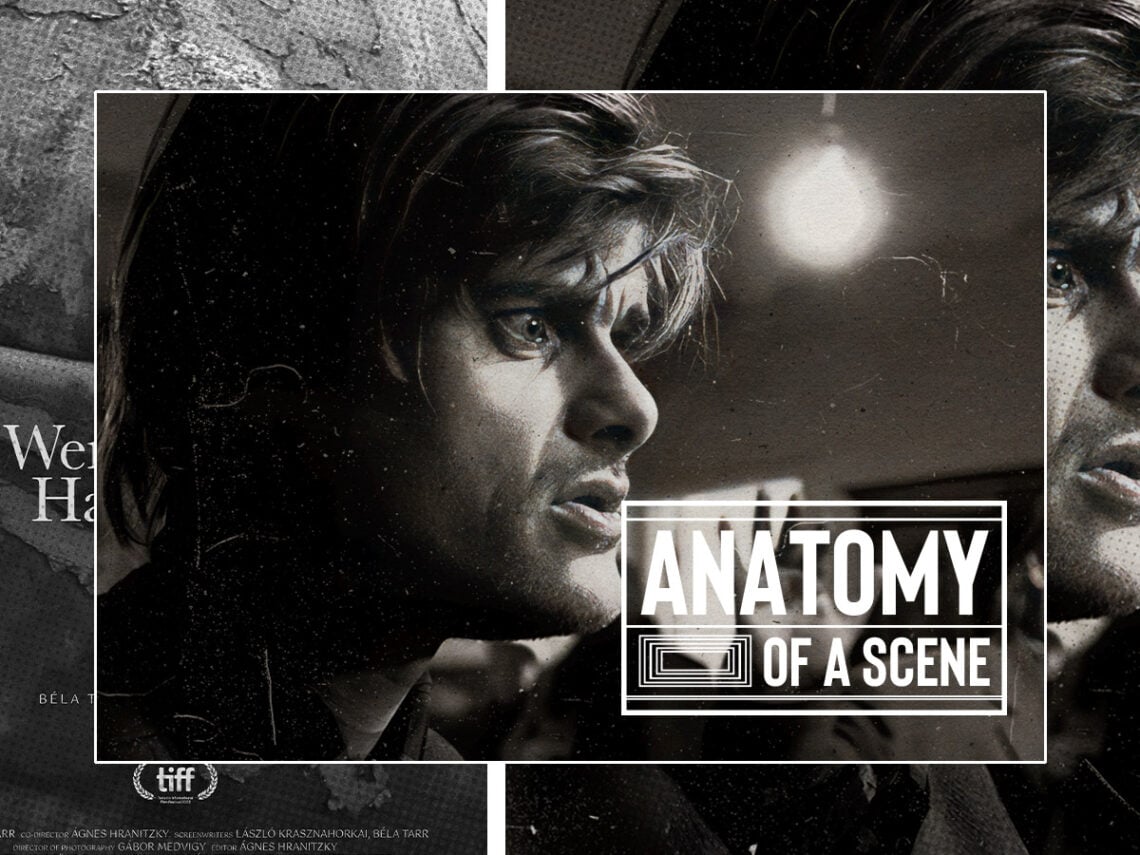
Anatomy of a Scene: The mystery of the cosmic divine in Béla Tarr’s ‘Werckmeister Harmonies’

Creating a sense of grand, epic cinema is a difficult feat on a screen that is usually only limited to an aspect ratio of 1.85:1 or 2.39:1, with filmmakers like Christopher Nolan and Denis Villeneuve filling this space with as much visual noise as possible, from crashing spaceships to incomprehensible dream heists. Yet, cinema has the unique ability to transcend the audience if every ingredient is delicately handled, with the Hungarian filmmaker Béla Tarr delivering this with the extraordinary opening sequence of 2000’s Werckmeister Harmonies.
Known for his somewhat bleak films that explore the cynicism of humanity, Tarr came to Werckmeister Harmonies just six years after the release of his near eight-hour epic Sátántangó, which is often discussed as being one of the most seminal releases of the 1990s. His follow-up was entirely more accessible, however, both in terms of tone and length, telling a curious story about a small Hungarian town whose livelihood is upended by the arrival of a strange travelling circus and its main attraction; a giant stuffed whale.
Like every Tarr movie, deep down, it’s an analysis of something a little more complex, with Werckmeister Harmonies picking apart the political systems that keep communities fearful and isolated, using the circus as one big surreal metaphor. János Valuska (Lars Rudolph), a young newspaper-delivery man, is the protagonist of the tale, a sensitive, inquisitive soul who shuffles the streets like a ghostly omniscient observer, foreseeing the imminent social collapse of the town.
A figure of great interest in the town, János is seen during the film’s introduction conducting a performance with the drunken men of the bar, with each person playing a different planet or object in the theatrical representation of a total eclipse of the sun.
“All I ask is that you step with me into the boundlessness, where constancy, quietude and peace, infinite emptiness reign,” János utters with careful sincerity, sparking life into the performance with a speech that seems to be inspired by a higher power. These men, many of whom are staggering with drunken sea legs, then become props in his performance, with Tarr setting the stage as if we’re not in a remote Hungarian pub but in the splendour of the cosmos.
The men, illuminated by Tarr’s dull monochrome wash, become the centre of the universe, having previously been at the mercy of flat brown beer, empowering a forgotten corner of a discarded town.
But, the tone shifts upon the arrival of the eclipse. “Can you feel it?” János starts, continuing his staggering monologue, “The dogs howl, rabbits hunch down, the deer run in panic, run, stampede in fright…and then, complete silence”. Tarr pans back, and Mihály Víg’s celestial ‘Valuska’ descends upon the scene; the camera too takes off, elevating as high as the ceiling will allow it to communicate its own existential trepidation.
Tarr bottles a transcendence in this remarkable opening scene, carrying the weight of this spiritual phenomenon with delicate filmmaking that places the viewer in a state of confused bliss, being a touching insight into the mystery of the human condition as well as an infinitely sad statement that affirms our insignificance.
But this sublime introduction doesn’t stand solemnly alone; it is a microcosm of what the film stands for, speaking to the absurdity of everyday existence and the line between tragedy and farce, the spectacular and the mysterious. Such is contained within the figure of the whale, a feat of grand divine creation, reduced to being stuffed inside a dark truck, the main event of a travelling circus.
Just as beauty and tragedy ride a fine line in the film’s opening sequence, with the eclipse taking away life as quickly as the dawn brings it, Jonas sees God’s wisdom and his curious wickedness in the whale, for who could allow such a creature to be treated in this way? In Tarr’s masterpiece, the opening sequence provides a spark of hope and childlike curiosity in a film that seems blinded by fatalism.
