


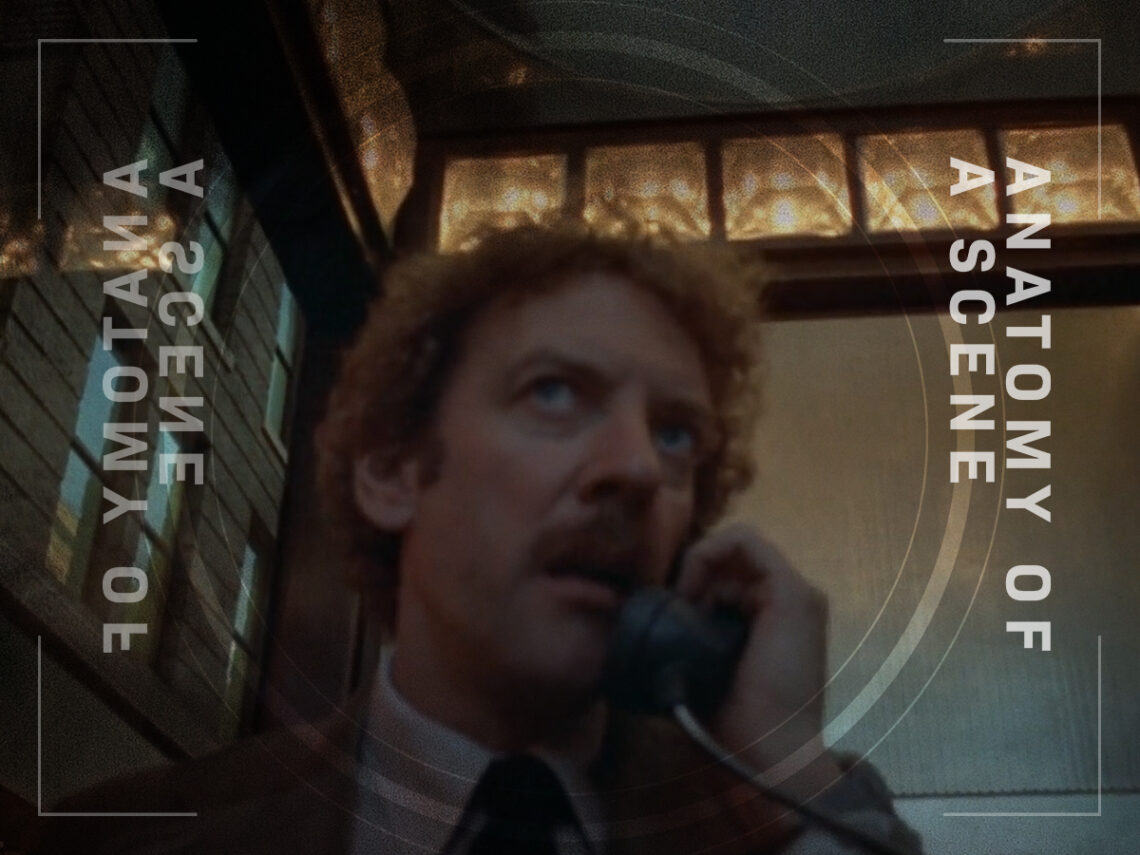
Anatomy of a Scene: Paranoia in the phone booth in ‘Invasion of the Body Snatchers’

There is perhaps no greater threat within the horror genre than that of zombies and human-esque monsters, with the creatures evolving throughout cinema in their meaning and manifestation, sometimes walking with a tepid sluggishness or with surprising urgency (for people who are dead). But perhaps more interesting than the physical traits and characteristics of these creatures is the way our fear is redirected towards something else, with their ever-changing presence often reflecting cultural trends and socio-political issues that manifest in the form of mass hysteria and an epidemic of the living dead, something that is perhaps most expertly explored in the 1978 adaptation of Invasion of the Body Snatchers.
Donald Sutherland was known for selecting projects with political undercurrents that aligned with his own beliefs, often voicing his concerns about the world through the films he chose, as well as through his heavy involvement in the antiwar movement. Invasion of the Body Snatchers is no exception, with the film springing up after the post-war economic boom suddenly came to a halt, with a surge of anxiety that was prompted by the sudden period of economic turmoil and uncertainty caused by new technological advancements.
In turn, this prompted a new decade in which people grappled with the looming threat of modernity and fears over how this would change the world, with the prospect of a digital age slowly hacking away at the infrastructures that comfortably defined everyday life. Given that we are now living in the age of artificial intelligence and know how this pans out, it is safe to say that these fears were completely valid, something that is reflected in Invasion of the Body Snatchers as lifeless clones are made of the people in San Francisco, representing this public fear over a complete loss of self and individuality.
The aliens slowly infect every corner of the city, something that is made all the more insidious given that they blend in with normal people, evoking this feeling of complete paranoia as you realise that something is not quite right, but you cannot immediately point a finger at what is wrong. Everything feels off-kilter and cold, with people suddenly becoming unable to feel or express any emotion, existing as barren bodies devoid of passion and freedom of thought.
Invasion of the Body Snatchers is not a horror movie but a paranoia movie, with one scene that best captures this as Donald Sutherland’s character, Matthew, desperately tries to make contact with anyone who will help him destroy the aliens, plagued by an invisible yet omnipotent threat that is everywhere yet nowhere to be seen.
As the reality of San Francisco’s epidemic begins to dawn on Matthew, we see him trapped in the realisation that he has to hide his true feelings and fear from everyone around him, with the alien duplicates being able to detect any human who hasn’t been copied as a result of their ability to express emotion.
This results in a dizzying sequence as Matthew walks down the street while being acutely aware that he is surrounded by aliens, trying to mask his panic while searching for a phone box to call officials in other states for help. The gaze of the camera becomes a visual representation of the all-consuming threat that lurks behind the lifeless eyes of the people all around him. We become flooded with the sound of identically paced footsteps from all angles, an ominous reminder of an epidemic that is barely detectable yet becomes starkly obvious in the stiffness of each movement and expression around him.
Looking for an escape from the monotonous parade, Matthew escapes into a nearby phone booth, with swooping shots as the camera shoots him from a low angle, looking up and capturing an expression of pure fear as he listens to the excuses of people who refuse to send help. Kaufman intercuts his helpless conversation with handheld and shaky footage of the camera moving through the crowds on the street, quickly cutting and spinning to a different perspective as it captures the hordes of mindless people that move in and out of Matthew’s periphery.
This scene portrays the height of Matthew’s paranoia and the arrival of a terrifying new era in which individuality and freedom of thought became the enemy, with conformity spreading like a plague that slowly kills any sense of autonomy over oneself. From the frantic cuts, handheld POV footage of someone walking through the city, spinning back only to look at Matthew and heightening his sense of complete isolation, the phone box scene captures the true helplessness of his mission and the sudden poisoning of a city as the people become sterile copies of their former selves.
While it works as a horror story, the film can also be read as a warning about the effects of modernisation and a society that punishes self-actualisation and expression, leading to a society that mindlessly goes with the flow without questioning the fractured and increasingly dehumanising world they’re a part of.
