


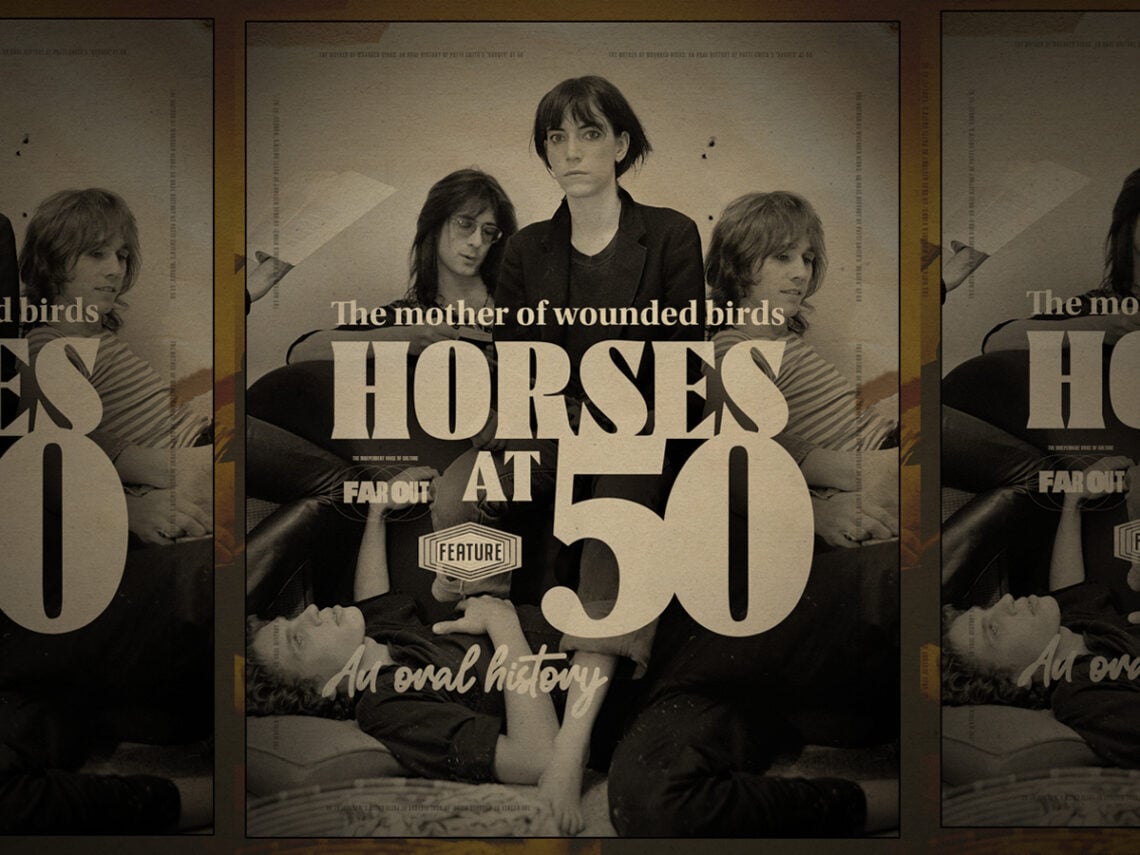
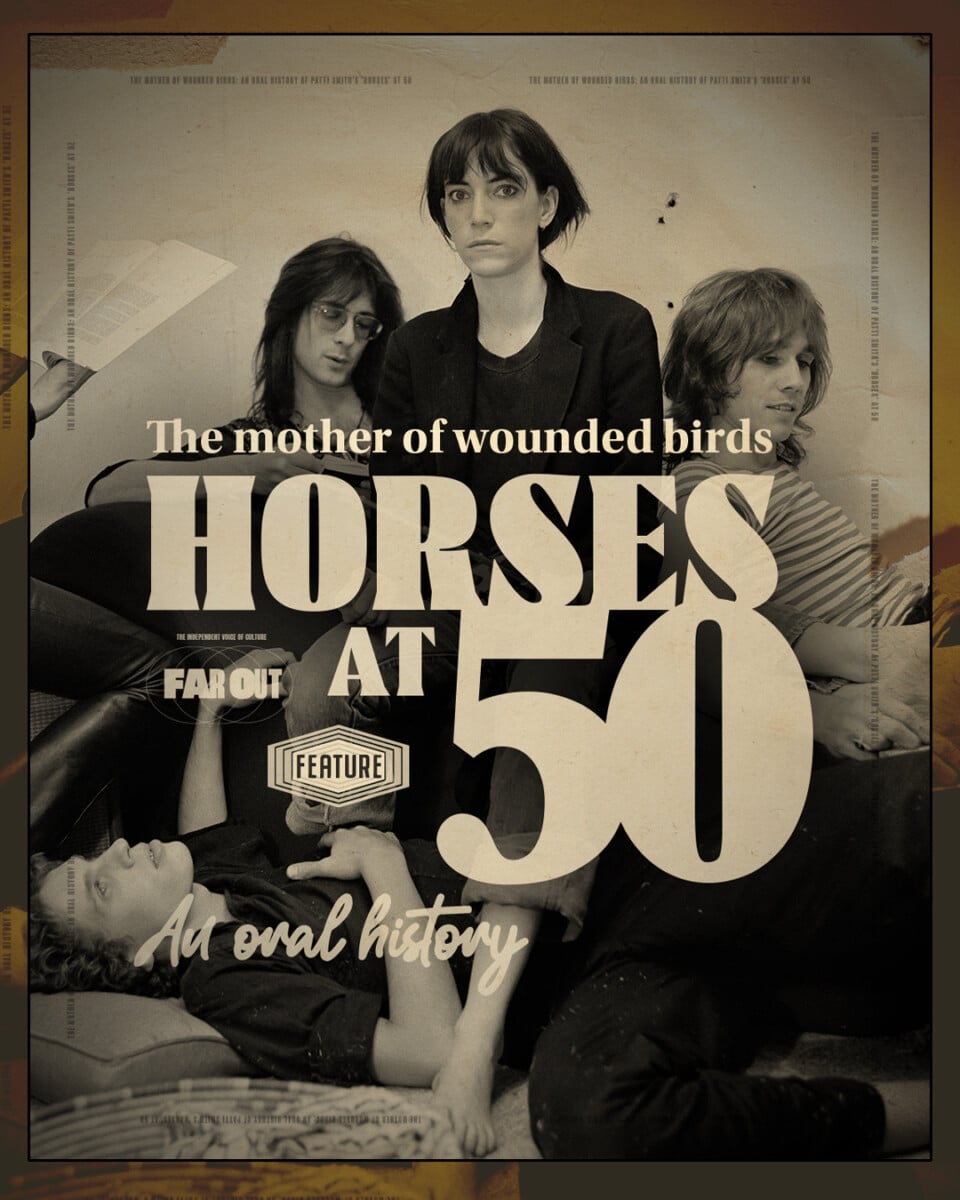
The mother of wounded birds: an oral history of Patti Smith’s ‘Horses’ at 50

In 1975, Patti Smith was a wayward poet seeking a creative outlet.
After making her artistic pilgrimage to New York City, Smith filled notebooks and scraps of paper with her endless poetic stream, dreaming of achieving greatness like her literary heroes, scribes the likes of Arthur Rimbaud, Sylvia Plath and Jean Genet, who were, in her mind, gods. In tandem, she worshipped the likes of Bob Dylan and Jim Morrison, poets with a musical sensibility who helped her conjure a higher impact in her writing.
Smith decided to set her poetry to song, performing in churches and clubs across downtown Manhattan, her spoken word soundtracked by the guitar stylings of Lenny Kaye, who would become her closest collaborator. Eventually, the two assembled a band and found themselves at the doorstep of Jimi Hendrix’s Electric Lady Studios. Smith was to record her debut album, Horses, which turns 50 this week.
Reflecting on this time in her memoir, 2010’s Just Kids, Smith wrote: “Jimi Hendrix never came back to create his new musical language, but he left behind a studio that resonated all his hopes for the future of our cultural voice. These things were in my mind from the first moment I entered the vocal booth. The gratitude I had for rock and roll as it pulled me through a difficult adolescence. The joy I experienced when I danced. The moral power I gleaned in taking responsibility for one’s actions. These things were encoded in Horses as well as a salute to those who paved the way before us.”
Horses remains an evocative display of power, a radical blend of spoken word and guitars turned into a rallying cry. Smith redefined the future of rock music, appearing androgynous and writing eloquent and complex fables that blended dreams and reality. She presented vulnerability in a way that felt dangerous, both imperfect and intentional. As punk began to take shape, the Patti Smith Group’s sound occupied a space that refused to be defined. Below, the sound engineers on Horses, old friends and more, recall the making of Smith’s debut album and define its power, half a century later.
Jaan Uhelszki (co-founder, Creem magazine):
“I met Patti before she was a musician and was a just-published poet. We were the first publication to publish her poetry at Creem, and later used her to do reviews, which were so good. It’s her word choices. I once had a professor who said, “When you can describe something that’s rust-colored, why would you call it a brick? Why not call it a kidney?” Patti had the same choice of words. She always takes you further out than you expect. I’ve always really admired that about her.”
Bernie Kirsh (head engineer, Horses):
“I moved to New York in 1970, at the age of 24. In the early 1970s, there was a lot of rock music and jazz fusion. It seemed like that kind of rock ‘n’ roll would go on forever; it was ubiquitous. New York was vibrant in those days. There were lots of clubs all over the Village and down in Soho, like CBGBs, where Patti and her group made their mark.
I started working at Electric Lady in 1970 and was an engineer for four years before getting the Horses project. I was starting to get into jazz a bit, which was a cousin to what Patti was doing, because of her improvisational approach. We had an interview with her manager, Jane Friedman, and decided to do the project together. “
Frank D’Augusta (musician and assistant engineer, Horses):
“I was 19 when the recording of Horses began. Before Patti, I was in the industry for five years. I left high school early and got into the recording business, starting at the real bottom as a messenger. The previous studio I worked at, Record Plant in New York, was one of the premier rock studios in the country. I came into the industry with the whole rock approach, to hear what I’d like to hear.
When I got to Electric Lady Studios, things were changing. They were getting into jazz fusion, with acts like Chick Corea and Al Di Meola, along with rock music; Electric Lady was a good teaching place for me.”
Inside Electric Lady Studios
On September 2nd, 1975, the Patti Smith Group entered the studio. Smith, lead guitarist Lenny Kaye, guitarist Ivan Král, pianist Richard Sohl and drummer Jay Dee Daughtery were set to work with the Velvet Underground’s John Cale as their producer.
D’Augusta: “I wasn’t familiar with Patti, nor with the Allen Ginsbergs, the [Jack] Kerouacs and the [William S] Burroughs, the Beat poets. That was totally foreign to me. I’ve never heard anything like what came out on Horses, and I didn’t “get it” for a few years. But I get it now.”
Philip Shaw (academic and author of 33 ⅓: Patti Smith’s Horses):
“There are all these cultural reference points that Patti is throwing out in her lyrics: Rimbaud, Jean Genet, Baudelaire, all these French, moody guys writing their poetry in the 19th century. She was levelling the field between high and low art, making poetry that might be regarded as highfalutin or elitist, and channelling it through a medium, rock ‘n’ roll, that was populist. So, you could think and dance at the same time. I thought that was really clever.”
D’Augusta: “Bernie Kirsh, traditionally, was more of a jazz guy. I was the rock kid because Bernie was a little older and at Electric Lady before me. I knew what amps to use, and he knew what sounds to get in the control room.”
Kirsh: “I understood Patti’s approach as an artist. The job entailed interpreting what she was doing. Before computerised mixing, everything recorded in the studio had to be combined and presented as a final mix, in the moment. In that sense, there was an interpretation of what the Patti Smith Group was doing and a contribution to its emotion. Horses was a simple, raw album, almost like a live album. There weren’t a lot of complex production values; the band presented as they probably would on stage.”
D’Augusta: “The guys in the band were great musicians, but were inexperienced and a little green in the studio. Bernie and I could make suggestions or try different things. The studio was a good place to get that workflow going.”
Kirsh: “There was a lot of intention in the room, and attention on getting what finally evolved. The band had performed these pieces before, so they weren’t searching for something sonically. They understood and were comfortable with the material, and free to express themselves any way they wanted. It was a smooth operation, to me.”
D’Augusta: “A lot of our sessions would start between three and four o’clock in the morning. The band was out doing gigs, so they would come in after and we’d start in the middle of the night. Electric Lady was the place to do it because it was all about the artist, mood and setting. The studio was set with perfect lighting; it was very cool.
John Cale definitely had his own way of producing. He would darken out the control room and sit under the console with a microphone to talk back to Patti. She couldn’t see him, which I understand; as an artist, you don’t like to see people in the control room. I thought it worked well with her. She could really be herself.”
Kirsh: “It’s a wild thing because I was in the room, but I didn’t experience what later began to appear as some sort of “conflict” between Patti and Cale. I’m certain that it did occur because it was expressed by Patti. In the control room, it’s not uncommon for there to be artistic differences, so it didn’t seem unusual to me. There must have been things behind the scenes that I wasn’t privy to.”
D’Augusta: “I remember John being very personable. He would want to get down to business. The band sounded really good, but when it came to vocals, that was Patti’s thing. There were no vocals like hers. Sometimes she would say, “Let’s try it this way, or that way”. She didn’t do it in a mean way, or in a “being a diva” way. She just got it because she’s a real person and down-to-earth.”
“She’s got a direct channel to something the rest of us are too clouded to have.”
Jaan Uhelszki
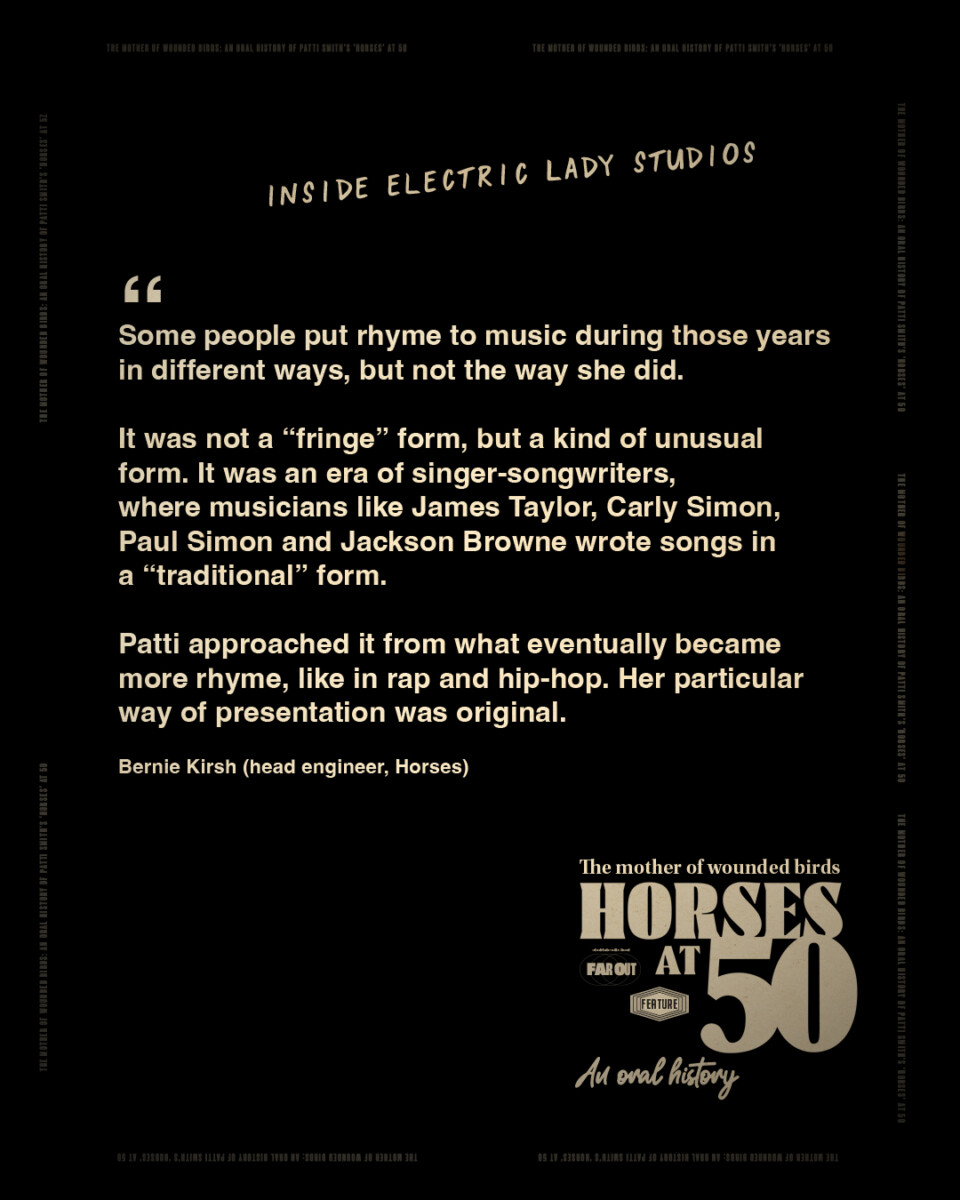
Kirsh: “Some people put rhyme to music during those years in different ways, but not the way she did. It was not a “fringe” form, but a kind of unusual form. It was an era of singer-songwriters, where musicians like James Taylor, Carly Simon, Paul Simon and Jackson Browne wrote songs in a “traditional” form. Patti approached it from what eventually became more rhyme, like in rap and hip-hop. Her particular way of presentation was original.”
D’Augusta: “And the things she was saying, only she could say it. She knew exactly what she wanted, and John Cale was all for it. He was methodical, straight ahead, except for the vocals, where he just let Patti consume all of us with the lyrics. Patti’s vocals were very unorthodox.”
Uhelszki: “I’ve always loved that she takes great joy out of writing. It’s almost like an erotic thrill. She’s got a direct channel to something the rest of us are too clouded to have.”
Kirsh: “There were different styles in the songs that would stand out. ‘Redondo Beach’ had a different feel from ‘Kimberly‘. They all had their own singular viewpoints. She paints a picture of each song. Sometimes you get albums where the lyrics change but the style is pretty much the same, but not with this album.”
Caryn Rose (music journalist and author of Why Patti Smith Matters):
“Improvisation still involves discipline. Patti found a way to capture it in the studio, which I don’t think she gets enough credit for. Most people don’t even notice that that’s what she’s doing.”
D’Augusta: “I got to mix one song on the album, ‘Birdland’. Bernie had left, and I stayed behind with the band, who wanted to continue. I mapped out the song: verse starts here, intro, verse, pre-chorus, chorus, guitar or piano solo. That was some experience, doing something so unorthodox to my general days in the studio with other groups.”
Kirsh: “I remember fooling around while doing the mix for ‘Land’. We had done a few vocal takes, which was not unusual. I was moving the faders and thought, “Well, this is interesting”, as I formed a little collage. I started talking to Patti about it, and she created this collage of voices at the beginning of the piece. It created a really nice emotion, where the lyrics would come in and out, and then present itself with the main lyric. That was fun.
Later, John left the project during the mixing, so I took over and worked with Patti to finish and present it to the world. There was a lot of leeway with the things I could do. I was basically mixing the album with Patti’s input, so I thought it went along nicely and easily. We just had fun!”
The Cover
Made by Patti Smith’s close companion, photographer Robert Mapplethorpe, Horses shows Smith in a white button-down and black trousers, a black coat slung over her shoulder. Her hair sits in a frizzy shag, her hands are clasped at her chest, and her face is poised, both sensitive and confrontational. It has become one of rock history’s most recognisable images.
Robert Heimall (artist & designer of the Horses album cover):
“Patti had lived with a photographer, Robert Mapplethorpe. She came to me with about five or six photographs from Rob and gave me some of the music. I thought that picture just nailed everything, at the time: Patti, Mapplethorpe, the music, the scene. With that photograph, Mapplethorpe came up with the cover idea. I did a mock-up and a back cover, and she approved it. She was a hoot!”
Uhelszki: “For years, I kept a copy of Horses on my desk because I love the iconic outfit she wore on the cover. It’s so minimalist; so many people have said it struck them. I think that elevated her into a symbol of the times.”
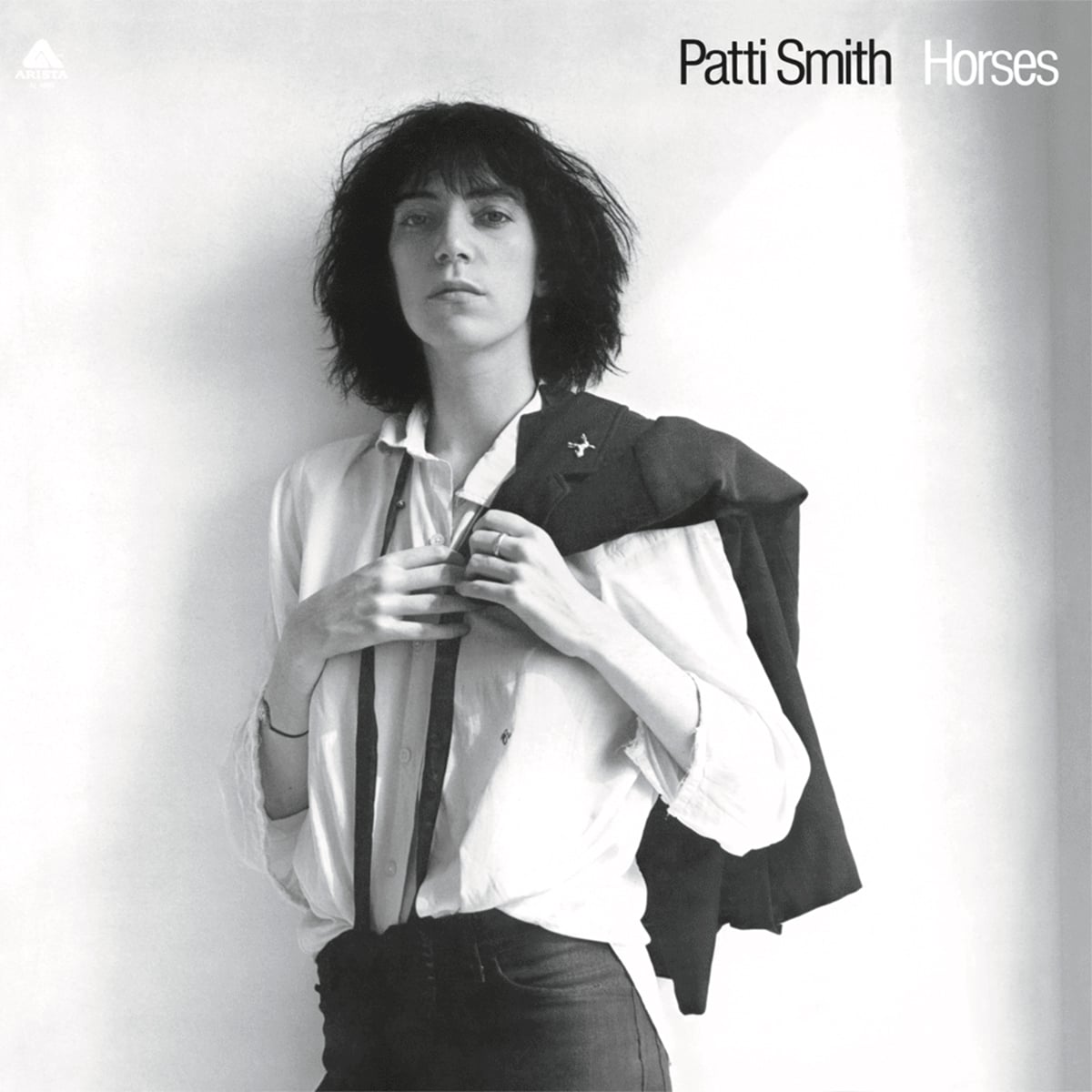
Shaw: “She doesn’t look like any other female singer of that period. She hasn’t been prettified. The sort of hangover of the “hippie woman” was predominant, I think, in the record industry’s view of what women should be. But here Patti is, looking androgynous, strange and challenging. That in itself was new and different.”
Rose: “She didn’t have a full face of makeup. It was the secret ‘Bat signal’. It was brave, but she didn’t know it was, that’s how she presented herself. There wasn’t really the concept of “nonbinary” when I was growing up. I liked makeup and dressing up, but I didn’t want any part of it. Patti also liked it, but she wanted to control it. The cover was out there for everyone who needed to see it.”
Horses‘ legacy
The album received modest commercial success, with 135,000 copies sold worldwide. Yet, it changed the course of rock ‘n’ roll, amplifying punk in its earliest stages and redefining the image of the female singer-songwriter.
Uhelszki: “I thought it was great that an androgynous girl attempted this kind of rock ‘n’ roll form in 1975. Disco was coming; Saturday Night Fever was changing the music landscape, and here’s Patti Smith standing there in her simple black and white outfit, and people were transfixed. It was like a religious experience when they saw her because it was so different from anything else. ‘Jesus died for somebody’s sins, but not mine’. It’s like Bob Dylan saying, ‘You’ve got to serve somebody’; it was on par with that.”
Shaw: “What she was saying made the hairs on the back of my neck stand up. Listening to Horses for the first time felt like an electrical charge going into my ears, my brain, down my spine, and it upset everything in ways that I couldn’t account for. At the time, I was in church school, being confirmed in the Church of England and had read the Bible. As a kind of “good boy”, that message really unsettled and changed me productively. I found the record disturbing and exciting at the same time.”
D’Augusta: “They call Patti ‘the Godmother of Punk’. I don’t know if I would say that, because the punk thing was out of tune, anger-ridden, unclear in its intention, to me. But her intention, and its fantasy and dream aspects, were very clear.”
Shaw: “I’m always astounded that Horses was released in 1975. This predates the Ramones and their landmark punk statement, 1976’s Ramones. Patti wouldn’t have called Horses punk at the time. It draws on garage rock from the 1960s, a vital stream of rock ‘n’ roll energy.”
Uhelszki: “Because I was so young, between 20 and 21, I didn’t see Horses as some epic document. I probably didn’t look at albums that way then. At the time, I just liked her. I liked her doing ‘Gloria’; it was rabble-rousing. She was signalling the troops that this wasn’t really ‘music’; it was music in the way that Iggy and the Stooges were music. It was a mess, announcing that something new was coming. The times were changing. She always wanted to create a new world.”
“Listening to Horses for the first time felt like an electrical charge going into my ears, my brain, down my spine…”
Philip Shaw
D’Augusta: “I think of the track ‘Land’. “I was leaning on the parking meter…”, I didn’t know if she was talking about a girl or a guy; that kind of blurred the sexuality lines in 1975. ‘Redondo Beach’ too had some of those overtones of gay culture, going against the force of how people felt at the time.”
Uhelszki: “I think Patti thought Horses wasn’t part of the collective. She wasn’t writing it for the ‘straight’ people or people of the past. She was writing it for outsiders, like herself, disenfranchised people with concerns. She talks about ‘the people’ all the time. She uses that phrase, for someone so sophisticated and imaginative, she always says “people”. She’s always been maternal towards wounded birds, those with no real voice. She oversees them through her work and is nice to the little people.”
Rose: “I perceived her as a feminist figure because she was upfront. “The Patti Smith Group”. Her name is on the record; their names are on the back. I knew about walking that line between not saying you’re a feminist but still wanting to be in charge, running the show. I just didn’t see how Patti wasn’t a feminist figure.
I can remember being 16, 17 years old, understanding why she didn’t want to call herself a feminist, because then, the interviewers are going to ask her, ‘Do you burn your bra?’, and other stupid shit. So, she’s not going to use the word, but there’s no way you can’t label what she did as ‘not feminist'”.
Shaw: “Almost without exception, all her musical, literary and artistic heroes are men. In a sense, one could argue that that makes her the ultimate queer artist. She refuses to be categorised by conventional ideas of what a feminist artist should be. She likes men and is happy to be in their company, but at the same time, she’s not a ‘rock chick'”.
Uhelszki: “She was fearless. She did what she wanted, and no one was the boss of her. It wasn’t really categorised as “feminism”; it was just humanism. She was exercising who she was. “
Rose: “She was one of us and gave us the blueprint on how to get out.”
Uhelszki: “Patti doesn’t take compliments well; she doesn’t think she’s doing anything special. She views her rock ‘n’ roll career as military service. She’s there because she has a purpose. She identifies herself not as a writer, artist, or singer, but as a communicator.”

Never Miss A Beat
The Far Out Punk Newsletter
All the latest Punk content from the independent voice of culture.
Straight to your inbox.