


‘Slanted’ movie review: an unconventional exploration of race

Slanted approaches racism, and particularly internalised racism, in an intriguing way, with an emotional coming-of-age story bordering on science fiction.
The film, which took the SXSW Grand Jury Award, is the first feature by Amy Wang, director of television series From Scratch and The Brothers Sun. Wang has clearly put a great deal of feeling and energy into this unusual comedy/drama, whose offbeat humour is matched by its emotional intensity.
Speaking at a film festival screening, Wang explained that she developed the initial ideas for the script from her own adolescence, saying, “I would wake up every morning and think, ‘Wouldn’t life just be easier if I were white?’” Drawing from her experiences, it later occurred to her to ask herself, “Why don’t I make a movie where that actually comes true?” Slanted is the culmination of that thought process. It is an unpredictable story, a little uneven and with a pitch-black sense of humour, not for all tastes, but a genuinely innovative approach to a complicated issue.
The film begins with a flashback: a small Asian girl, Joan Huang, whose family have just immigrated to the US, taking in typical American signs and images, eye-catching but completely alien to her. As she settles into her new home, she struggles to fit in, as she is often mocked by her white classmates for her appearance, and absorbs the fact that ‘American values’ are typically represented by white people.
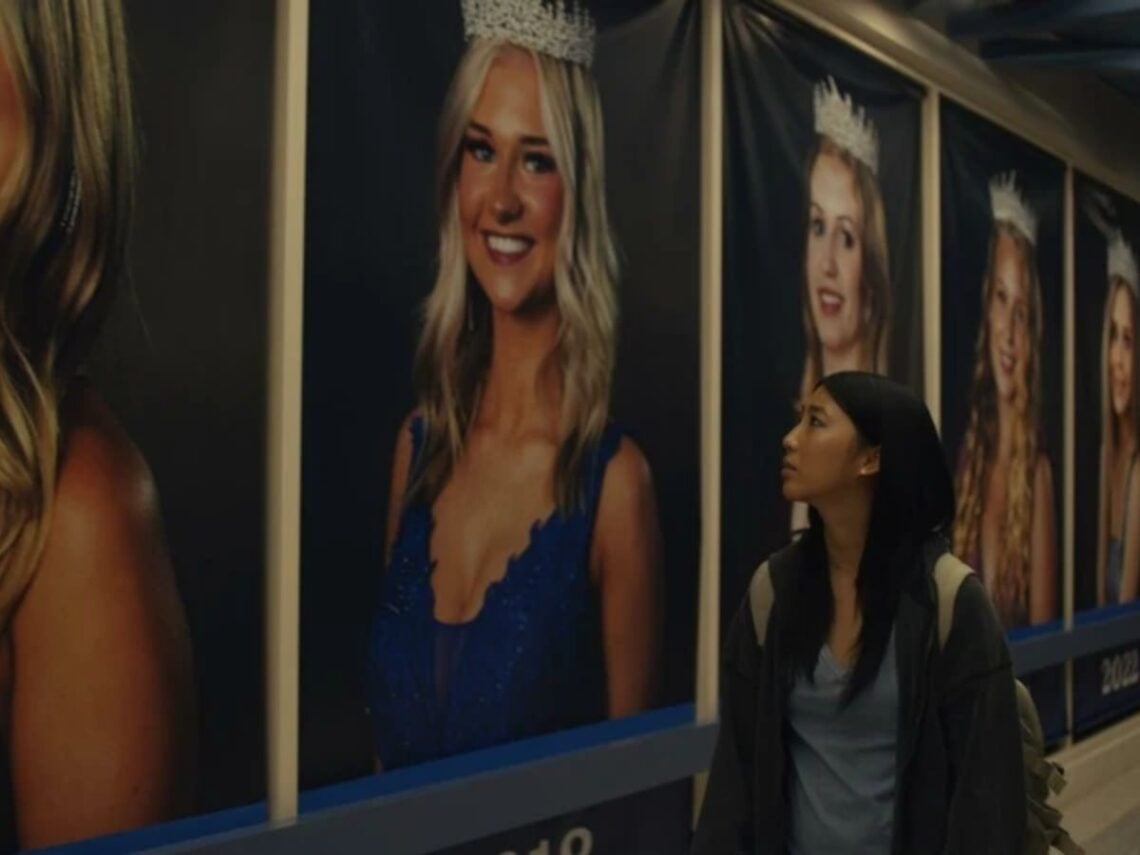
As a teenager, Joan’s bedroom wall is covered with posters featuring popular blonde actresses and singers, and her personal, hopeless fantasy is to become her school’s Prom Queen. Teenaged Joan (played by Shirley Chen) loves her parents but firmly rejects Chinese culture. She takes pains to cosmetically make herself look less Asian. Her discomfort with her own race and heritage is presented with a deft combination of sympathy, dismay, and dark humour.
Things take a strange, magical-reality turn when Joan discovers a private clinic which promises to alter their clients’ race through a mysterious discovery known only as The Procedure. The plot diverges into Joan’s dealings with the clinic, which, without giving away the details, leads to disturbing results on many levels and moves into the realm of body horror.
In the mixture of comedy and tragedy that follows, a newly Caucasian version of Joan is played by McKenna Grace, managing a near-perfect imitation of Joan Huang’s voice and mannerisms. Director Wang admits to drawing inspiration from several films that tackled racial issues, including Sorry to Bother You, but gives credit for the concept of a race-changing medical procedure to the satirical novel Black No More by George Schuyler; there is a direct reference to the novel hidden in the dialogue, as a minor tribute. Slanted, however, takes the idea in a very different direction.
Director Wang is Australian but chose to set the movie in the US; the American-style high school prom seemed to her ideal as a background for Joan’s story. She commented, “I feel like the prom king and queen really represent the All-American guy and girl; and when you think of an All-American girl, you think of the blonde-haired, white-skinned girl… It was just such a strong representation of what my main character wanted to be.”
It is Joan’s obsession with the idealised, white prom queen that drives the first act, mostly played as comedy, but with vague hints of Carrie coming through. The race-changing clinic and its clients are also portrayed as comical, but with distinctly sinister overtones. The script unfortunately loses focus and clarity during the less amusing and more gruesome final act, although not enough to spoil the overall production.
As the film progresses, the view expands to take in other characters whom the youthfully self-centred Joan had overlooked, and other aspects of the racial identity she had not given much consideration. She is reminded that people close to her – her parents, her one close friend from school – have also endured discrimination, and found their own ways of dealing with it. In a pivotal scene, Joan has a heartbreaking confrontation with her father, who regrets that in her altered form, he can no longer see Joan’s resemblance to her late grandmother. She faces the consequences of her decision, and other unexpected consequences as well.
“I love to make movies that talk about things that people don’t normally like to confront or face,” the director once commented; that preference is clear in both the funny and the painful moments of Slanted. It is a highly unconventional exploration of race, and an imaginary solution in the form of a modern Monkey’s Paw.
