


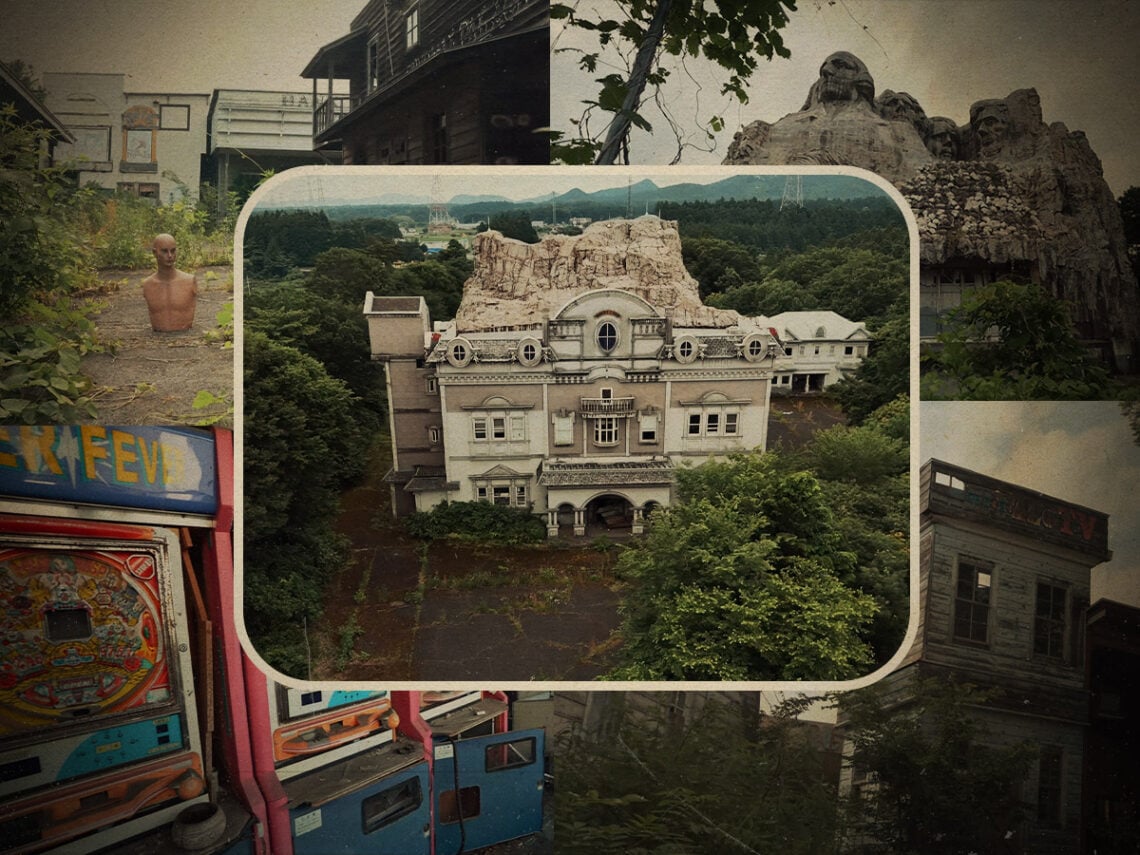
Westworld: America’s failed attempt to shape Japanese culture with a theme park

There was a period of time, not that long ago, in which American culture heavily influenced that of Japan.
Whether that’s the Japanese eating KFC at Christmas, adoring Levi’s jeans, areas such as America-Mura in Osaka that revel in American culture, or even their adoption of baseball as a national sport.
How things have changed. The best baseball player in the world is Japanese, with Shohei Ohtani starring for the LA Dodgers. Japanese cuisine has permeated across every state in the union, and teenagers are dripped out in streetwear and anime and manga have grown into the mainstream.
However, there’s one enduring legacy of Japan’s love affair with the United States, it’s Western Village, a now-abandoned Wild West theme park in the mountains of the Tochigi Prefecture.
Abandoned places in Western countries often end up in a state. Every surface is tagged, metals are stolen for scrap and needles and empty beer cans litter the floor. That’s not the case in Japan, with Western Village surviving in a shockingly good condition, despite closing its doors for the final time in December 2006.
Opening in 1973 in Nikko, it came to life as the very peak of Japan’s interest in Americana. The movies had made mega stars of John Wayne and Clint Eastwood, and the American West symbolised freedom and adventure to a country still picking up the pieces from the Second World War.

It started life as a ranch, gained popularity with tourists and eventually growing in a stylised version of the American frontier featuring saloons, cowboy shooting ranges, churches and a general store. Despite being high in the mountains of Japan, it looked and sounded like a small American town, even down to the sheriff’s office.
It didn’t stop at that; they had replicas of American landmarks, with a huge replica of Mount Rushmore being the most popular. It’s said that it is one third os the scale of the reason monument and was a huge hit. Most interestingly, even more so than the lifelike landmarks, was a full range of animatronics, with robots bringing this idealised America to life.
These mechanical human-like entities acted as cowboys and historical figures, which, alongside real human performers, made the town come alive. Wherever you walked in the town, you’d be surrounded by robots playing out scenes and interacting with the surroundings.
It’s this similarity with the plot of Westworld, the HBO adaptation of Michael Crichton’s 1973 movie, that has drawn a fascination since it closed nearly 20 years ago, with the parallels only growing after the closure of the park.
Western Village boomed as theme parks surged in popularity towards the end of the 20th century. With Tokyo’s Disneyland being the first Disney theme park outside of the USA, and the likes of Tomiuriland, Fuji-Q Highland and others being hugely popular.

The new millennium saw a change in tourist patterns, with theme parks evolving hugely and at breakneck speed. Newer parks offered a more sophisticated experience than Western Village, while the costs involved with maintaining expensive animatronics were high. As visitor numbers dropped, it started to become untenable to continue.
By the clock striking midnight on New Year’s Day 2007, the park was no mark. What was initially a temporary closure became permanent, and visitors never stepped foot again, not officially at least. It’s not unusual for amusement parks to close, but usually they get taken apart, and the land is turned into something else very quickly. That isn’t the case here, with Western Village slowly being reclaimed by nature.
With vandalism and crime rare in the mountains, it has left a truly unique landscape. This dystopian-looking ruined theme park soon started a second life, with photos of people’s visits gaining traction on urban exploration websites. These empty saloons, frozen in time, with robotic cowboys, look truly mesmerising and only encouraged further visitors.
What started as a family attraction and a symbol of Japan’s fascination with all things America has grown into an unsettling, eerie monument to a country that is now at ease with itself.
What started as a Japanese vision of the American dream is now a ghost town, but it’s one that’s arguably more famous worldwide than it was in its heyday. Perhaps it now symbolises the degradation of America’s cultural influence in Japan, as the country has begun to look inward.
