


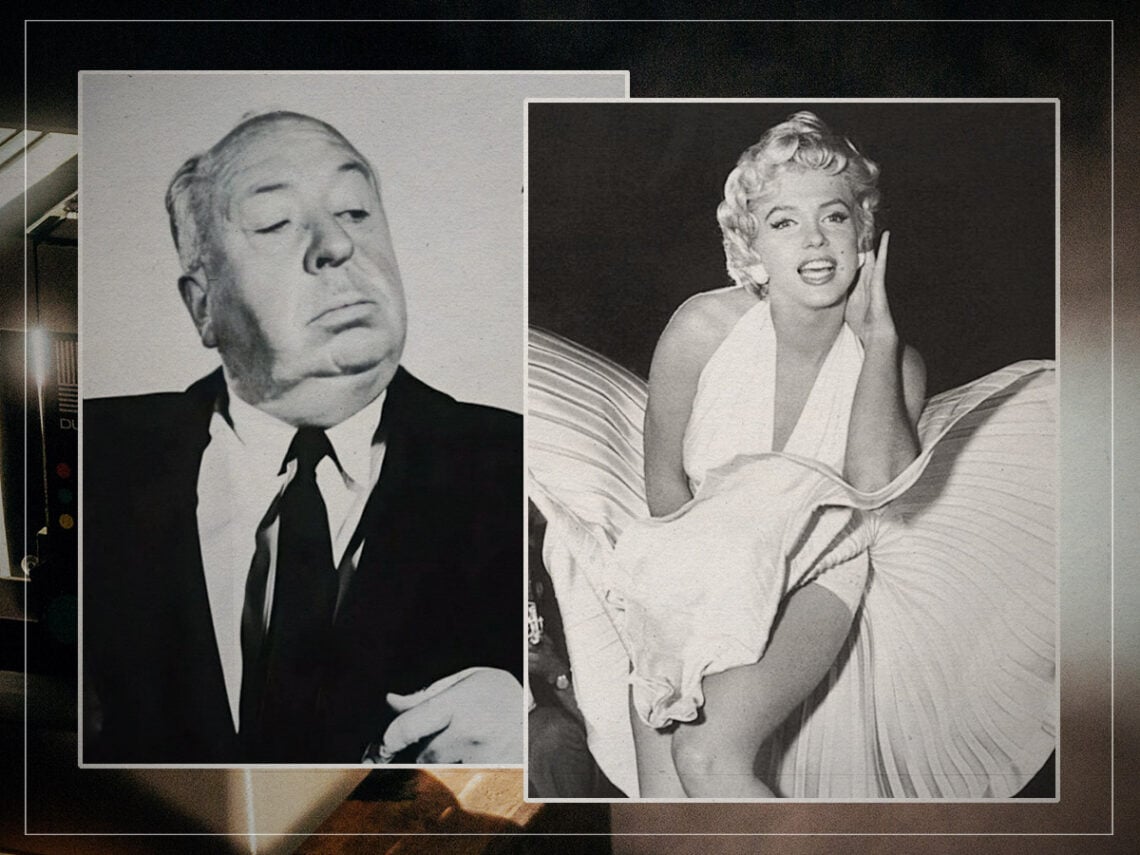
Why Alfred Hitchcock never wanted to work with Marilyn Monroe: “You get an extra dimension”

The most influential directors in cinema history all have a set of trademarks they incorporate into most of their work. Alfred Hitchcock had more than a few, but the one that was closest to his heart, for better or worse, was his well-known soft spot for casting a blonde bombshell in a major role.
It wasn’t something he favoured from his earliest days as a filmmaker, but once Madeleine Carroll had been cast as Pamela in 1935’s The 39 Steps, an archetype was born. The classic thriller was Hitchcock’s 21st film as a director, but from that point on, the ‘Master of Suspense’ became increasingly synonymous with hiring blonde-haired actors to inhabit a string of calculating, charismatic, and eye-catching roles.
Saboteur‘s Priscilla Lane, Vertigo‘s Kim Novak, North by Northwest‘s Eva Marie Saint, and Psycho‘s Janet Leigh were among those who followed in Carroll’s footsteps, only for the filmmaker’s overbearing and obsessive nature to rear its head to a troubling degree when he became so possessive of The Birds and Marnie star Tippi Hedren that he effectively strangled her flourishing career.
Even if it wasn’t for the fact she was the only ‘Hitchcock blonde’ to appear in three of his pictures, it became clear that Dial M for Murder, Rear Window, and To Catch a Thief‘s Grace Kelly was his favourite, mostly because Hitchcock said so himself. It was a trope that he relied on for seemingly no other reason than personal preference, which makes it strange that he drew the line at Marilyn Monroe.
After all, she wasn’t just the most famous blonde of her era but the most iconic in Hollywood: past, present, or future. They were active on opposite sides of the camera at the same time, so it wouldn’t be unreasonable to assume – given his proclivities – that Hitchcock would have watched Monroe’s success from afar with covetous eyes.
Then again, the notion of the industry’s most famous – or infamous – fan of blonde women collaborating with the most famous blonde on the planet, who also happened to be an A-list megastar, seemed a little too neat. That was Hitchcock’s explanation anyway, after he informed Speculation of his reasons for avoiding Monroe in a typically creepy fashion.
“No, because, you see, a Marilyn Monroe type would be so obvious to me that I, personally, would prefer the audience to discover the sex in a woman,” he said. “like in Grace Kelly, who is very beautiful but looks rather cool until she gets down the business of sex. You get an extra dimension by the revelation, you see.”
There were a thousand less unsettling ways for Hitchcock to get his point across, but he basically thought that because Monroe was already an object of desire for audiences, she wouldn’t serve his storytelling functions. Based on how he treated – and viewed – many of his female actors, it’s probably for the best that she wasn’t subjected to his lecherism.
