


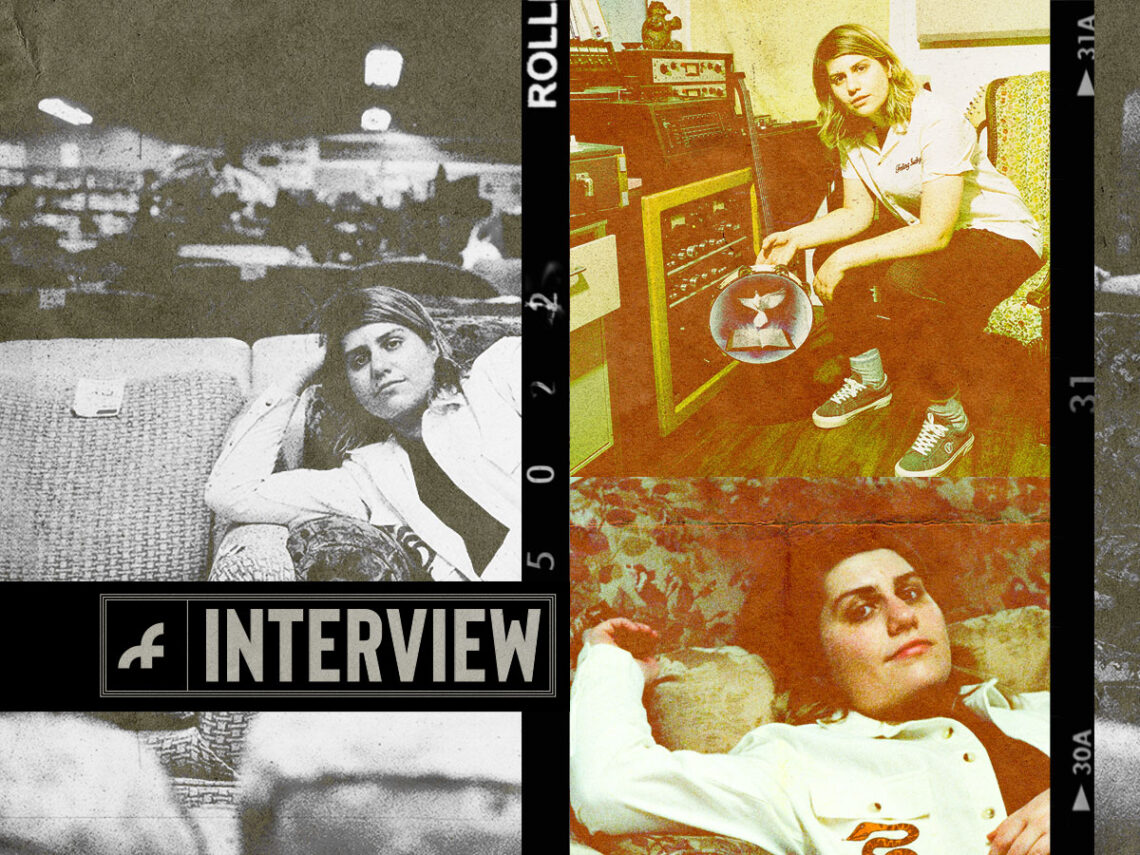
Alex Lahey talks the new album, queerness, and maturing as an artist

The lobby of an imposing modern highrise in St. Pancras Square was maybe not where I’d have initially expected to meet Alex Lahey, but what is life if not surprising?
She was in good spirits and immediately amiable despite just flying in from Los Angeles. Together with her PR, the ice of strangers meeting slowly thawed as this unlikely trio made our way from the ground floor to a sprawling, vacated office space higher up the contemporary monolith. We were to have the interview in one of the record label’s meeting rooms, but before we could commence, we needed a label rep to show us to our location. Offices have a tendency to provide a homogenous cascading of glass and concrete that not only offer laptop refuge but operate as an effective maze.
The wait for our handler became a surreal peak into the other side. Akin to a sequence cut from 28 Days Later, it was as if the workforce had suddenly evaporated in what looked like the middle of a working day. When we finally converged with the rep, she told us they work from home on Wednesdays. Now that mystery was cracked, we went into a brightly lit but comfortable corporate meeting room. Here, the walls were decked with stencils of large green vinyl composed of artists’ names, an interesting aesthetic choice.
Regardless of this unusual setting – as opposed to the usual of a bar or cafe – we were here to discuss Lahey’s latest album, The Answer Is Always Yes, which arrived this week. It’s the Australian’s most accomplished effort to date. The time afforded by the pandemic and the experience of having two albums under her belt facilitated the creation of ten tracks that display a clearer sonic picture of Alex Lahey than ever before. With sharp lyricism also present, both elements combine to pack a punch as she explores her life’s joyous and bluer moments in a way that never feels overcooked – a triumph in itself.
As the album opens with the unashamedly optimistic single ‘Good Time’, wherein Lahey sings, “I want a good time, not a long time / Let’s get the hell out,” I was keen to understand what is a good time to the Melbourne native, and what experience, if any, had inspired her to write a piece. “That’s a great question,” she replies with an amiable warmth that is hard not to be comforted by. “In the context of the tune, it was just about party, party, party. But to me right now, a good time would be a cup of coffee.” She laughs. Perhaps the jetlag was starting to take its toll. “As far as the tune goes, it’s about having a big party time.”
As the video for the single takes place in a bar, I wondered if a Melbourne-styled bonanza impacted the big party time she sought to capture in the song. It did, and so did a specific moment that brought an unfettered amount of happiness. Lahey reminded me that when Covid-19 was rampant, Melbourne was the most locked-down city in the world. What made things worse was that the lockdown was lifted at various times before the heartbroken populace was then forced back inside by another spike in infectious, teased by freedom and the chance to live a normal life again.
Accordingly, when the lockdown lifted for good, “people just wanted to go hard,” Lahey recalls. “It was simultaneously a form of mass celebration and release. It was this one weekend and the few days around it, when the city felt like we were really out of the trenches, and people just wanted to get, like, pretty lit.”
The crack of inspiration struck when Lahey had gone to the pub with her friend in a “bougie” part of town. There, a group of chino-wearing, puffer-jacketed males were taking turns going into the bathroom. It was clear what was going on. Although her friend was put out by their behaviour, Lahey was amused by the scene, and the memory of the “energy at the time in this particular place” majorly impacted ‘Good Time’. It’s remarkable how she captured such an exciting time so precisely.
The new album is a wide-reaching body of work, both musically and thematically, something not so easy to pull off when a part of a band full of differing creative forces. Lahey’s been in groups before that have all been “very, very collaborative, true bands,” yet when you try to please everyone, she notes, it naturally bottlenecks proceedings. So, “yes, in theory,” Lahey’s experience as a solo artist has removed barriers there might have been if she’d been in a group.
Accordingly, only one of her band members played on The Answer Is Always Yes. Aided by the ease with which you can now record music on your own and due to the other collaborators, such as the eminent Jacknife Lee, Lahey handles the album largely on her own. Between herself and these new creative aides, they could play all the instruments themselves, meaning that no other outside help to convey the message of the LP was necessary.
Lahey explained that she wanted to work with collaborators such as Lee – who has produced for the likes of R.E.M. and Bloc Party – on the new album as a way to shake up her norm. As a creator, she’d already completed two LPs as a distinctly solo artist, meaning she knew exactly what sort of album she’d produce if she followed this same route for a third time. Other factors influenced her decision to branch out, with the isolation of living at her parent’s house during the lockdown a defining one. It wasn’t all negative, though, and after a dawning realisation, Lahey used the opportunity to develop as a person and artist.
“Every part of my life at that point was so isolated,” she says, “but there was also this opportunity because people were at home as well, and everyone was available all of a sudden. I was like, ‘It feels like the right time, and I can make these unfortunate circumstances work in my favour, given I’m trying to write a record right now.’ So, a few opportunities came out of that, and creatively, I wasn’t really excited by what I was doing by myself anyway.”
Maybe the material she was working on then was the best she’s ever done, Lahey comically ponders before asserting that it certainly didn’t feel that way at the time. Understanding that a record stays with you after release, she reflects: “I just didn’t really want to be pursuing that and living with the songs that would have come out of that process for the next two years or whatever, you know?”
As this was such a significant decision for Lahey, and with it feeling like she’s entered a new chapter on The Answer Is Always Yes, it seemed that the pandemic had changed her definitively. After all, many artists have said that the period had an indelible impact on their operation, whether leading to refinement or signalling the end. “I think so,” she concedes before positing that as a young person, “time changes you more rapidly,” in one of the more profound junctures of the conversation.
“Also, maybe I’m a workaholic, I don’t know, but I love to work,” Lahey continues, steering us away from a gloomy philosophical morass. “And I tried to use the time to do things to help develop myself and make myself more useful, like learning to engineer properly in the studio and doing a bit of study, stuff like that. Just things I could do with the time that plausibly and, hopefully, we’ll never have again. It was a case of ‘how can I take full advantage of this right now and do the things that when I’m sitting in the back of the van’, I’m like, ‘Oh my god, if only I had a bit of time, I’d do this.'”
I suggested that the lockdown might have been a golden period we didn’t realise then. Lahey agrees, “Time is arguably one of the greatest luxuries, and I think that’s what that era gave us all.” A lack of control over the outer world allowed many artists to focus on their inner world, for Lahey it was “a good practice in understanding that you can’t control everything, you know? There are things that are out of your control,” she says before elucidating, “I think that’s effectively what the record is about. Life is more or less out of your control, but the thing you do have control over is throwing yourself into it.”
The song ‘Congratulations’ was used as an example, inspired by two ex-partners of Lahey’s getting married in quick succession. The track is dripping in sardonic wit and unrivalled sarcasm, and she likes that about it. There’s also an essential lesson demonstrating the new album’s scope in a stark departure from the lighter tale of the bougie cokeheads. After a relationship, people will continue living their lives no matter how involved you once were. You have to let go and accept it. “I think ‘Congratulations’ is a sign of acceptance,” she adds.
Is The Answer Is Always Yes a result of Lahey maturing as an artist? “I think so,” she affirms before offering that she was staring down the barrel of another familiar album but decided to take “risks” to avert that outcome. You can’t argue with that.
The guitar playing needed attention, another area that stands out on the new opus. Whether it be the upbeat indie of ‘Good Time,’ the atmospheric post-punk of ‘They Wouldn’t Let Me In,’ or the post-rock dalliances of ‘The Sky Is Melting,’ she covers a lot of ground in the ten tracks. Even on the first listen, you get the sense that she’s pushed herself to the next level by taking risks on the instrument. Further listens provide lessons in pop poetry, powerful vocal potency and delivering a reflective creation.
Unsurprisingly, she had pushed herself with her guitar playing. Approaching things differently than before, she experimented with new tunings and used different songwriting techniques, such as conceiving ‘They Wouldn’t Let Me In’ without a scale, in an explicit attempt to make an angular piece of post-punk. She tells me she’s self-taught and feels attached to the instrument because of this journey. This close familiarity means that now when she has a concept for a song in mind, she can seek the answer out without too much confusion. The final guise of the aforementioned track “was no accident,” she clarifies.
One vital aspect of The Answer Is Always Yes is Lahey’s forensic analysis of her experience with queerness. I was keen to understand if Lahey felt she did this in a more precise way than on her previous outings. While all her records default as queer records because they discuss her past relationships, the new one is different. “I feel like with this one, I actually address it as part of my identity. I was very aware of my queerness as a child and grew up as an out-gay kid, which is a certain type of experience. Not everyone has this; many queer people don’t have that experience. That is just as I haven’t had the experience of other people who come to realise their queerness later in life and have to evaluate their identities.”
Lahey cast her mind back to a UK tour she did with the band Lazy Day. At the time of this run, Lazy Day’s leader, Tilly Scantlebury, was doing a PhD in queer representation in art. At one point, they were on the bus together and were talking about Scantlebury’s thesis. During the conversation, Lahey mentioned that she grew up openly gay, which the Lazy Day vocalist was fascinated by. According to her research, it is not something many have done in such an accepted and open way as Lahey had experienced. Until that moment, this reality was something Lahey had never really considered, which led to her reflecting on “how lucky I was in so many ways.”
It wasn’t such a straightforward period, though. This conversation also made Lahey think about the “inherent difficulties that came with that era, and there not being a whole lot of understanding or representation, especially among teenage kids. So yeah, shout out to Tilly for getting me to think about the big questions.”
Upon listening and reading about the queerness that influenced the album before the interview, the song ‘They Wouldn’t Let Me In’ had been registered in the press material as a moment where Lahey delves into the matter more deeply. After listening to it several times, the line “they left me outside” stood out. Was this referring to something that literally happened to her? “Yeah, there have been moments where I haven’t been able to get into spaces because of that,” she says in a shocking reminder of the barriers the LGBTQ+ community have faced and continues to face.
Things seem to be improving, though. Whilst some people haven’t changed, Lahey believes there’s been a form of identity revolution over the past few years, encompassing gender identity, sexuality and other areas. “People have, are aware of, and have access to and acceptance of a lot of language that helps themselves and the broader community identify and get what they need. This allows them to get the support they need and to have the relationships they want. I don’t think that was the case when I was growing up, and I think it’s awesome it exists now.”
If you were wondering about influences on the new album, Lahey named a variety of acts, another indicator of why it is so wide-reaching. Paramore, Sheryl Crow, Mac Demarco, and even the drum sounds of a King Gizzard and the Lizard Wizard album – of which she forgot the name, but with close to 500 records released this year, who can really blame her? – were some of the flavours that made their way into it.
Believe it or not, ‘The Sky Is Melting’ was the piece directly influenced by those particular King Gizzard drums. She had discovered from a podcast that they tracked a kick drum down the centre of the song, recorded identical drums without a kick on reel-to-reel and then hard-panned them. Although she didn’t have a reel-to-reel, she did have a cassette recorder. So, she did the same thing with her Tascam to emulate the sound as best as possible. That is why the drums on the song sound so ’90s. “Easy,” she says, contently relaxing back into her chair.
She then humorously recalled a festival that she played at – possibly Bonnaroo 2018 – and as luck would have it, both Paramore and Sheryl Crowe were on the lineup and hanging out backstage. Despite usually being unafraid to speak to anyone, something deep down stopped her from going over and introducing herself to the former, even though her band encouraged her to do so. Naturally, she now regrets the inaction. “I think my band maybe spoke to some of the Paramore band at some point,” she says, “but yeah, I regret that. So Sheryl and Haley (Williams), say hi if I’m around, because I won’t.” We both burst into laughter.
Alex Lahey has come into her own with The Answer Is Always Yes, both personally and as an artist, and after listening to the album, you get the sense that the future will be fruitful.
