


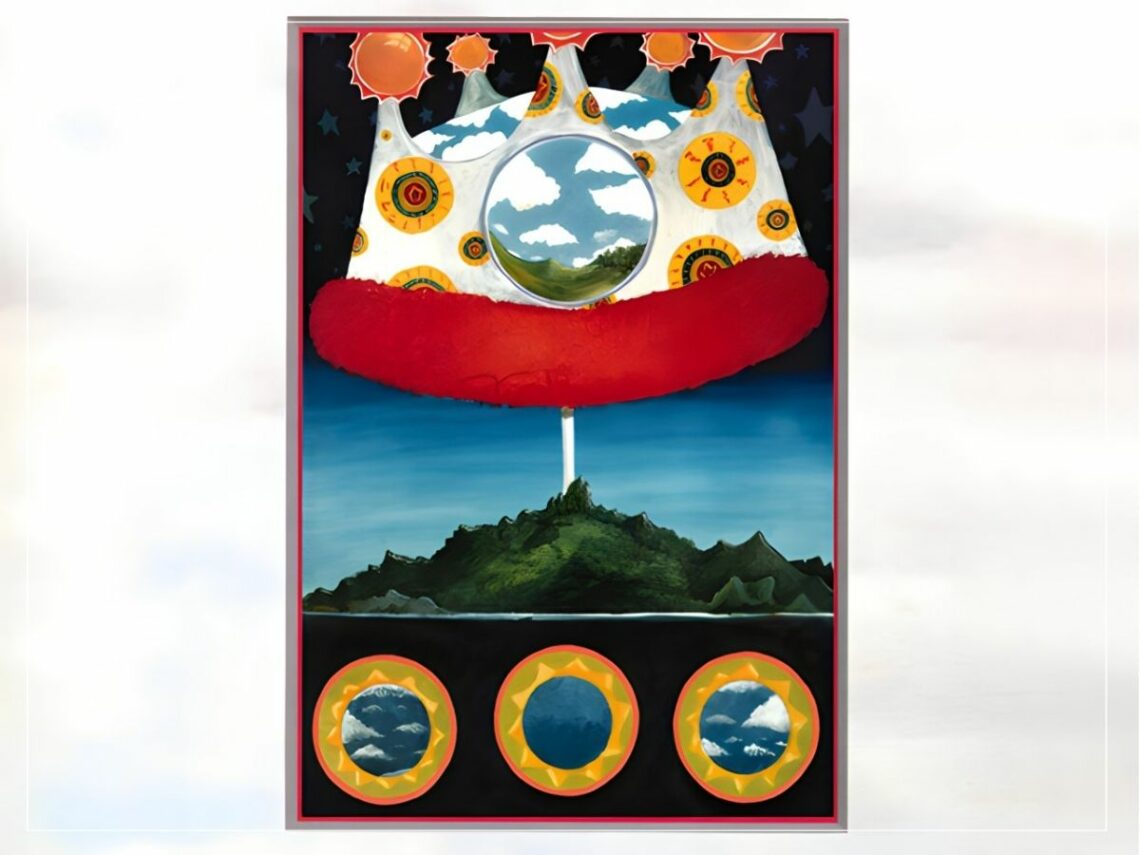
‘Dusk at Cubist Castle’: The album that aims to alter your consciousness

There are many great records of two halves: The Beatles’ Abbey Road, David Bowie’s Low, and Kate Bush’s Hounds of Love offer the most obvious examples. In many ways, it’s the beauty of the traditional A and B side format that forces us to digest what we’ve heard before moving on. There is, of course, a danger to this also; while two sides of an album can differ yet coexist within the same universe, too much and a record renders itself disjointed and lost amidst an expansive effort to challenge the listener. This danger becomes particularly prescient when the tracklisting runs up to 27 songs in length.
Music from the Unrealized Film Script: Dusk at Cubist Castle was the debut album by the American band Olivia Tremor Control, a 27-song epic that takes you on a magical tour of pastiche, innovation and sonic texture. Along the way, there are nods to Brian Wilson’s style of composition and Paul McCartney’s delicate touch of the pop psychedelic before the B-side takes a sharper, more expansive turn.
The Olivia Tremor Control formed during the early 1990s in Athens, Georgia, and through a common love for psychedelic pop, namely Pet Sounds and Sgt. Pepper’s Lonely Hearts Club Band members Bill Doss, Will Cullen Hart, Eric Harris, and John Fernandes quickly began experimenting with sounds of that genre. For what must have been a spiritual home for the band, they found themselves in Pet Sounds Studios to record their debut album.
The sonic intent between the members seems immediately synergetic within the opening tracks of the album. Nights spent bathing in the colour of 1960s psychedelic pop classics like ‘Lucy In The Sky With Diamonds’ and ‘I’m Waiting For The Day’ can be easily pictured as the band pulses through the opening tracks.
Opening track ‘The Opera House’ wobbles a bass line in front of you, transfixing your attention as the melodic layers of the vocals and guitar lines dance freely. It’s a celebration of sonic freedom and euphoria that merely doffs its cap to its influential forefathers before turning its back on them and finding a path of its own.
As that A-side continues with standout tracks like ‘Jumping Fences’ and ‘Define A Transparent Dream’ it almost feels as though the band are building a bridge upon which The Beach Boys and The Beatles can shake hands with Tame Impala, Pond or Ty Segall; two eras unified by the sprawling experimentation of sounds old and new. But in an almost Willy Wonka-like turn, the bridge tests the open-mindedness of the listener dramatically with a B-side that delves into ambience and tape experimentation.
The B side has ten tracks titled ‘Green Typewriters’, the fifth of which stands out, particularly in terms of boundary-pushing. With an almost static-like underbelly decorated with a droning pulse, it feels a far cry from the A-side’s sunnier disposition. But the patience of listeners who have gotten that far is rewarded with the title track, which, amidst similar ambient experimentation, offers one of the record’s catchiest choruses.
Cinematic, sparse and catchy all at the same time, there’s no arguing this album sits uniquely among its psychedelic peers – which takes some achieving. Despite his freedom as an artist, there’s no denying Paul McCartney’s fame left him victim to a commercial responsibility that, if he hadn’t been present, may have resulted in an album similar to this. Dusk at Cubist Castle is dense but necessary listening for music fans eager to track the lineage of music influence through the psychedelic and indie eras.
