


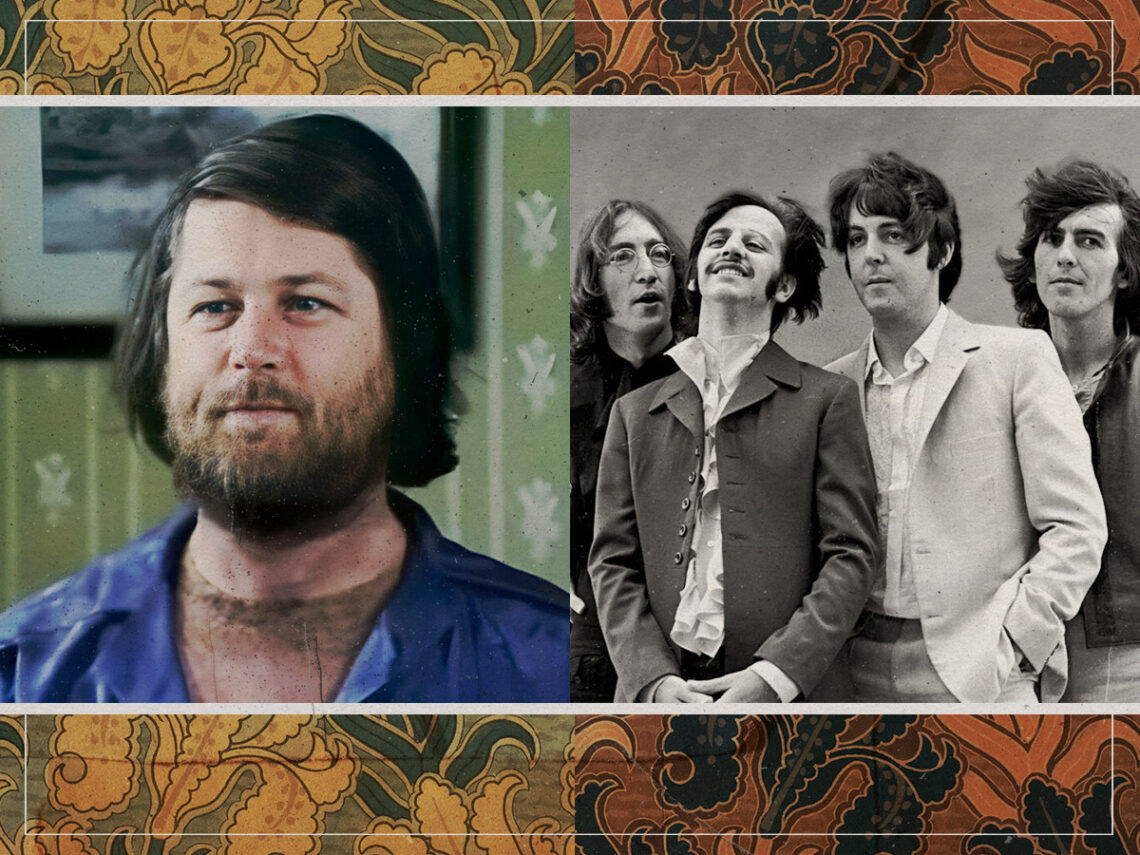
Brian Wilson’s favourite song by The Beatles: “The lyrics are so good and so creative”

Cheese and crackers, Sunday’s frozen pitch and a thermos flask, 2am texts and mornings of regret, none of them pair quite as synonymously as The Beatles and The Beach Boys. They were two of the most defining bands of the 1960s, who both shared the uncanny knack of straddling genres and pushing forth into pastures anew, not to mention the harmonies.
Despite being from different sides of the Atlantic, the two groups were musically related and inspired one another to hit great heights. Unlike The Beatles and The Rolling Stones, who regularly bad-mouthed each other during this era, the Fab Four had nothing but positive remarks to say about their Californian contemporaries.
As the bands developed alongside each other, their styles and influence would entwine. Furthermore, Paul McCartney once said that Brian Wilson and James Jamerson were his two favourite bass players, stating, “Actually, he and Brian Wilson were my two biggest influences.”
Elaborating on his reasoning for selecting both individuals, McCartney revealed the attributes he admired most greatly in the two musicians, adding, “James just because he was so good and melodic. Brian because he went to very unusual places. Brian would use, if you were playing in C, he might stay on the G a lot just to hold it all back, and I started to realise the power you had within the band.”
As ever, the relationship was a two-way street, and Brian Wilson’s favourite Beatles track would go on to heavily influence The Beach Boys’ sound that followed. While much has been made of how the Fab Four were influenced by Wilson’s magnificence, he was equally enamoured by their boundary-pushing sound.
When discussing Rubber Soul, the record that marked a coming of age for The Beatles following their famed meeting with Bob Dylan, where McCartney discovered “the meaning of life”, Wilson recalled first hearing it: “It must have been in November of 1965. I was living in this house in the Hollywood Hills then, way up on Laurel Way, and I remember sitting in the living room one night talking with some friends when another friend came in with a copy of the Beatles’ new one, Rubber Soul, I don’t know if it had even come out yet. But he had it and so we put it on the record player and, wow. As soon as I started hearing it I loved it. I mean, LOVED it!”

Wilson then championed ‘Michelle’ as a classic, but there is one song that stands out from the crowd for the singer-songwriter. “‘Norwegian Wood’ is my favourite,” Wilson told TLS. “The lyrics are so good and so creative, right from the first line: ‘I once had a girl/ Or should I say, she once had me.’ It’s so mysterious. Is he into her, or she into him? It just blew my mind. And in the end, when he wakes up and she’s gone, so he lights a fire. ‘Isn’t it good? Norwegian wood.’ Is he setting her house on fire? I didn’t know. I still don’t know. I thought that was fantastic.”
The Beach Boys founder then went on to eulogise about instrumentation on the record, which achieved the Promethean feat of mixing world music with the world of rock ‘n’ roll. “I can’t forget the sitar too, I’d never heard that before, that unbelievable sound. No one had heard that in rock and roll back then, this amazing, exotic sound. It really inspired the instrumentation I ended up using for Pet Sounds,” he remarked.
The sitar in question was initially an instrument confined to the realm of Hindustani music. Then—inspired to wander the world aimlessly in search of nothing in particular by beat literature—beatniks, hippies and the occasional recently divorced Geography teacher waved a middle finger to the suburbs and clambered aboard a spiritual bandwagon weaving a path to the answer-chocked lands of the past in Nepal and India. This was the start of the sitar’s rise.
However, it wasn’t until 1965 that it crash-landed from the celestial realm of shrouded history to make its seismic mark amid the fuzz-pedalled kaleidoscope of sixties musicians with severe incense addictions.
In April 1965, the tale goes that The Beatles were filming Help!, and an Indian band played background music in a groovy restaurant scene that set George Harrison agog. In casual conversation with Roger McGuinn of the Byrds, Harrison would mention this mind-bending moment, and McGuinn would fatefully slip the ‘Quiet Beatle’ a copy of Ravi Shankar. The rest, as they say, is ancient history, as the ’60s instantly got groovier thanks to this historic meeting of minds.
For Wilson, the enduring appeal of ‘Norwegian Wood’ relates to two key factors. Firstly, the lyrics were unusual and prompted him to think about their meaning, which he was free to interpret in whatever way possible. This showed Wilson a vital lesson in using songwriting as a storytelling tool in a manner that he’d never experienced before. Furthermore, the other major attraction of ‘Norwegian Wood’ was the use of the sitar, which was a simple yet pioneering and hugely effective addition to The Beatles. While it would become more prominent in the pop sphere, the Fab Four were the first in their world to integrate the instrumentation, and Wilson wasn’t the only one to be blown away by its use.

Never Miss A Beat
The Far Out Beatles Newsletter
All the latest stories about The Beatles from the independent voice of culture.
Straight to your inbox.