


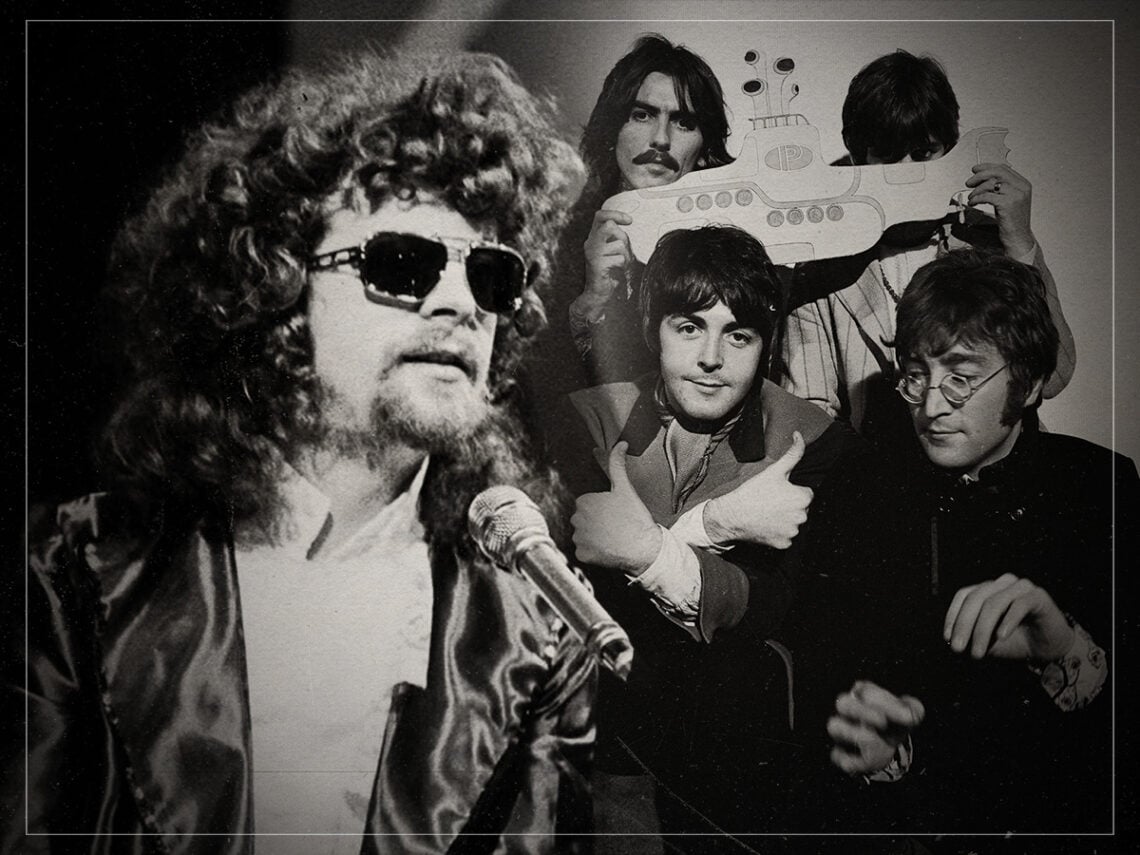
The album that made Jeff Lynne feel inferior to The Beatles

Given how Jeff Lynne and George Harrison ended up being close friends and collaborators, it shouldn’t come as a surprise to learn that the former was a massive acolyte of The Beatles in the days before he found success with Electric Light Orchestra.
Granted, there’s always been plenty of Beatles influence audible in his primary band’s work, and he used this inspiration to create his own interpretation of what pure pop perfection could be. Of course, with ELO having been most active in the 1970s and ‘80s, technologies had moved on significantly from when The Beatles were active, and there was more opportunity for Lynne to push boundaries in production, but even so, the similarities that he shared with his idols from other perspectives were inescapable.
Since Lynne was always interested in how he could push production forward, he would have initially looked towards their producer, George Martin, and some of the techniques he used to elevate the compositions of the band to the next level. However, given how each member of the band established themselves individually after the turn of the 1970s, all of them ended up developing new sounds with different producers, which equally piqued an interest in Lynne.
When Lynne came to recording his solo debut, 1990’s Armchair Theatre, he felt he became unstuck obsessing over certain aspects of the production, and because he had so much at his disposal despite literally writing and recording it from the comfort of his armchair, he was bogged down by the endless possibilities.
In order to get himself out of this creative funk, he recalled his time working with Harrison on his 1986 album, Cloud Nine, and tried to recreate the exact same setup that the former Beatle had assembled for himself in his home studio, but not even he was able to figure out how to overcome this.
Something still didn’t feel right about the sounds he was creating in his own studio, despite having all of the gear he wanted to work with. “I put in a desk, a Raindirk, which is not a famous one, but the guy who builds them makes them all by hand,” he said in a 1991 interview with EQ Magazine, trying to justify his lavish setup. “It’s really warm on the bass end. A lot of desks, I think, are just too hard.”
However, he continued to talk about some of the other gadgets he’d installed in his home studio, and how they weren’t able to serve him as he wished. “For recording, I always use an Otari 24-track,” he continued, “which is very robust and it seems to always work for me. It doesn’t go bang in the night. I got to a point where I was sick of linking up two machines. The one sound I got to hate more than any other was that ‘rrrhhmm, woooooow’ as the two 24-tracks got into sync. And I decided, ‘If I can’t get it all on 24 tracks, when The Beatles used to get it on four…’”
Of course, by the 1990s, the technology had advanced so much that using a four-track recording system felt outdated, and the more tracks there were available, the more producers could do with their sound. Lynne himself was certainly guilty of having helped this become the norm in pop production, given how he had a tendency to overlay several different tracks of the same instrument to create a bigger sound, but still, he felt as though his Beatles obsession had made him resent the fact that he was always searching for a way to make things sound massive.
Lynne eventually used the experience of making this record as a reason to downsize and rethink the way he approached working in the studio. “Now I’m thinking, ‘Simplicity is the best thing after all,’” he concluded. “The fewer gadgets and boxes and shit in the way, the better. To tell the truth, I like a microphone and a tape recorder best of all.”

Never Miss A Beat
The Far Out Beatles Newsletter
All the latest stories about The Beatles from the independent voice of culture.
Straight to your inbox.