


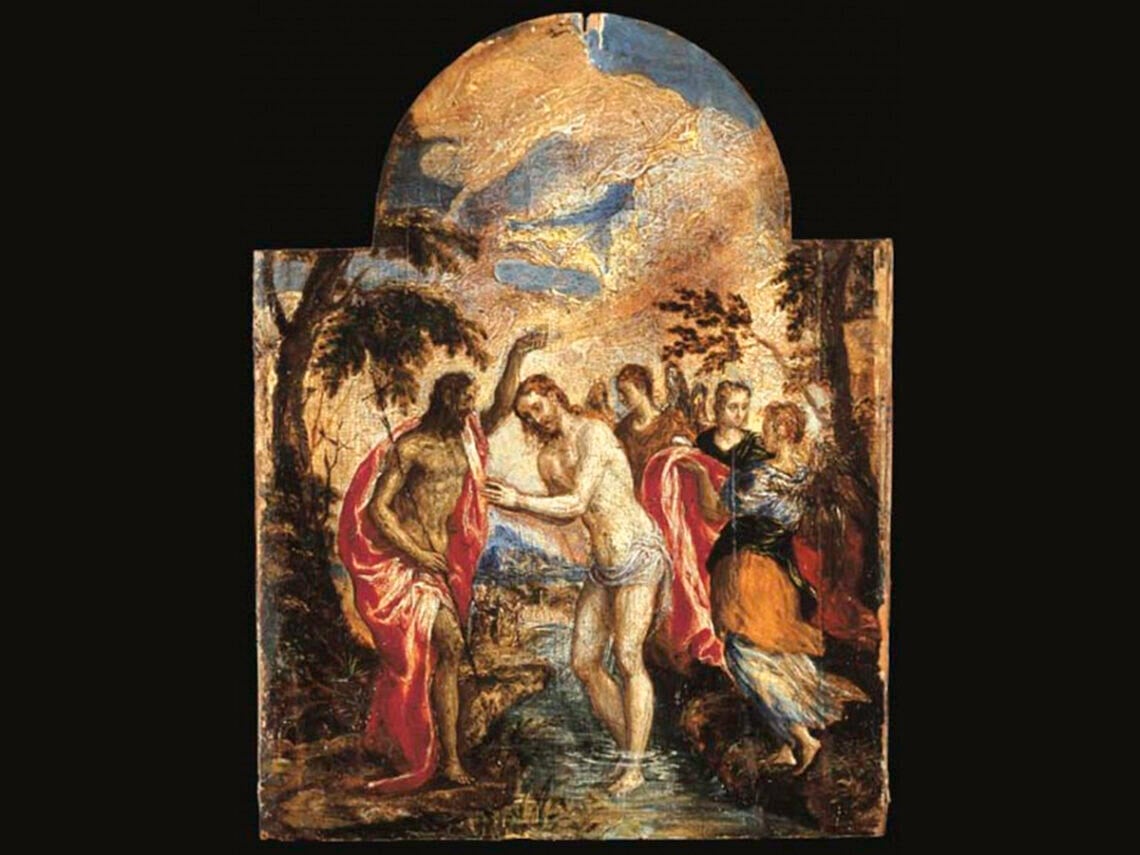
AI may have solved a key mystery behind seminal El Greco painting

El Greco’s famous painting, The Baptism of Christ, has long mystified art historians, who had a hard time placing the exact authorship of the work; now, a new AI tool seems to have unlocked the final answer.
The 1608 to 1614 painting was made toward the end of the artist’s life, painted for one of the three altarpieces commissioned for the church of the Hospital de Tavera.
It was the largest commission ever undertaken by the artist, and was thought to be left largely unfinished at the time of his death.
Therefore, consensus in the art world suggested that it had been completed posthumously in his workshop by many hands under the guidance of his son, Jorge Manuel Theotokópoulos.
However, a new AI tool made jointly by specialists from the US and Spain, which detects granular specificities over brushtroke patterning, has suggested that El Greco alone should get the credit for the work.
The AI system used the machine-learning model known as Patch, which begins by scanning the surface of a painting using high-resolution 3D imaging. This captures the peaks and hollows left behind by a painter’s brush, which are mapped segment-by-segment in search of irregularities in handiwork.
The researchers ran The Baptism of Christ and another Greco painting, Christ on the Cross, through the model. It, rightly, attributed Christ on the Cross to the artist alone, and attributed many parts of The Baptism of Christ, thought to have been shared among other artists, to the sole master.
Lead author of the study, Andrew Van Horn, explained to Artnet, “We still have work to do to get it to the point where it can conclusively identify the elements of what we’re calling artistic practice regimes.”
He added hopefully, “Once we get there, we could figure out what causes the interconnections in The Baptism. We may even be able to, for example, track an artist through their apprenticeship(s) to their own workshop.”
