


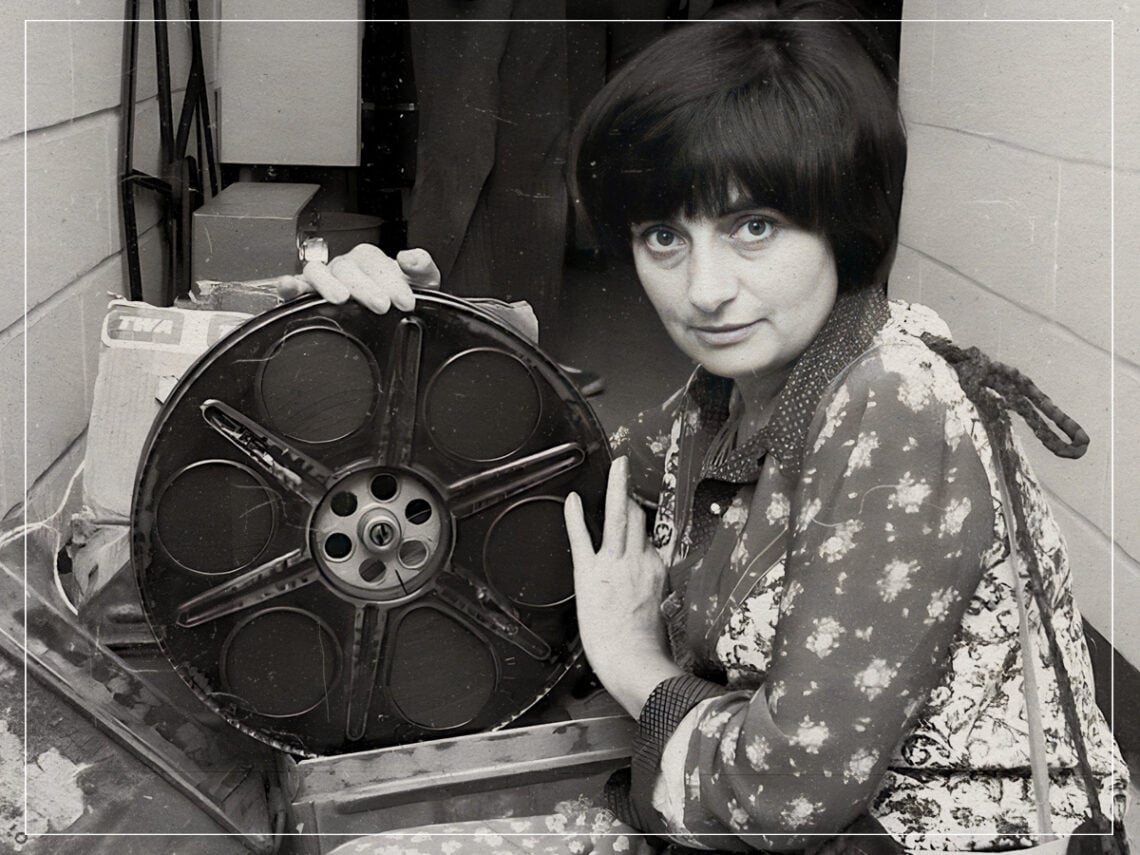
How Agnès Varda’s career as a photographer shaped her filmmaking style

It is hard to believe that Agnès Varda, one of the most revered filmmakers of all time, had little cinematic knowledge before she made her first film, La Pointe Courte. Predating the movies often credited as the first entries to the French New Wave, such as Claude Chabrol’s Le Beau Serge and François Truffaut’s The 400 Blows, Varda’s 1955 film was incredibly innovative.
She wouldn’t begin to attract widespread attention until the release of Cleo from 5 to 7 in 1962, a feminist film about a woman’s journey of self-discovery which subverted the male gaze and stereotypical notions of femininity. It didn’t take long for Varda to become one of France’s most acclaimed directors, always pushing the boundaries of the medium and creating films that tackled womanhood unlike anyone else.
Over the years, Varda discussed her approach to filmmaking, citing her lack of previous cinematic awareness and her background in photography as key to shaping her style. Paired with a love for paintings, such as those by Edgar Degas, Varda chose to shoot scenes with an emphasis on composition and lighting, with many stills from her movies appearing as though they could be photographs.
Varda once explained, via Agnes Varda between Film, Photography, and Art, “I took photographs of everything I wanted to film, photographs that are almost models for the shots. And I started making films with the sole experience of photography, that’s to say, where to place the camera, at what distance, with which lens and what lights?” In many ways, La Pointe Courte was an extension of Varda’s photographic career, challenging her to use a new medium to expand her creative practice.
While Varda wasn’t the cinematographer for her film, she directed the camera so that her characters were framed distinctively, giving her movie a strong visual identity defined by carefully composed close-ups of the two main actors and street-photography-like shots of the villagers. From then on, Varda always ensured that her movies were visually impressive, sometimes even centring the practice of photography in her films, such as One Sings, The Other Doesn’t and Ulysse.
In the latter, Varda deconstructs a photograph that she took in 1954, almost 30 years before, allowing us to sit with the image for an extended period to consider its potential meaning. She once told Film Comment, “I learned a lot about how people can look at an image and load it with different feelings—the same image.” It’s this notion that propels much of Varda’s work. How can we freeze meaning into one image without words?
The filmmaker approached her work in the same vein as a photographer, working with compositions which could be interpreted in a variety of ways in order to probe the audience into thinking about what they are consuming. Varda didn’t just frame her subjects artistically so that her films looked nice – she forces us to treat her films the same way we would a photograph, drawing attention to their very form with an almost-meta quality. We are made to acknowledge that we are watching something constructed, with Varda addressing us directly and asking us to pay attention.
