


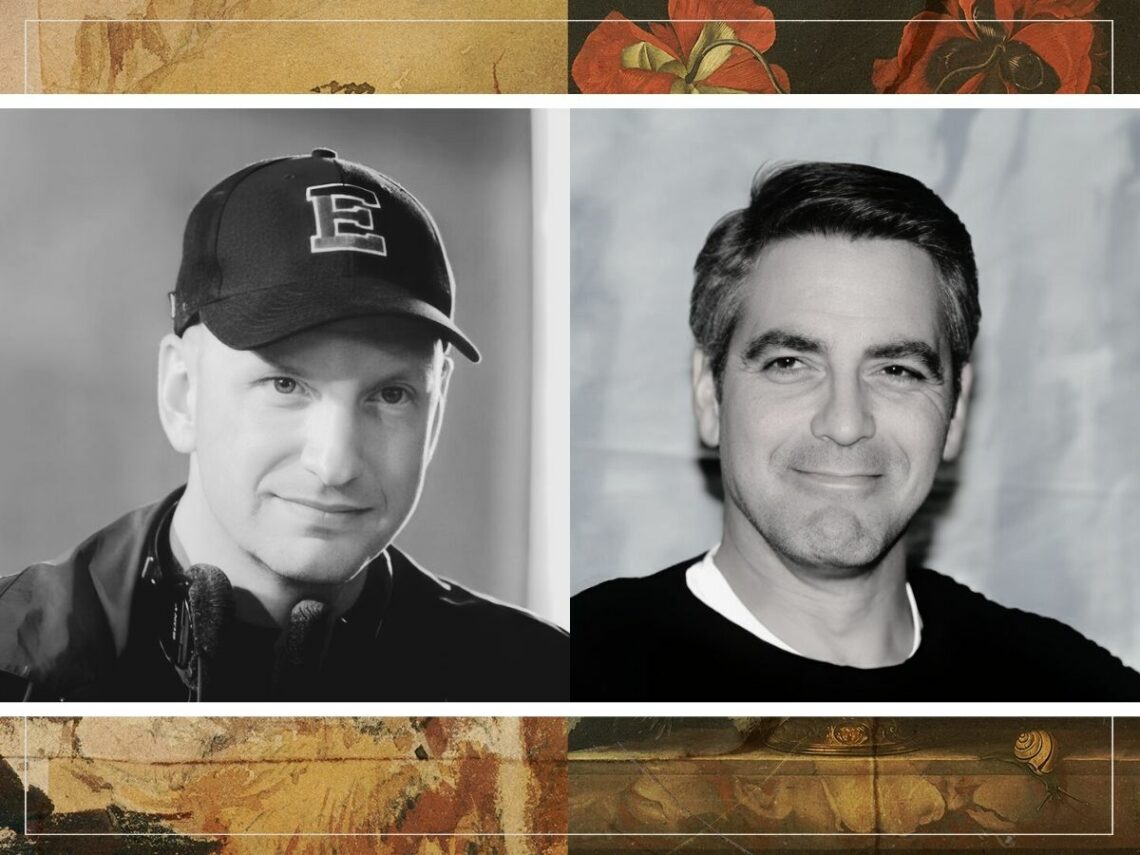
The crucial star-making advice Steven Soderbergh gave to George Clooney

In the early 1990s, George Clooney broke through to nationwide acclaim after landing the recurring role of Dr Doug Ross in the hit NBC medical drama ER. He followed his nose into the movie industry in 1996 with a crucial appearance in Robert Rodriguez’s 1996 action horror From Dusk Till Dawn, in which he starred alongside filmmaker Quentin Tarantino. Gradually, his career gained momentum as he was scouted by Steven Soderbergh, David O. Russell, and the Coen brothers for a run of highly acclaimed and high-grossing movies.
By the time Clooney hit the screen in Soderbergh’s popular 2001 reboot of Ocean’s Eleven, he was a bonafide Hollywood heavyweight alongside his co-stars Brad Pitt, Matt Damon, and Julia Roberts. The classic heist movie saw Clooney consolidate his status as a silver fox and classy leading man with a nuance of newfound on-screen maturity. Pivotally, Ocean’s Eleven was a critical and commercial success, grossing $450million at the box office and securing a fruitful ensuing decade for all stars involved.
Since 2001, Clooney has enjoyed hugely successful roles in Alfonso Cuarón’s Gravity, Wes Anderson’s Fantastic Mr. Fox, Alexander Payne’s The Descendants and his biggest directional success, Good Night and Good Luck. Although these huge milestones followed decades of training and perseverance, Clooney ascribes much of his latter career success to Soderbergh.
Not only did the American filmmaker and producer give Clooney a major break with a role in Ocean’s Eleven, but he inspired him to broaden his horizons as a director and, through friendship, offered some invaluable advice. The pair first worked together in Soderbergh’s 1998 movie Out of Sight, which saw Clooney transform from the cheeky ER doctor into the edgy anti-hero.
Speaking to Amy Taubin in 2012, Soderbergh discussed Clooney’s development as an actor between the mid-1990s and early 2000s. Acknowledging the director’s massive role in this transition, Taubin asked Soderbergh how he had such a dramatic effect on his stars. “I try in every way that I can without being overt to give them confidence and make them feel secure,” he said.
Adding: “I remember one of the first things we shot on Out of Sight with George. I told him that I wanted him to be stock still. I said, ‘We have great material, we have a great cast, you don’t have to do anything to own this scene.'”
As Soderbergh suggested, the most important quality in acting, especially in the brutal battlefield that is Hollywood, is self-confidence. “That was the only conversation we had like that. He got it,” Soderbergh said before noting that he wanted Clooney to find the character within his own personality instead of contriving his mannerisms to fit a vision of the character.
The filmmaker’s idea was that if his actors feel like they are more or less portraying themselves, they are more likely to be at ease during the shoot. “I wanted him to know how much I believed in him,” he said. “The point is, ‘Don’t hide behind stuff. I want you, the inner part of you. That’s what’s most interesting, so don’t distract me.’ But when you have a lens three feet from your nose, that’s hard to do.”
Tom Hanks has often echoed similar sentiments when discussing his approach to acting. Although he has portrayed a diverse range of characters throughout his career, he invariably takes on good guy roles. Hanks is at his best when playing the part of the everyman hero, such as those seen in Saving Private Ryan, Road to Perdition, and The Green Mile.
Speaking to Oprah Winfrey in a past interview, Hanks also observed the importance of self-confidence and a willingness to let loose. “Whenever I auditioned for a part, I’d think, ‘I’m probably better than 50 per cent of the actors here because half of these people are self-conscious in ways I’m not.’ I would do anything—I didn’t care. But many would not make fun of themselves the way I’m willing to,” he said.
