


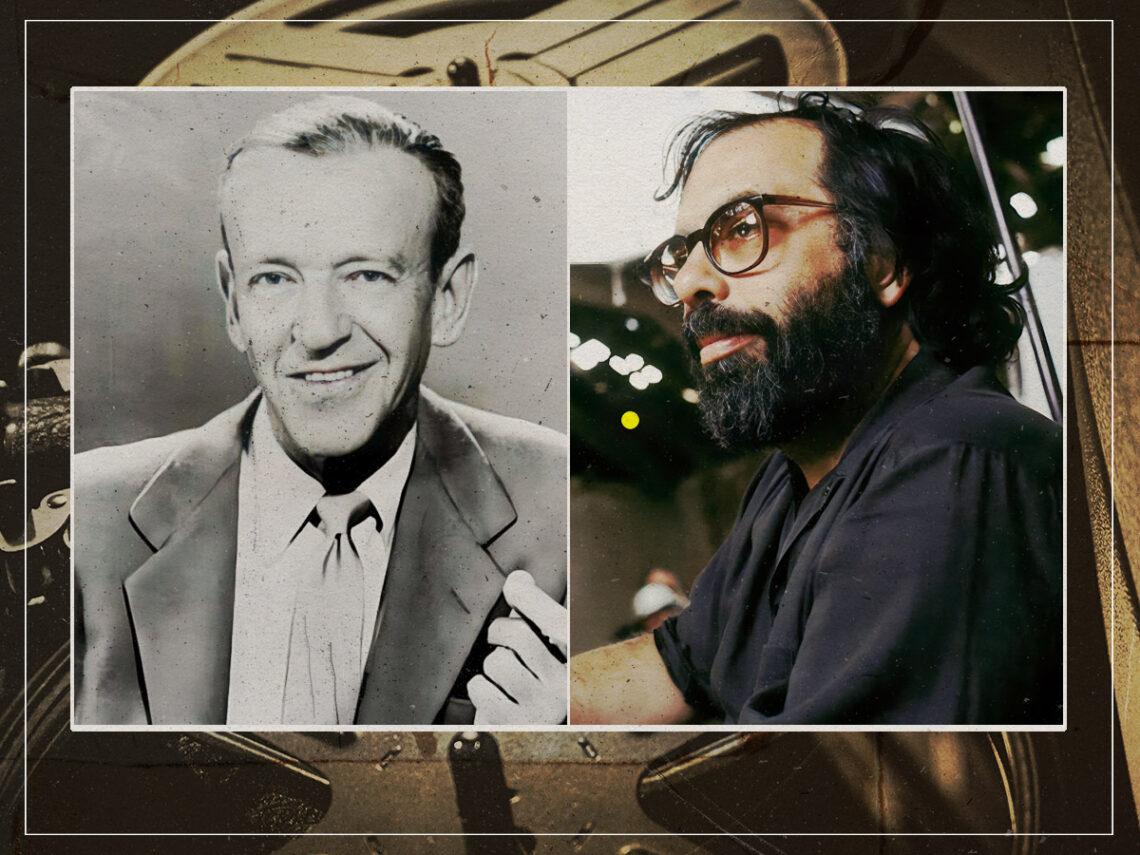
The life-changing advice Fred Astaire gave to Francis Ford Coppola

Fred Astaire and Francis Ford Coppola: two undisputed titans of cinema, but perhaps not two people you would expect to have had an immense impact upon one another’s lives.
On the one hand, Astaire is well-regarded as one of the greatest music dancers of all time. He had hits throughout the 1930s and the decades that followed, including Funny Face, Swing Time, and Top Hat, to name just a few. His films, often technicolour romances full of spectacle and delight, spanned a career of over 70 years and solidified Astaire as an icon of cinema.
As the legendary dancer and choreographer Jerome Robbins said of his performances, “Astaire’s dancing looks so simple, so disarming, so easy, yet the understructure, the way he sets the steps on, over or against the music, is so surprising and inventive.“
American director Coppola, on the other hand, is hailed as a great of the New Hollywood movement, offering gritty, dark and epic works like Apocalypse Now, Bram Stoker’s Dracula, and a little-known hit called The Godfather. His upcoming film Megalopolis, featuring a star-studded ensemble cast including Adam Driver and Aubrey Plaza, is meanwhile said to be his most controversial yet. Coppola was so desperate to make the sci-fi epic that he bravely put $120million of his own money to back the film.
Despite their vastly different careers, the two icons of the industry did, however, cross paths, and the pair shared a moment that changed the trajectory of Coppola’s life. While song and dance mightn’t have had any place on the near-deadly set of Apocalypse Now, old Astaire still had some influential advice.
When asked in an interview with Rolling Stone what the best advice he had ever received was, Coppola didn’t hesitate to reference the famed dancer. “Fred Astaire told me that his biggest regret was giving up the license to the Fred Astaire Dance Studio,” he commented.
“All his life, he was haunted by seeing his name on a bunch of dance studios he hated. He told me, ‘Never give up your name.’ If our name is on something, then it’s wine that we personally like to drink, or food we like to eat or places we like to stay. Your name is your word,” Coppola recalled.
So much of art is about perception. The reason The Godfather is such a triumph is tied to the iconography that surrounds it, too. Its chic posters provoke dinner party chatter. Its score takes you back to the first time you ever saw it. It is a cultural force. And that gravity can quickly become derided if it is suddenly associated with a pizza advert.
While Fred Astaire and Francis Ford Coppola had markedly different careers in the film industry—Astaire dancing his way through Hollywood’s Golden Age with charm and joy, and Coppola tackling the tougher subjects of human existence with gripping, brave works—their brief crossing of paths left a lasting impact on Coppola.
Astaire’s powerful advice stayed with Coppola throughout his career, with few artists in history having such a firm grip on the industry side of their art. Even if they never met again before Astaire’s passing in 1987, they both secured their places alongside one another in the annals of cinematic history. Would Coppola have self-financed so many epics, with full control, if it wasn’t for the greatest dancer in Hollywood being peeved about daft adverts adorning his name?
