


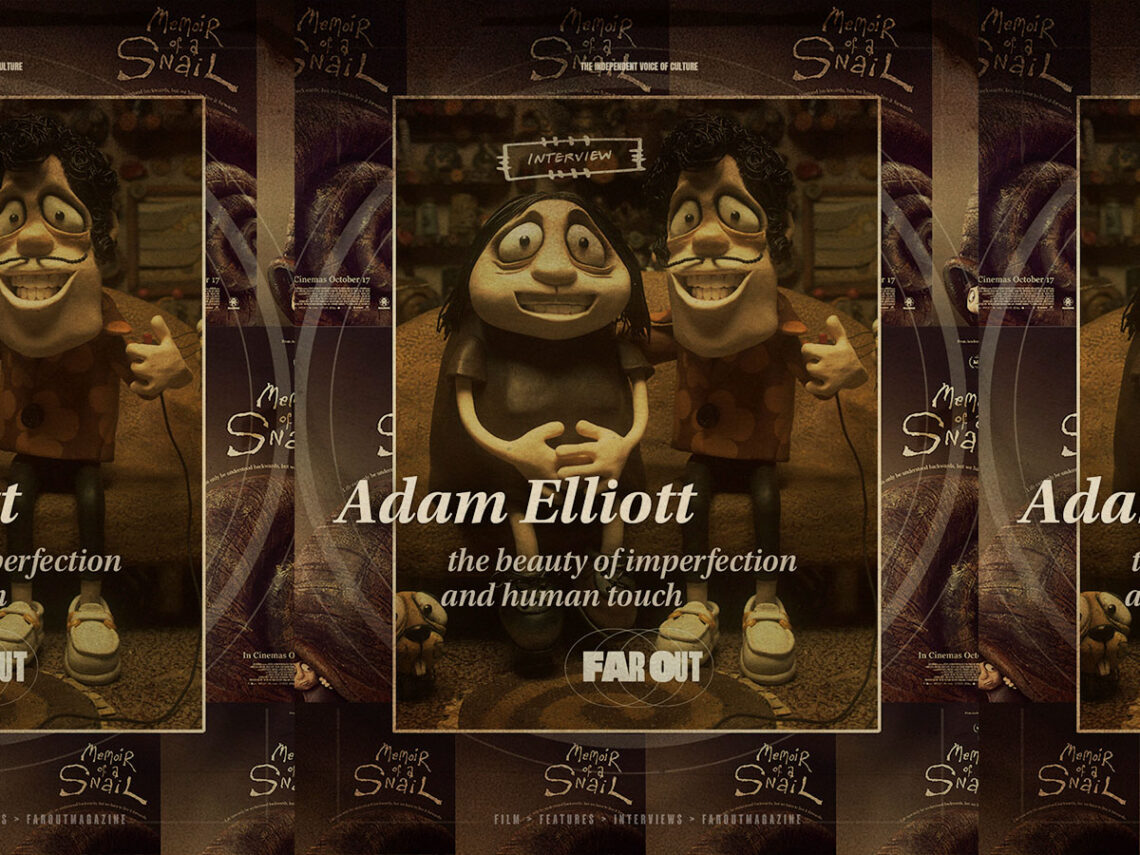
Adam Elliott: the beauty of imperfection and human touch

When watching early iterations of Wallace and Gromit, there are shots in which you can see human fingerprints on the clay figures. It’s so slight that you can barely see it, but upon closer inspection, you can see the tiny web of lines left by someone’s thumb. The 2006 stop-motion feature Blood String and Red Tea took the director 13 years to make, with the delicate felt characters living alongside the director in her New York apartment as she slowly chipped away at their story. The same goes for Coraline, with the filmmakers using popcorn to create the trees and dozens of carefully placed mice for the whimsical circus sequence.
The medium of claymation is the very definition of handmade – it is painstakingly time-consuming and laborious, with each movement, facial expression and new character requiring hours of effort to create the illusion that inanimate objects are moving before your very eyes. As film production becomes increasingly digitalised and the involvement of human beings in the creative process is being debated and questioned, I cannot think of a more perfect time for a film like Memoir of a Snail to grace our screens, reminding us of the beauty of imperfection, handmade stories and why this is needed now more than ever.
Claymation filmmaker Adam Elliott lived with the story of Grace and Gilbert in his head for over ten years, plucking inspiration and tiny gems of ideas from his ‘recipe book’ – a notebook filled with potential seeds for stories that he finds anywhere; an anecdote from a family member, a strange name overheard in a supermarket or an amusing thought about mating guinea pigs that could one day find its way into a script. After years of collecting and curating, a tapestry of ideas began to take form, with each thread coming from a person in Elliott’s life, eventually leading to his latest feature film, Memoir of a Snail.
Memoir of a Snail is both life-affirming, soul-crushing, heart-warming and deeply upsetting, following a pair of twins called Grace and Gilbert who are separated in childhood after a handful of tragedies. Grace is subsequently exposed to an endless stream of awful experiences that both isolate her and make her just like everyone else, becoming burdened by her sadness and finding comfort through her collection of snails.
Elliott is fascinated by what he calls “the extraordinary ordinary”, highlighting the quirks, miracles and sometimes devastating hidden stories of our friends, neighbours and strangers we pass everyday on the train. Through his endearing clay characters, he opens us up to the kaleidoscopic collection of pain and joy that often slips through the cracks, with everyday lives being regarded as unremarkable compared to the other stories we immortalise on screen.

Elliott’s father was a professional acrobat and a hoarder, a wonderfully weird thread from his own life that made it into the film, adding to the very lived-in authenticity of the characters. “My films are character driven, so it’s all about getting characters that are that are not just quirky, but that have dimension to them, that are layered, and the thing I strive for the most is authenticity and believability; that these characters, even though they’re blobs of clay, have a soul and a heartbeat”.
Despite being ‘blobs of clay’, it’s impossible to not feel for the plight of these characters because it feels so inescapably real. Over the course of the film, Grace is put through the wringer in a way that feels almost relentlessly cruel, living through a series of unfortunate events that becomes impossible to escape from. But while it is easy to become bogged down in our sadness, Memoir of a Snail is about the catharsis of finding humour in our dark experiences and not letting our tragedies define us. “Life is bittersweet”, Elliot says. “It is a mix of comedy and tragedy. We have highs and lows. We have moments of joy, moments of absolute depression and torture at times, and I’m trying to really just reflect that in my films”.
At first, Grace finds it easier to retreat into her metaphorical shell and take comfort in the simple pleasure of hoarding. But after forming a friendship with an eccentric older woman called Pinky, Grace discovers that while Pinky had her own tumultuous upbringing and catastrophic levels of grief, it led her to develop a wonderful sense of humour and blasé approach to the trials and tribulations of being alive. Her experiences highlight the fact that no-one has a monopoly on pain and everyone has their share of suffering, but that joy and hope can exist in tandem with our pain. Each bad experience simply evolved into a new story to tell, adding another thread to her colourful tapestry and allowing her to find fun in everyday mishaps. Both characters were inspired by people in Elliott’s life, with the director describing an old friend who had similar experiences to Grace yet “grew up to be this very confident extrovert, and is now the first to take her clothes off at a party”.
To watch Memoir of a Snail is to embark on a journey through light and dark, ebbing between the ups and downs of a marvellously mundane yet miraculous life. There’s something inherently funny about watching awful things happen to these clay figures, mirroring the duality of the dance between comedy and tragedy that runs through real life. Grace finds love, but then discovers her husband was only with her because he has a fat fetish. Gilbert saves his money to visit Grace, but is trip is then thwarted by a tragic accident.
Just when one thing goes slightly right, another goes horribly wrong, adding to the whimsical and deeply bittersweet tone of the film. Elliott enjoys pushing our emotional buttons, describing his love for the careful balance between light and dark. “There’s that theory that laughter is a release of tension, and sometimes a gag can be funnier if it’s straight after a very tragic moment, because you’ve built up all this tension. I want the audience to be engaged right through to the very end and then come out of the cinema exhausted but still not depressed, coming out feeling hopeful about life and uplifted”.

While most of Hollywood is trying to push towards a safe and sanitised cinematic style, Elliott showcases the power of authenticity through the ups and downs of a very real life, one that is inspired by the misfortunes and achievements of genuine people. Despite being dragged through the mud and pushed to the limits of human resilience, Grace is able to move past her tragedies and allow them to add depth and meaning to her overall story.
“A lot of people say my films are about disability, and I say, no, they’re not” he explains, “They’re just about everyday people. When we all have some imperfections that we don’t like about ourselves, and some of us try to cure that or fix it, and often, it’s just learning to embrace that imperfection. I give my characters all these afflictions, but it’s not really about the afflictions. It’s just about how we’re all imperfect. We’ve just got to accept ourselves and others, and that’s sort of what strings all my films together, is that they’re not heroic people. Grace, I think she’s heroic just because she survives”.
Much like real life, the art of claymation is a reflection of humanity its purest form – a calling card to the power of human touch and infusing real life into our creative tapestries. Memoir of a Snail possesses an irreplaceable authenticity that comes from the amalgamation of both light and dark experiences that reflects the exquisite chaos of being alive – the soaring highs that are abruptly followed by crushing lows and the stories you don’t think you’ll ever recover from to share.
While this is reflected in the story, the overall effect is only made possible through the uniquely tangible and handmade nature of the film; a film in which the closing statement that simply reads ‘made by humans’ summarises the imperfectly perfect nature of this story. The medium of claymation reflects the irreplaceable impact and ingenuity of human touch on storytelling; where hundreds of fingertips are carefully enacting the experiences of clay characters, cotton wool is used to create cigarette smoke and sexual lubricant for the many tears shed by Grace.
Nothing comes close to the brilliance of real people and what we can conjure with our own minds and lived experiences, and Elliott’s handmade masterpiece encapsulates the unparalleled power of the extraordinary ordinary and the artists who achieve what no-one else can in translating this to the big screen.
