


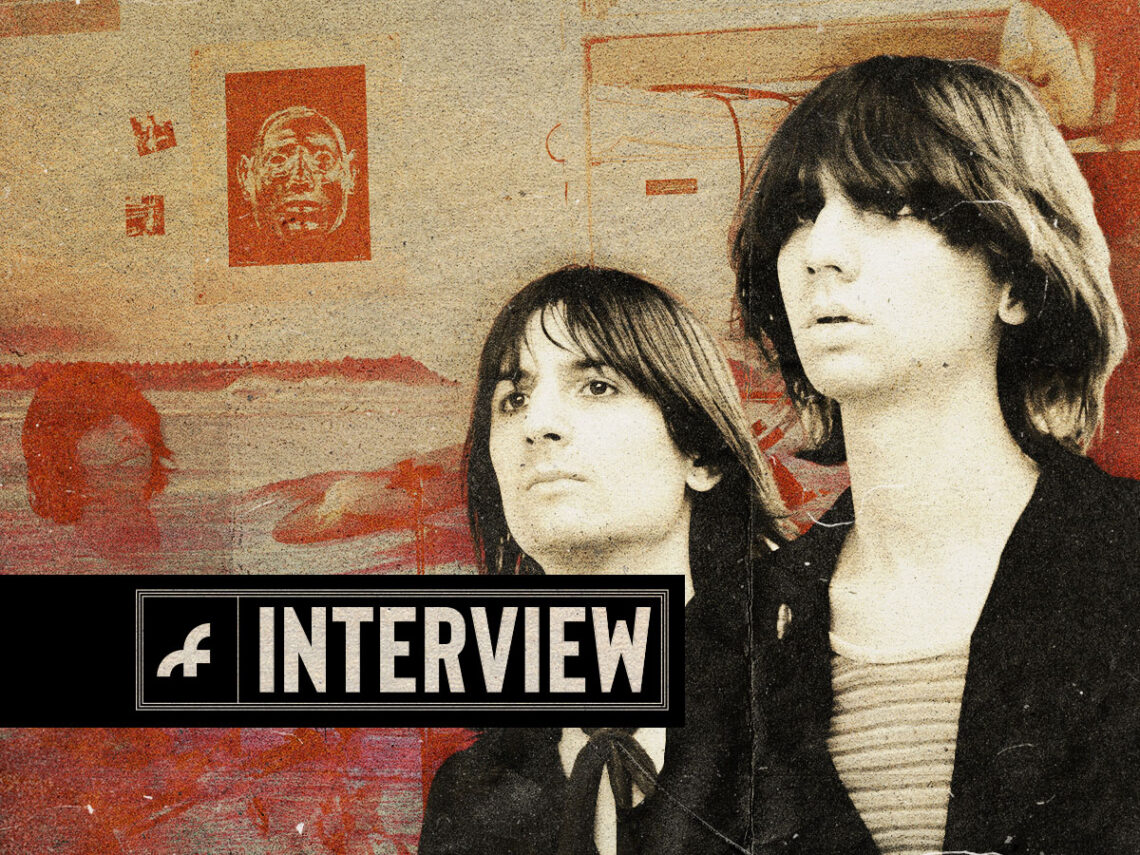
A very chaotic interview digging into the enigma of The Lemon Twigs

Interviewing The Lemon Twigs on your day off because they’re your better half’s favourite band is hardly up there with the Byronian feats of things fellows have done for love, but it’s a small detail that made for a rather comical introduction. Flushed with free time, I arrived on Zoom bright and early. But it was morning over on the other side of the Atlantic and the band were working to a deadline. They had taken it upon themselves to edit their own music video and clearly, chaos was afoot.
Michael D’Addario opens the call freshly slouched on their studio sofa. His brother Brian, by Michael’s admission, is on the toilet. So, we begin with a pause as Michael chases things up. “Briaaan,” he keeps hollering in the same familial manner that Will Ferrell shoots “mom” in The Wedding Crashers. This slovenly start seems to offer a keen insight into their childhood past together. Moreover, how the quirk of family ties has pervaded their artistic life too, making for a relatively surreal but endearing start to the interview.
As we wait for Brian, Michael goes on to explain that they’ve been up all night honing the music video footage for their eager label. There aren’t many bands who get so hands-on with their videos, I muse, but then again, there aren’t many bands like The Lemon Twigs. They are undoubtedly one of the most unique and interesting groups currently operating. Their new album, Everything Harmony, once again stands aside current fads of dissonance and discontent and takes a more singular and smiling approach to illuminating these trying times.
They admit that doing their own thing is a liberating pursuit that frees up their music. “It helps to not feel in competition with anyone,” they tell me. “It’s good to just be on your own completely and not feel like what you’re going to put out is going to age or come out of a particular moment or fad.”
Once again, on Everything Harmony, their music is decidedly rooted in the melodious side of the 1960s and lyrically they look at things with the wry smile of a slyly unreliable narrator. They project sorrow through comedy with such a light touch that it’s like stepping on a loose paving slab on a rainy day and having pocket change and confetti slosh up onto your sock. This style of taking upbeat melodicism from the past and revitalising it with the defibrillation of your own quirky ways is something one of their heroes did before them.
For some people, Tiny Tim is the weird guy who sings that terrifying tune in the Insidious movies, but to the D’Addario brothers, he’s a master of his craft. “I think the way he presents those great 1920s songs just really appealed to me and Michael,” Brain says. “The Richard Perry arrangements are really integral, the fact that it’s through kind of a ‘60s lens, at least with his first couple of records is initially what grabbed me.”
“Then his voice is just… he’s got one of the most unique voices ever,” he continues. “And he’s very sincere about it, obviously. I mean, people kind of think he’s funny, or they used to at least, but I think now when you hear his record, you hear a man possessed by great songs, and who resurrected all these great songs from before his time.”
This is something that they look to lean on themselves in some capacity, harnessing the ways of the greats gone by to create something fresh through a tested lens. “In terms of arranging a pop song,” Michael explains, “the Beatles are one of the best at it – if not the best.” So, along with others like The Beach Boys and Phil Spector, they whisk a classical sense of structure into their mix and layer this with their own imaginative ways.
Naturally, with the counterculture classics framing their work alongside outsider artists like the Viking composer Moondog, the swinging ‘60s Swedish band Tages, and the kooky songwriting of Pete Dello all whirling in the welter, the band’s sound is understandably eclectic. They always manage to make this potent mixture enticing and pretty, but beyond the music itself, they offer a whole lot more.
As is readily apparent from my chat with them, they are very natural artists in music for the love of it—and they clearly opine that love should be fun. “I’m not into taking it too seriously,” Michael casually says. “It always comes off silly when somebody’s taking it really seriously.” Far from flippant, that is actually a very valid stance to take in music and it comes across vividly in their invigorating work. As a result, the band are a source of joy. They say that sanguine spiritualism might come naturally to an extent, but it is also something that they actively think about deploying in their music too.
On this front, I ask if a particular ‘can this day get any worse’ moment inspired the rather hilarious ditty ‘Every Day is the Worst Day of My Life’. I half expect that Michael and Brian jokingly raced home to write it after being informed that the McFlurry machine was broken, but the inspiration actually came from an unlikely source. “That’s the whole point kind of,” Michael says, “there’s always a downbeat moment.” He goes on to tell me that accepting this is key, a concept derived from the Netflix documentary about Jonah Hill’s therapist, which was central to their new record, although Michael can’t remember the name of the doc in question.
“When we get angry we get uncreative.” – Michael D’Addario
“Stutz,” Brain points out with a firm interjection. With the title now established Michael eagerly continues, “remember he says you have to be comfortable with constant work and… It was three things I can’t remember but constant work was one of them.” To polish that point up on Michael’s behalf, Dr Phil Stutz says that to live well you need to understand three aspects of reality that absolutely nobody can avoid: pain, uncertainty and constant work.
Ironically, it is this moment of mindfulness and the discussion of how spirituality enters their work that results in perhaps the most enlightening moment regarding their enigmatic relationship. For a moment, they come across as simple bickering brothers and it is a charming thing to witness. “Of all the people you’re going to misquote in the world,” Brian jokingly proclaims, “you’re going to misquote Stutz!”
After a brief comic spat during which Michael jabs that he’s “not as hung up on, y’know, people thinking, y’know… I don’t need to sound like an intellectual.” And as if to join him on that point, Brian mentions another of the great sages of our times that have influenced the spiritualism of the record: Jerry Seinfeld. Although he also initially can’t think of the pearl of wisdom either, he eventually concludes that it was something like, “You have to find the hell that you’re comfortable with.” Adding: “That is something that I also wouldn’t want to quote publicly.” Alas, this bickering about spiritualism is brief and they quickly declare that they’re the opposite of the Oasis brother on that front, stating: “When we get angry we get uncreative.”

So, if you were deploying all this to decode the enigmatic nature of the band then what you could garner is that they don’t get too hung up on things, instead opting to let the music come through naturally. This, in part, is grounded in their artistic upbringing. Their father was also a musician who worked with the likes of Tommy Makem (go and look up Makem’s song ‘The Butcher Boy’, it’s a masterpiece).
“He’s a huge influence. I mean, that whole idea of, of writing melodic songs with good arrangements and good structures and everything. That’s all informed by him. We were kind of told that this is what the criteria is for a song, that is like a good song to him. And although we don’t always follow within that framework it was still very influential. There was always this separation between what’s a decent thing, and what’s actually a good song.”
So, unlike many of us who come of age and find our new heroes to emulate, Brian and Michael were already infatuated with alternative culture as kids. “We were watching Beatles Anthology and, you know, The Monkees TV Show and all that kind of stuff from the time we were four years old.”
Perhaps therein lies the solution to why fans find them to be so endearingly enigmatic – a strange loveable otherworldly entity too innocent for this cesspit, despite loading their sweet songs with dark comic subversion – they are born musicians. Much like David Bowie or Iggy Pop, you can’t picture these boys selling you a used car or flying an airliner for a living, they simply had to be musicians and that is not something you come across every day.
As they explain themselves: “We never had another dream,” Brain says. Michael adds: “We were always musicians, though. We didn’t really want to become musicians. We were musicians always.” So, the choices that faced them were not related to things like the solid pension that a private equity firm might offer, it was simply a question of flitting between genres and instruments: “I want to be a heavy musician. I want to be a lyricist. I want to be a classical guitar player, I want to be a drummer. It was all within that. Music is just more like that because there’s plenty of ways to branch out just within music.”
That sense of being at ease with music comes across perfectly on Everything Harmony, their most seamless record to date. This vibrancy inspired the spring-like nature of the album. “There were definitely themes of rejuvenation or renewal,” Brain says. “That basically came from the first track, ‘When Winter Comes Around’, I think that was probably one of the first tracks that we wrote. So there’s some nice nature imagery that was kind of thrown in. And then there are sort of references to like city, stuff that was more like what we would experience in our everyday life,” he adds as mark of contrast.
Concluding: ”So I feel like there’s some kind of clash between nature and manmade things that are in some of the lyrics on the album. Then sonically we really want it to be very delicate and tentative. We wanted there to be an acoustic echo chamber throughout the whole record, so that was the only echo that we use. They were the sonic principles that we set ourselves.” The result is a record that typifies The Lemon Twigs themselves: it’s full of heart, fun, duality, and a glug of enigmatic mysticism that I’m no closer to solving after a manic half hour with that band, which ended with a comic shout-out to my better half.
Everything Harmony is due for release on May 5th. The band are currently on their world tour with plenty of dates ahead. Stay tuned for more titbits from the interview and a forthcoming full review.
