


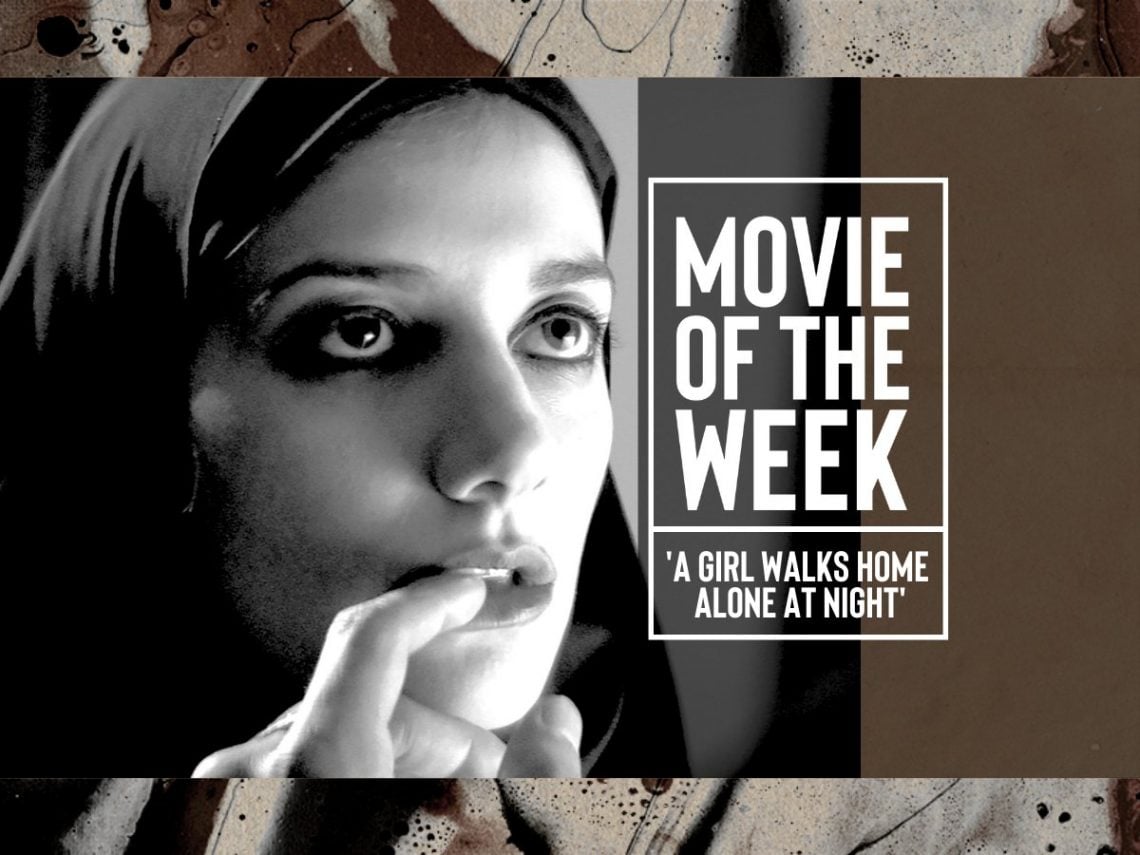
Movie of the Week: ‘A Girl Walks Home Alone at Night’ – Ana Lily Amirpour’s stylish Iranian protest

It’s been over a week since Mahsa Amini was arrested and killed in police custody in Iran, prompting the country’s worst unrest in years with protests across the country. Violently beaten for violating the country’s strict dress code, which requires women to wear the hijab as well as long, loose-fitting robes, the 22-year-old has stirred up a renewed conversation about the lack of freedoms for women in the middle eastern country.
Such has long been a contentious conversation in Iran, with filmmakers throughout the country’s rich cinematic history having commented on strict rules against female freedoms. Just last week, we discussed Marzieh Meshkini’s powerful protest for women’s rights in the form of her film The Day I Became a Woman, released at the turn of the new millennium in a plea for real-world change.
From Meshkini to Samira Makhmalbaf to the late great Abbas Kiarostami, director of such modern classics as 1990s Close-Up and 2002s Ten, Iranian cinema has long-flourished, finding success in all corners of the industry. Ana Lily Amirpour’s 2014 “vampire spaghetti western” A Girl Walks Home Alone at Night, proved this beyond doubt, with the British-born American film director with Iranian heritage creating a key text in contemporary horror cinema.
Inspired by the monochrome panels of Frank Miller’s graphic novels, Amirpour’s strange romantic horror resides in the bleak corners of ‘Bad City’, a fictional sin city inhabited by thugs, drug dealers, beggars and a young female vampire described simply as ‘The Girl’.
Subverting the freedoms that females are handed in Iran, despite the suggestion that the titular girl may be fragile and vulnerable, Amirpour makes her young female lead a hero, rather than a victim of her environment. Targeting men around the city who abuse their powers and persecute others, the girl makes her unassuming appearance her weapon, empowering the very dress code that has kept her oppressed.
Speaking about how the chador was used as a key piece of iconography in the stylistic horror, Amirpour told SciFiNow, “It was the chador. It was a prop for another film, and I just grabbed it, put it on, and I just directly felt like a bat, a stingray, like it moves a certain way, I just felt like a creature. And then I was like, ‘Oh yeah, of course, this is an Iranian vampire in a brilliant disguise.’ I thought, ‘Ah, nobody’s going to expect anything from her’”.
Such would point towards A Girl Walks Home Alone at Night being considered an important piece of contemporary feminist cinema, and whilst it certainly is by avid fans, the director is quick to avoid such claims. In Amirpour’s eyes, her film should be worthy in and of itself, without the need to project a feminist message onto it. When asked by Gawker if she had made a feminist text, the director firmly responded, “Personally, I find that these philosophies are the disease for which they claim to be the cure. I am afraid of categorisation in general. I don’t really see a usefulness to it. For me, what it does is it stops thinking”.
Nodding to spaghetti westerns, classic horror and even anime, Amirpour tells an eccentric, utterly compelling story that stands freely, away from comparisons to being a ‘strong feminist text’. Though cinema is what the viewer makes of it, and eight years after its release, for many, A Girl Walks Home Alone at Night remains an empowering protest against male control.
