


In defence of Johnny Cash’s wonderfully depressing ‘The Christmas Spirit’

“Sometimes I like to be sad,” a 41-year-old Johnny Cash told Newsday back in 1974, “Because I feel so much better when it’s gone. It’s like a baptism.”
When most Boomer-age Americans think of Johnny Cash and Christmastime, it’s probably the 1970s that spring to mind, when a “settled”, middle-aged Cash, now shacked up with June Carter and living a clean life, hosted his own annual Christmas TV special on the CBS Network. Those specials are amusing to dig back into, but they’re also schmaltzy in the usual way of the overly-structured ‘70s variety show, without much suggestion of Johnny’s darker edges to be found.
You might say, well, why would we want to hear the darker side of ‘The Man in Black’ at Christmastime anyway? And to this, I can only respond by directing you to Mr Cash’s very first full-length foray into yuletide music, the much-maligned 1963 album The Christmas Spirit.
Cash was only 31 when he recorded this LP, but it was already the 17th studio album in his discography, and his world-weary bass-baritone might as well have made him 60. His label, Columbia, likely encouraged Johnny to record a Christmas album as a quick moneymaker to further capitalise on the bounce-back success of his hit single from earlier in 1963, ‘Ring of Fire‘. Cash was suddenly a hot commodity again after a bit of a commercial downturn, but as soon became evident, he was not interested in smiling his way through a feel-good holiday romp on his first Christmas record.
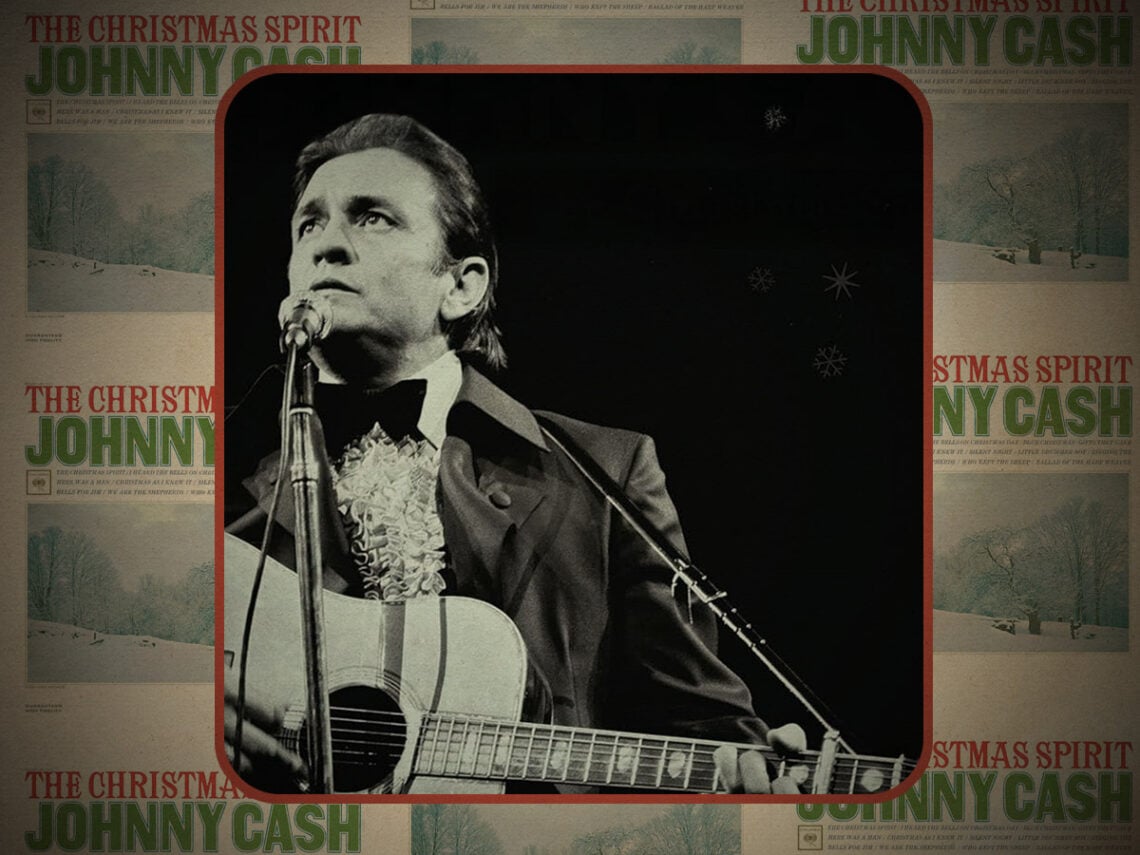
The Christmas Spirit is tough sledding, to use a metaphor suited to the album’s stark cover art – a nondescript snowy scene somewhere in the countryside. Cash himself isn’t pictured, nor are any elves, reindeer, wreaths, or bells. Right out of the gate, the music matches that image, as the title track finds Johnny spoken-wording his way through a dream sequence like a sleepy pastor. “On Christmas Eve I dreamed I traveled all around the earth / And in my dream I saw and heard the ways the different people / Hail the king whose star shone in the east / And what a dream it was.”
The pace starts slow and rarely picks up, and the song choices are quirky, more reverent to the lord with very minimal kissing under the mistletoe. Tex Ritter’s ‘Here Was a Man’ is another chapel sermon; ‘I Heard the Bells on Christmas’ adapts a Longfellow poem; and the album’s lone single, ‘The Little Drummer Boy’, is virtually a cappella save for the taps of the titular percussion instrument itself. One song credited to Cash, called ‘The Gifts That They Gave,’ is mainly lifted from an ancient folk standard about the nativity, but does include one of the best single lines you’ll ever hear the man sing: “I, said the donkey, shaggy and brown.”
Lest the whole thing be dismissed as a restless Cash sleepwalking his way through a novelty album, though, it’s worth revisiting some of the genuinely original compositions on The Christmas Spirit, especially ‘Christmas as I Knew It’, another spoken-word narrative, this time very specifically about Johnny’s own Christmas memories as a poor country kid growing up in Dyess, Arkansas. Yes, it’s slow again, and yeah, it’s probably better to listen to while drinking whiskey than wrapping presents. But it’s also one of Cash’s most personal songs; a worthwhile window into who he was and where he’d come from, complete with a mention of his big brother Jack, who died when Johnny was just 12.
“I whittled a whistle for my brother Jack / And though we disagreed now and then / When I gave Jack that whistle he knew I thought the world of him / Mama made the girl’s dresses out of flower sacks / And when she ironed them down / You couldn’t tell that they hadn’t come from town.”
It’s quite reasonable to say that The Christmas Spirit is the saddest Christmas album ever released by a mainstream artist, but it wound up unintentionally well suited to the mood of America in December, 1963, as that holiday season had a dark pall over it following the assassination of John F. Kennedy. Even today, a drearier take on holiday “cheer” can sometimes serve as a useful change of pace and opportunity for reflection. As Cash said himself, it’s a bit like a baptism; you do feel strangely better after coming back up from it.
