


A catalogue of curious tales: The strange life of Captain Beefheart

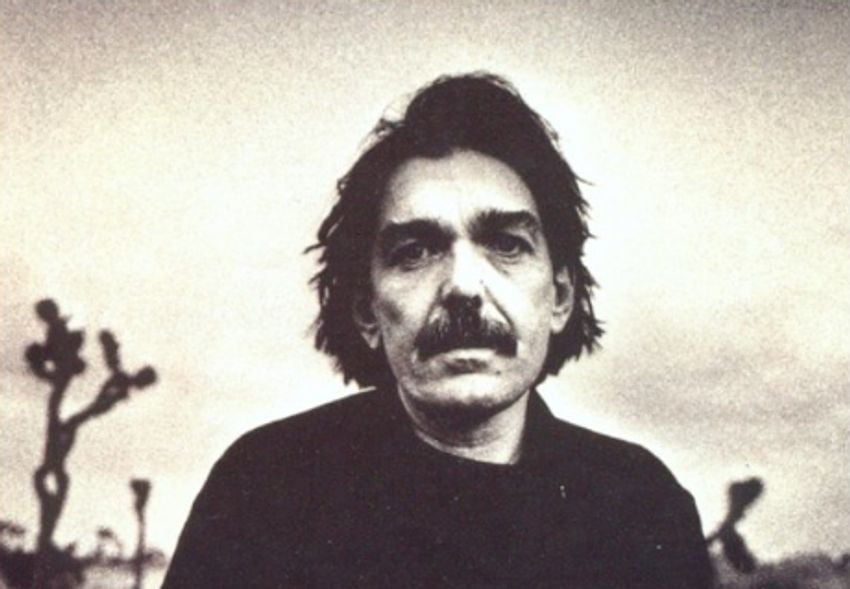
Captain Beefheart is a fish-faced creator who seems to have sailed across the shallow orange sea on HMS Clown Shoe to reach a world of his own creation. He bludgeoned his counterculture peers with a strange stick that illuminated their obviousness, and he whacked his drummer with a similar baton when the beats weren’t to his own wavering demands. Don Glen Vliet is without a doubt one of the strangest creative forces that have ever flashed upon the outer radar of the mainstream—the fact he christened himself Captain Beefheart could’ve told us that from the off.
To begin with, Vliet was a child sculpting prodigy, which is, we can all agree, one of the rarest prodigious talents a boy can display. But boy did he display it. He began sculpting at just three years old. His early works exhibited a particular interest in dinosaurs, fish and mammals. It is even said that Vliet’s parents had to push dinner under his door such was his juvenile obsession with creative endeavours.
Eventually, this sculpting obsession resulted in the prestigious Los Angeles Zoo children’s award. His submission far outstripped the other three-legged cows and monkeys with legs bigger than their torso that had been entered by bogie-nosed hopefuls. It was recognised that this Vliet chap had a unique talent. Thus, he was offered a six-year fully paid European scholarship at the age of 13, but his parents turned it down because they thought it was too “queer”.
That may have been an opportunity missed but to Beefheart, it didn’t matter, as he once proclaimed: “The stars are matter, we’re matter, but it doesn’t matter.” His artistry would simply mutate into a new realm. Music was the talk of the day anyway, sculpture was old-hat. The slight hitch was that even decades into his career, Vliet would almost proudly say, “I don’t know anything about music.”
This venture would be another one filled with a sense of surreal mania. The embodying moment for this strange movement would come to the fore when Vliet battered Trout Mask Replica into existence. When the weirdest thing about an album is not the smartly sartorial fish-man on the cover, then you realise you are dealing with a rather peculiar artefact.
At the time Don Van Vliet, the Captain himself, was out of a label and out of luck. Then a blast from his childhood past would offer a helping hand. Frank Zappa had grown up with Vliet in what must surely be one of the weirdest High Schools in Los Angeles County, which would place it high in the running for weirdest worldwide. Zappa had just set up two of his own labels.
They were aptly titled ‘Bizarre’ and ‘Straight’. Naturally, he signed the madman Vliet to Straight and gave him total creative control over his next album—the consummate record label exec. This is a decision that would prove interesting, to say the least. With the keys to creative oblivion tucked firmly away in the back pocket of his jeans, Vliet and his merry band of Beefheart brethren absconded to a small, rented house in Woodland Hills, Los Angeles. Little did some of them know how truly obscure their Captain was.
Upon this hill, a commune was formed and on occasion, an album seemed like land that they would never reach. For eight months the band remained in this stuffy abode. Everything unravelled. After years of being passed around labels like the hot last toke of a joint, Vliet was determined to craft an album that would make Zappa proud, although it’s hard to see how that a bizarre practice he called The Barrel.
To explain The Barrel, we shall lean on a vignette put forth by John French, otherwise known as Drumbo, no prizes for guessing what he played in the band. When he was drafted in, he recalled making a mistake one session and having Vliet fly off the proverbial handle. Vliet commanded Drumbo to “get in the barrel”. Unwittingly he climbed into the old beer cask at the behest of the Captain. Therein, Vliet repeatedly struck the booze receptacle with a stick and berated Drumbo’s performance with a fury akin to the Devil’s father on the sidelines of a football game.
In short, perhaps the best description of the commune comes from French’s visiting friend who described the vibe of the mass boudoir as “positively Manson-esque”. As far as rehearsal spaces go, that’s the sort of comparison you’d usually hope to avoid. At least Manson had an income though, the austerity in Vliet’s HQ was verging on some sort of Soviet reverse artistic opulence. The entire commune had zero income other than welfare for the duration of their stay and powered through 14-hour practice sessions fuelled by no more than a cup of soybeans that had usually been stolen on scavenger hunts.
The recording was equally bewildering and Vliet frequently deconstructed the songs just as they were coming together. Nevertheless, the album they created remains an influential force to this day. As Tom Waits proclaims: “Once you’ve heard Beefheart, it’s hard to wash him out of your clothes. It stains, like coffee or blood.”
Naturally, the album didn’t sell very well. As John Lydon would later explain it, “It was anti-music in the most interesting and insane way … all the bum notes I was being told off for by the teachers were finally being released by well-known artists. That was my confirmation. From then on, there was room for everything.” So, in his own weird way, Vliet had started a revolution.
What did he do with this new platform? Well, he disappeared back into the shadows. When he was trying to make it in the music industry, he made a mere 25 public appearances between 1964 and 1970. It seemed that as soon as he managed to create an album of note, he realised he was more equipped to sit behind a canvas rather than conduct a band. As such his public appearances dwindled even further. “I don’t like getting out when I could be painting,” he said. “And when I’m painting, I don’t want anybody else around.”
Thus, he squirrelled away to the desert and set about creating his conceptual art. “I don’t look like a desert person,” he would later say, “because I stay indoors most of the day and fool around at night. That’s what the desert animals do—they don’t have a tan either.” Despite saying that, it was during his trips to the coast that he felt most attuned to the world around him, as he said, “When I see a dolphin, I know it’s just as smart as I am.” Such is the way of things in the odd world of Beefheart.
