


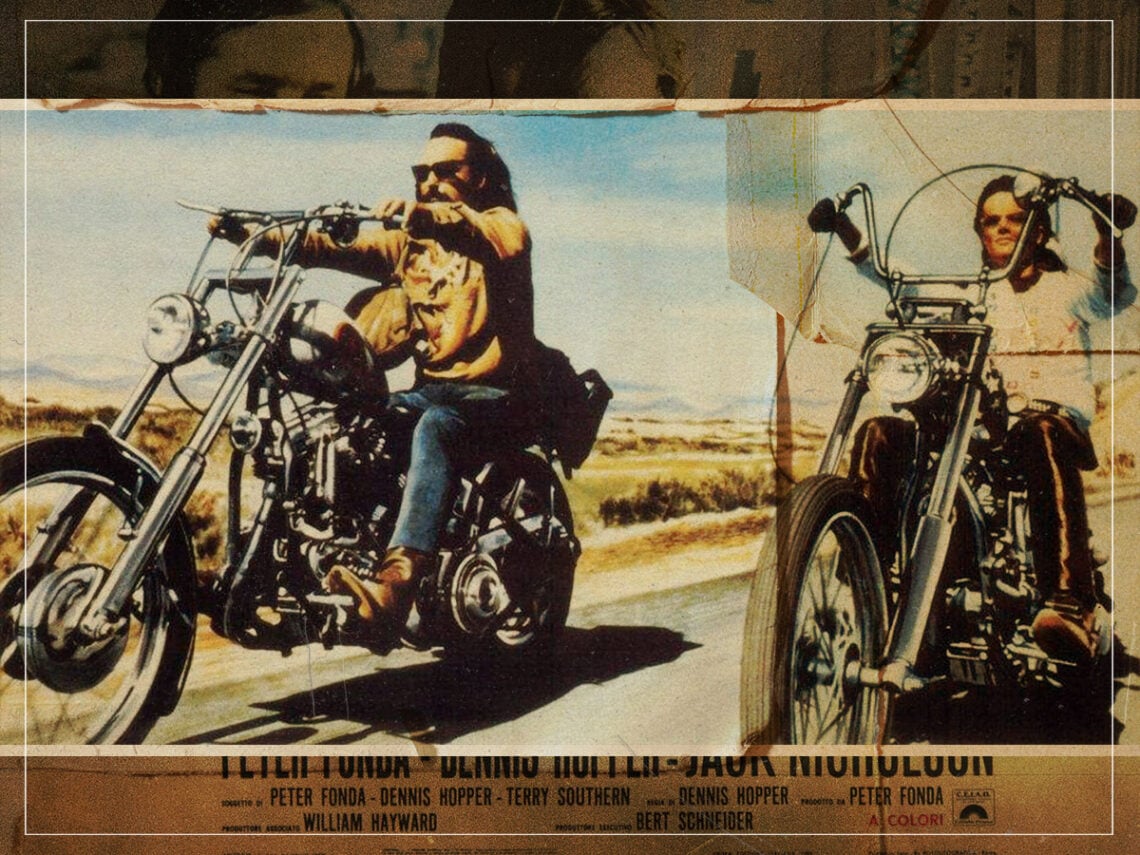
55 years of Dennis Hopper’s hippie-biker masterpiece ‘Easy Rider’

As the counterculture movement of the 1960s just about threatened to end, and as the era of Free Love saw the hedonistic excesses of the following decades peep their ugly heads over the horizon, Dennis Hopper delivered perhaps the finest cinematic expression of the hippie, communal lifestyle with his legendary 1969 road drama Easy Rider.
Written with Peter Fonda and Terry Southern, Hopper tapped into his personal countercultural experience and the iconic qualities of his collaboration with Fonda on 1967’s The Trip, as well as Fonda’s own performance in 1966’s The Wild Angels, to deliver a biker movie with a hippie twist. It is heavily laden with the psychedelic revelry of the 1960s, only without the innocent sheen of studio-led Hollywood productions.
Fonda and Hopper play two freedom-seeking bikers who travel from Los Angeles to New Orleans for the Mardi Gras festival, carrying the cash from a recent Mexican cocaine deal. In essence, Wyatt and Billy go in search of America, much like Robert M. Pirsig had during his own biker journey in Zen and the Art of Motorcycle Maintenance or John Steinbeck had in Travels with Charley, accompanied by his trusty titular poodle and proto-“van life” motorhome.
However, just as it felt like America was beginning to move towards a leftist paradise amid the emergence of counterculture and Free Love – and even despite the ongoing Vietnam War – whatever freedom the American Dream might represent to our cocaine-sniffing, pot-smoking, LSD-dropping, lovable biker pair, it simply evades being found. What is discovered, though, is the ambivalence or even remonstration of an older generation of squares who seek to delimit the quest for lifelong good times of our leather-clad heroes.
There’s a striking sense of authenticity to Easy Rider that evades modern filmmaking, whether it be in the improvised dialogue of Fonda, Hopper or a scintillating Jack Nicholson – who plays “square” George Hanson, an alcoholic who soon comes around to the idea of getting stoned and delivering some genuinely barmy conspiracy theories – the greasy hum of its Harley Davidson choppers, or just the fact that real drugs were consumed during filming. Quite simply, Hopper, Southern, and Fonda not only documented or even recreated the hippie biker lifestyle with Easy Rider but also lived it.
Throw in some of the haziest cinematography of the 1960s, an unbelievable soundtrack featuring the likes of Steppenwolf, The Band, The Byrds and Jimi Hendrix, and a narrative that drips in engine oil, sexuality, masculinity and occasionally vulnerability, and it’s easy to see why Easy Rider lives and breathes the 1960s with an unrivalled sense of authenticity. Add in a handful of Oscar nominations and the fact it was made for less than half a million dollars, and it would be difficult not to throw the “masterpiece” tag around.
Fuelled by drugs and an innate desire to live as openly and honestly as one ought, Billy and Wyatt head out across America with their bikes serving as symbols of their quest for freedom, a journey that is put at odds with the rest of conservative Americans. It might have felt at the time that all that existed was the counterculture movement, a party that would go on forever, but a film like Easy Rider shows it was always destined to come to a sad and even tragic end.
In some of the most beautiful scenes of Hopper’s film, the pair are either camping out on the trail under the stars or bursting along the road next to the stunning backdrop of the American countryside. Things only seem to turn awry when Billy and Wyatt come into contact with modern civilisation, showing that the only absolute freedom one can take is in one’s agency, riding against the skies of tomorrow, free from the anxieties of the every day and the looming threat of what the future holds.
