


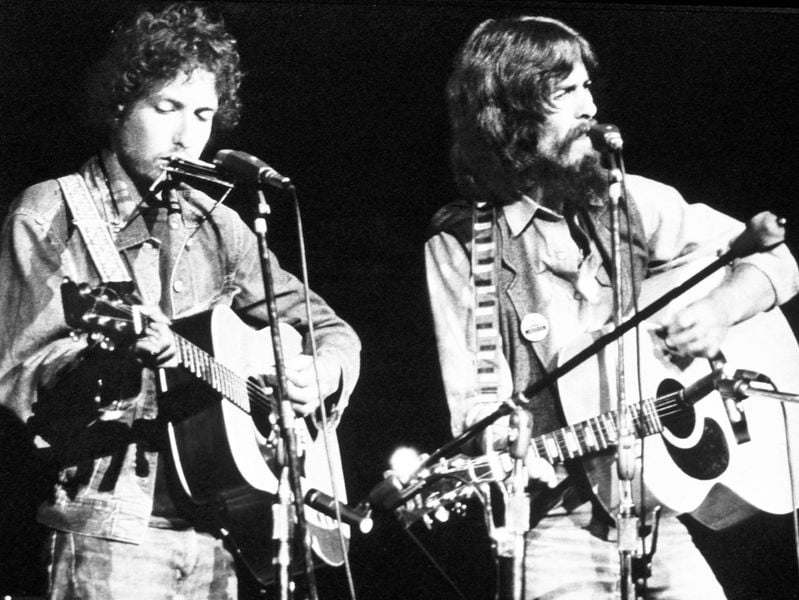
50 years on from George Harrison’s ‘Concert for Bangladesh’

Today marks the 50th anniversary of one of the most iconic concerts of all time. George Harrison’s 1971 Concert for Bangladesh was a groundbreaking exercise in altruism that paved the way for charitable spectaculars such as Live Aid that would appear over the coming decades. It was the finest example of the brilliance and resourcefulness of the former Beatles guitarist. The multi-media extravaganza that sent aid to cyclone ravaged and war-torn Bangladesh will forever be remembered.
The two shows that Harrison organised under the banner Concert for Bangladesh took place across Sunday, August 1st 1971, at the prestigious Madison Square Garden, New York. Retrospectively, it embodies the ethos he had continued to exude since his chance encounter with the almost mythical Ravi Shankar in 1966. Music was indeed the great healer.
Reacting to the terrible humanitarian disaster in his homeland that had lead to the deaths of millions and the displacement of seven million, Shankar remembered the moment when the wheels set in motion: “I was in a very sad mood, having read all this news, and I said, ‘George, this is the situation, I know it doesn’t concern you, I know you can’t possibly identify.’ But while I talked to George he was very deeply moved… and he said, ‘Yes, I think I’ll be able to do something.'”
In 1992, Harrison agreed that the original impetus for his decision to undertake the mammoth relief effort was his deep friendship with Shankar. In 1992 he recalled: “The Concert For Bangladesh happened because of my relationship with Ravi … I said, ‘If you want me to be involved, I think I’d better be really involved,’ so I started recruiting all these people.”
The irony of the event is that Shankar original hoped to raise $25,000. Overnight, the two shows raised $243,418.50. It does not end there, though. The accompanying George Harrison single ‘Bangla Desh’, concert live album and film together far exceeded Shankar’s hopes. Speaking of the event in the ’90s, Harrison said: “Now it’s all settled and the UN own the rights to it themselves, and I think there’s been about 45 million dollars made.”
The exhibition mixed Western rock with Indian classical music in a tour de force of mutual respect. Harrison and Shankar finalised the concept for the show, and then Harrison set about using his assets to aid Bangladesh in the most effective way as possible. A lot of the event’s success undoubtedly came from Harrison’s celebrity and the might of the Beatles’ Apple Corps organisation. At this early stage, Harrison had already drawn up a list of esteemed possible acts. These included former Beatles John Lennon and Ringo Starr, Eric Clapton, Leon Russell, Jim Keltner, Klaus Voorman, Billy Preston and Badfinger.
Luckily, the majority of Harrison’s first-choice names pledged to the cause instantly. However, the one participant Harrison desired more than anyone else was Bob Dylan. The ‘Blowin’ in the Wind’ man would eventually perform at his first show since his August ’69 comeback at the Isle of Wight Festival. Unsurprisingly, Dylan’s name added considerable allure to the event.

Getting the curly-haired troubadour on stage wasn’t so straightforward, though. Harrison was frustrated by Dylan’s reluctance to play at such a glamorous and large event. Right up until the night before the shows, Dylan would not definitively commit himself. Harrison argued that “Look, it’s not my scene, either”.
Personally, this was a monumental moment for Harrison. Of course, he wanted the event to be a success for his friend Shankar and the Bengali people. Despite the enormous pressure, this was to be the first time Harrison had physically played before an audience since the Beatles retired from touring in August 1966. His response to Dylan’s doubts was crisp: “At least you’ve played on your own in front of a crowd before. I’ve never done that.”
Wondering how the hallowed venue of Madison Square Garden was secured? It was through a mixture of metaphysical good-luck and Harrison’s all-star connections. An Indian astrologer advised Harrison and Shankar that early August was the best time to stage the concert. In a stroke of karmic goodwill, the first day of August, a Sunday, was at such short notice, the only day that the venue had available.
The luck did not end there. Stephen Stills had sold Madison Square Garden two days prior to the Concert for Bangladesh (July 30th) as he was supporting his acclaimed album Stephen Stills 2. The former Buffalo Springfield frontman kindly allowed Harrison to use his stage, sounding, lighting, and production manager. Weirdly though, Harrison “neglected to invite him to perform, mention his name, or say thank you”. Allegedly, Stills was so affected by Harrison blighting him that he spent the entirety of the show holed up in Ringo Starr’s dressing room “barking at everyone”.
Having already written the uber-successful relief single ‘Bangla Desh’ at the start of July 1971, Harrison then organised rehearsals with all parties for the end of the month. His backing band would comprise of Billy Preston on keyboards, all four members of Badfinger on acoustic guitars and tambourine, Voorman and Keltner on bass and drums, respectively. The galactic lineup also included Jim Horn’s ‘Hollywood Horns’, featuring Chuck Findley, Jackie Kelso and Lou McCreary.
Iconic songwriter Leon Russell also committed himself to the show, but his condition was that he played his own backing band. Even old “Slowhand”, Eric Clapton, pledged himself to the cause, with many surprised he was asked to play due to his severe heroin addiction, which had affected his ability to perform.
Of course, Ringo Starr’s commitment was never in doubt. He had interrupted the filming of spaghetti-western Blindman in Spain to come to the aid of his old friend.
Where were the remaining quarters of The Beatles? You might remember that earlier in the piece; we noted that John Lennon was amongst those Harrison had initially fingered for the lineup. The ex-Beatles frontman had initially agreed to take part in the concert without his wife and musical sidekick Yoko Ono. Apparently, the exclusion of Ono was a stipulation of Harrison’s, the provenance of this you can decide for yourself.
Lennon did not make it to the shows. It is rumoured that Lennon and Ono had a severe argument as a result of the former Beatles’ arrangement, and Lennon ended up furiously leaving New York two days prior to the Concert for Bangladesh. Paul McCartney also declined to lend his hand as he cited the bad feelings stemming from the Beatles 1970 break-up.
The final rehearsal took place late in the evening of July 31st, the day before the event. It combined with the soundcheck. At this point, Clapton was in the early stages of heroin withdrawal and was in no fit state to play. Luckily, a cameraman supplied him with methadone, which secured his performance.
Then the day came. Harrison acted as “master of ceremonies” and the concert was split into an afternoon and evening show. The opening of the afternoon show was the Indian music segment. He politely asked the audience to “try to get into” it. He proceeded to introduce Ravi Shankar and his group including Ali Akbar Khan on the sarod, tabla maestro Alla Rakha and Kamala Chakravarty on the tamboura.
Before jumping into their set, Shankar explained the reasons behind the concerts, not wanting them to be overshadowed by the glamour of the occasion. The four musicians performed a traditional dhun formed as a khyal, rather than a traditional raga that Shankar was known for – it was aptly title ‘Bangla Dhun’. The set included a stunning second piece, and the overall performances were said to have lasted for forty-five minutes in both of the day’s shows.
Not escaping the whitewash completely, only seventeen minutes of Shankar’s group’s performance appears on the Concert for Bangladesh live album.
It is said that the eager audience gave a “fidgety respect” to Shankar and Co., although it was clear that their focus was fixed on uncovering the identity of all of Harrison’s advertised “Friends”. Regardless, the goodwill exuded by the audience was plain for all to see, and it is easily visible in the footage.
After Shankar’s performance, a small intermission was had while the stage was cleared. More importantly, though, a Dutch TV film was broadcast, forcing the crowd to witness and understand the dire situation in Bangladesh. It contained footage of the atrocities and natural disasters that were taking place in the country.
Then the rest of the lineup would perform one by one, met with “thunderous” applause by the audience. Highlights include Harrison and Clapton undertaking a marvellous rendition of ‘While my Guitar Gently Weeps’ and Leon Russell’s medley of the Rolling Stones’ ‘Jumpin’ Jack Flash’ and The Coasters’ ‘Young Blood’.
Dylan played five of his iconic songs” ‘A Hard Rain’s A-Gonna Fall’, ‘Blowin’ in the Wind’, ‘It Takes a Lot to Laugh, It Takes a Train to Cry’, ‘Love Minus Zero/No Limit’ and ‘Just Like a Woman’.
For the final segment, Harrison and Co. returned. They triumphantly performed ‘Hear Me Lord’, his recent number one ‘My Sweet Lord’, and closed with his song du jour, ‘Bangla Desh’. The second concert, which comprised of much the same, albeit with slight setlist tweaks, commenced at 8pm.
Capturing the ethos and atmosphere of the event, the murderous producer of ‘Bangla Desh’, disgraced producer and convicted murderer, Phil Spector, recalled in 2011: “It was magical. That’s the only way to describe it, because nobody had ever seen anything like that before, that amount of star power… all in two hours onstage at one time.”
Following the resounding success of Concert for Bangladesh, the participants attended a celebratory party at a club called Ungano’s. Ironically, Dylan was so ecstatic that he picked Harrison up, hugged him and proclaimed, “God! If only we’d done three shows!”. The festivities went on into the early hours until the Who’s resident madman, Keith Moon, began destroying a drum kit that belonged to Badfinger’s Mike Gibbins.
The month after, on September 18th, the English version of the Concert for Bangladesh took place at the Oval stadium. Entitled, Goodbye to Summer – a rock concert in aid of famine relief of Bangla Desh, it featured performances by legends such as The Who, The Faces, Mott the Hoople and America.
Bangladeshi historian Farida Majid wrote that the 1971 shows grated a feeling of “warmth, care and goodwill” that was “echoed all over the world”. Majid maintains that Harrison’s efforts inspired droves of volunteers offering assistance to UNICEF, and also receiving larger private donations towards the relief effort in Bangladesh.
As we mentioned at the inception, events such as Live Aid, Farm Aid, the 2001 Concert for New York City and Live 8 all owe their blueprint to Harrison and the Concert for Bangladesh. The 1971 effort has literally aided millions of people worldwide through its own efforts, and the efforts it inspired in the years following it. Therefore, it can take equal responsibility for aiding Bangladesh as well as the Ethiopian people suffering from the famine that Live Aid aimed to help.
Harrison gave Live Aid organiser Bob Geldof “meticulous advice” when it came to donating the £50 million fund that Live Aid raised in 1985, helping it find its way to the victims of the disastrous famine.
The Concert for Bangladesh also differed from the later events it inspired. Live Aid et al. benefitted from widespread media coverage of the causes that they supported, whereas Harrison’s did not. Harrison and Shankar were personally responsible for identifying and projecting the issue — opening the Western world’s eyes to the plight of Bangladesh.
The noted voice on the matter, Gary Tillery argues: “Because of its positioning as a humanitarian effort, all descriptions of the show included a summary of the catastrophe in South Asia. Overnight, because of their fascination with rock stars, masses of people became educated about geopolitical events they had not even been aware of the week before. The tragedy in Bangladesh moved to the fore as an international issue.”
Harrison and Shankar would, along with Apple Corps boss Allen Klein, be awarded for their “pioneering” fundraising efforts on June 5th 1972. The trio was jointly bestowed the “Child Is the Father of the Man” award by UNICEF.

The praise did not stop there. In December 2008, seven years after Harrison’s tragic passing, it was reported that the Bangladeshi High Court was undertaking proceedings to officially recognise Harrison as a hero for his role during the nation’s violent birth.
Incredibly, 50 years on, sales of the live album and digital release of the film continue to line the coffers of UNICEF’s George Harrison Fund. It is this which makes it truly an incredible feat. It has traversed what was meant to be a time-specific tragedy — Harrison only ever performed the single ‘Bangla Desh’ at the concert due to its relevance and subject matter. It has also lived way past the era in which it was produced, continuing to fight for the unfortunate across the globe. The scale of this feat cannot be understated.
Decades later, Shankar said of the event: “In one day, the whole world knew the name of Bangladesh. It was a fantastic occasion.” Clearly, Harrison has superseded Shankar’s, and everyone else’s, expectations.
In 1992, Harrison gave a definitive take on the Concert for Bangladesh: “The money we raised was secondary. The main thing was, we spread the word and helped get the war ended … What we did show was that musicians and people are more humane than politicians.”
Fifty years on from its broadcast, with both Harrison, Shankar, and most of the performers at the concert no longer with us, it is a testament to them all that proceeds from the pioneering multi-media event continue to aid and inspire people across the globe. It is a clear reflection of the fact that icons live on through their work. Harrison’s quiet, understated, but no less brilliant essence lives on.
Watch those who were there talk about the timeless Concert for Bangladesh, below.

Never Miss A Beat
The Far Out Beatles Newsletter
All the latest stories about The Beatles from the independent voice of culture.
Straight to your inbox.