


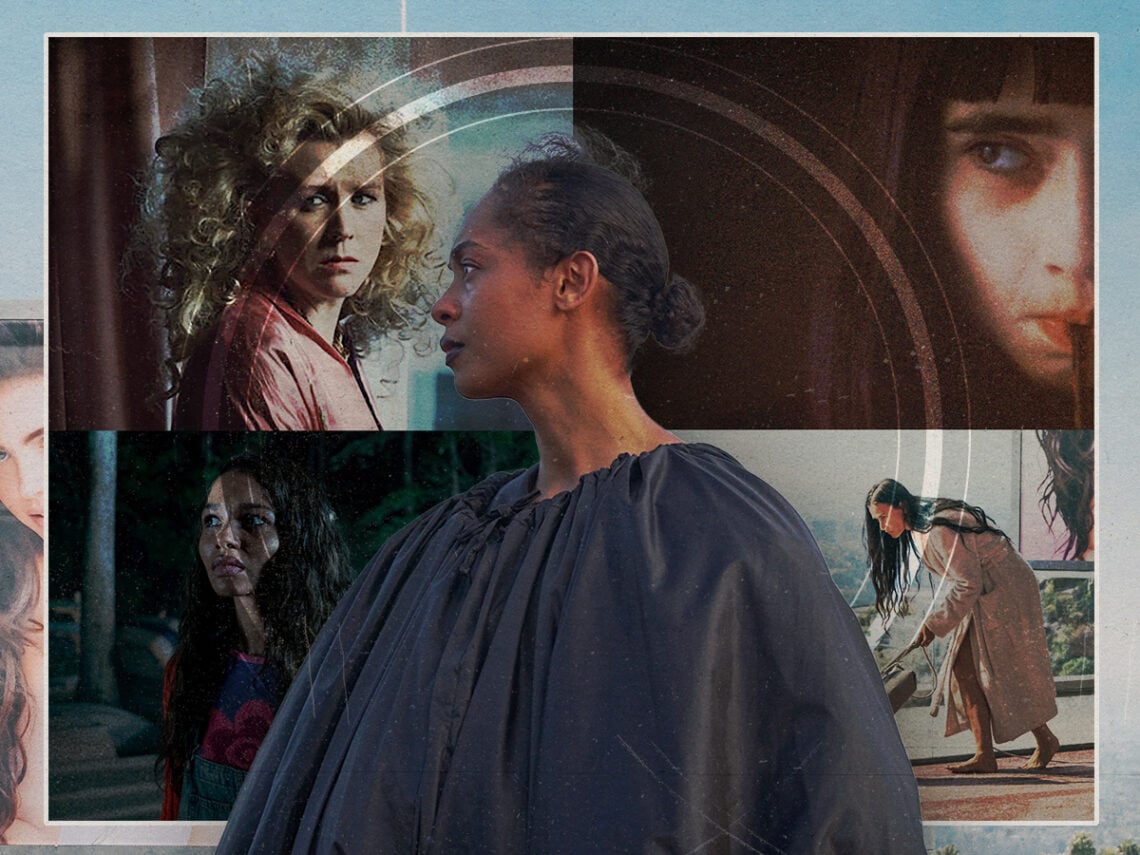
2024 was the year of unbridled female weirdness

It is an established fact that female music artists are having a lot more fun than their male counterparts. While Drake and Kendrick Lamar take their beef to court and the black hole of Diddy’s depravity rapidly engulfs the likes of Justin Bieber and Jay Z, Chappell Roan, Charli XCX, and Raye are putting in the work, topping charts, and, for the most part, seeming to enjoy the hell out of it. While the same gender dichotomy is not happening in the world of film, it is hard to ignore the reality that some of the most magnificently strange, ambitious movies of the past year were made by female or non-binary filmmakers.
From Coralie Fargeat’s stylishly gory body horror hit The Substance to Jane Schoenbrun’s delicately surreal coming-of-age drama I Saw the TV Glow, these films eschew realism in favour of something destabilising, bizarre, and often transcendent. Not only are these some of the best movies of the year, but they represent an exciting possibility – that wildly original, intensely stylised, and elusive filmmaking can flourish in an industry that is rapidly falling prey to commercially-driven franchise bloat that will probably soon be made entirely by artificial intelligence.
Let’s do a quick rundown of some of the female and non-binary-driven films that have made a splash this year. In addition to The Substance and I Saw the TV Glow is Megan Park’s comedy My Old Ass, in which a teenager meets an older version of herself while enjoying her last summer before college, Ariane Louis-Seize’s Humanist Vampire Seeking Consenting Suicidal Adult in which a young vampire is so uncomfortable with violence that she risks dying of starvation, Alice Lowe’s brilliantly goofy Timestalker, in which a self-absorbed woman with main character syndrome stalks an indifferent love interest across several centuries, and Rungano Nyoni’s surreal dark comedy On Becoming a Guinea Fowl, in which a family goes through a lengthy series of funereal rituals for a relative whose abuse had a devastating impact on them all.
There are few unifying factors to these movies aside from their complete abandonment of convention. The Substance is pure body horror with a heavy dose of glitzy showbiz satire that goes gleefully over the top and then completely over the edge. I Saw the TV Glow is a heartfelt, often painful exploration of dysphoria and self-alienation. My Old Ass is a buddy movie in which the chemistry between its two leads (Maisy Stella and Aubrey Plaza playing the same character at different stages in life) is as electric as any romantic comedy. At turns hilarious and heartbreaking, it provides an understated, unexplained take on time travel that transcends genres.
Timestalker is gloriously irreverent and similarly ignores logic to triumphant effect. The main character reappears throughout the centuries in pursuit of an unwaveringly disinterested paramour, convinced they are meant to be together. Satirising British period dramas, ‘80s pop music, and the romance genre more broadly, Lowe’s film is unapologetically juvenile (a wooden dildo features heavily in the 18th-century portion of the story) and visually playful, side-stepping explanation in favour of refreshingly goofy one-off gags.
Humanist Vampire and On Becoming a Guinea Fowl take comedic approaches to the darkest of material – suicide and the legacy of abuse, respectively. Humanist Vampire is largely deadpan, focusing on the inherent humour of a vampire who possesses too much empathy to hunt for food. On Becoming a Guinea Fowl creates strangeness and contrast visually, juxtaposing the blue-tinged scenes of repressed trauma and complicity with brightly coloured reruns from a children’s television show.
What these films have in common is a sense of liberation. They demonstrate what cinema can be when the usual conventions of plot, tone, and realism are tossed aside in favour of creative freedom. As the commercially-minded sector of the film industry becomes increasingly repetitive and risk-averse, these female and non-binary filmmakers of 2024 demonstrated that leaping headfirst into auteur-driven strangeness can be crowd-pleasing and revolutionary all at the same time.
