


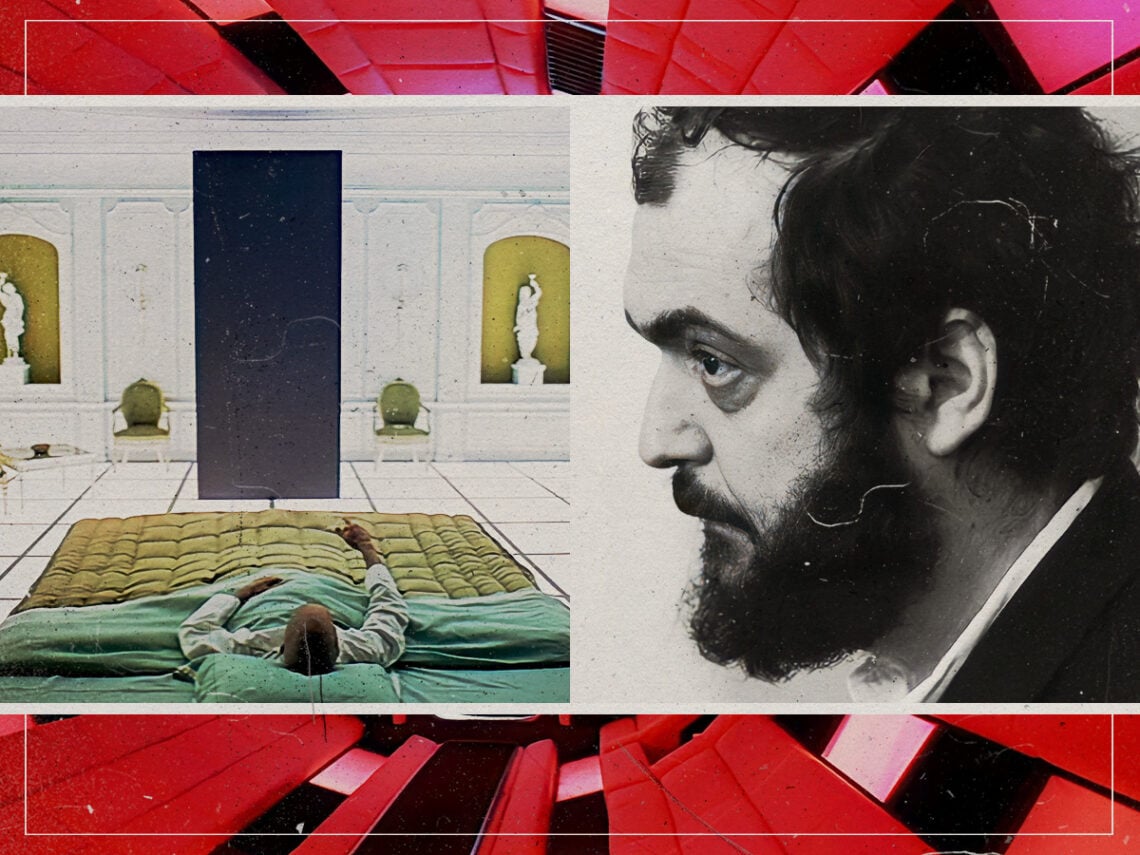
‘2001: A Space Odyssey’ explained: What is the purpose of the monolith?

Most of the works of Stanley Kubrick are rife with symbolism and hidden meanings, but few are as enigmatic as his 1968 science fiction masterpiece 2001: A Space Odyssey. Detailing the evolutionary stages of humankind from club-wielding apes to technologically advanced space farers, the classic film is a true marvel to watch and leaves much room for personal interpretation.
One such question left open at the conclusion of 2001 is just what the monolith means throughout the film. The black cuboid structure is a central piece of the film’s undoubted puzzle, a strange and alluring object that seems to propel the story onwards and, in turn, poses questions about the course of humanity.
The monolith appears each time there is a leap in the evolution of human consciousness. It was there when the pre-historic apes discovered the use of tools for the first time, tools which they inevitably use in acts of violence, laying out the path of humanity for the proceeding millennia, aeons of war and bloodshed. This indicates that perhaps it is the monolith that granted the apes their newfound realisation and gave permission to their new position as the king of the animal world.
The idea that the monolith is indeed responsible for triggering such an evolutionary advancement is further cemented when it again appears while humans are exploring space. The first time is underneath the moon’s surface. Humans reaching the moon for the first time was seen as a huge achievement in our scientific progress, and in 2001, the reward was the discovery of the monolith. But upon this discovery, the monolith emits an ear-piercing sound and transmits a signal into the outer reaches of space.
It’s this signal that urges humanity onwards rather than allowing them to be proud of their achievements thus far and believe their evolutionary journey is complete. As the film continues, the monolith also turns up at further significant moments. Astronaut Dave Bowman is sent along with Frank Poole to investigate the source of the signal, and after arriving at Jupiter, amid the mission nearly going AWOL as per the malfunction of the onboard computer system HAL-9000, Dave finds himself being sent beyond the infinite possibilities of the solar system into another dimension and galaxy unknown to his prior reckonings.
It’s in this strange, far-flung part of space, where time is compressed and visions of light flash past him in shades of brilliance, that Dave undergoes yet another evolutionary leap, emerging from his human body into the form of Star Child, an interdimensional being representing humanity’s next part of the evolutionary journey. And what object was present as Dave made that leap? The monolith.
So clearly, Kubrick used the monolith to represent the triggering of such evolutionary jumps. However, there are still questions that remain about the monolith. Questions that unfortunately seem unanswerable include where the monolith came from. Answers to such questions remain obscured, indicating perhaps the relentless and unending human quest for knowledge and understanding and also that perhaps our evolutionary journey is not entirely of our own choosing. Could that mean that the monolith is an alien or even a God that seems to have power over humanity’s course? Perhaps.
We should also consider the physicality of the monolith. Its strange and featureless form resembles a black mirror of sorts, a reflective perfect stone through which we can project our existential fears and anxieties, as well as our hopes and dreams. It’s representative of the enduring mystery of the cosmos, a phenomenon we are desperate to understand and yet are inevitably doomed to not.
In that light, the monolith of 2001 is symbolic of the unknown, the kind of facets of knowledge that will forever remain shrouded by our wild curiosity. The monolith poses far more questions than it can ever answer, and its presence in the film is, therefore, to invite audiences to contemplate and reflect on our highly improbable journey to existence. Just how did we get here?

What is 2001: A Space Odyssey about?
Stanley Kubrick and Arthur C. Clarke’s legendary science fiction film 2001: A Space Odyssey explores the place that humanity has in the infinite cosmos. It details several key events that occurred in the progress of humankind, beginning with their existence as pre-historic apes who discovered the use of tools.
The film then charts several key spacefaring missions as humanity begins to explore the stars and planets that surround their home on Earth. Kubrick examines the evolution of consciousness amid the dangers and limitations of our technology while driving home questions of just what it means for us to exist.
What is the monolith in 2001: A Space Odyssey?
The monolith in 2001: A Space Odyssey is a huge black cuboid structure that seems to appear at the key moments of human evolution. It’s present when pre-historic apes discover the use of tools at the beginning of the film and also shows up during humanity’s most vital spacefaring missions.
The structure is also present at the film’s conclusion when astronaut Dave Bowman makes the last evolutionary jump into Star Child. This indicates that the monolith is somehow connected to the evolutionary progress of humankind and is perhaps even triggering these critical moments.
Where to watch 2001: A Space Odyssey?
2001: A Space Odyssey is a true classic of the science fiction genre, and as such, it is often screened at cinemas across the world. In the UK, the Picturehouse Cinemas sometimes screen the film, as does the Prince Charles Cinema in London.
Otherwise, there are many DVD and Blu-ray copies of the film available to purchase, either new or second-hand, and Kubrick’s masterpiece sci-fi can also be rented online from BFI, Amazon, Google Play or YouTube movies. The film may occasionally be streamed on services like Netflix or Amazon Prime.
