


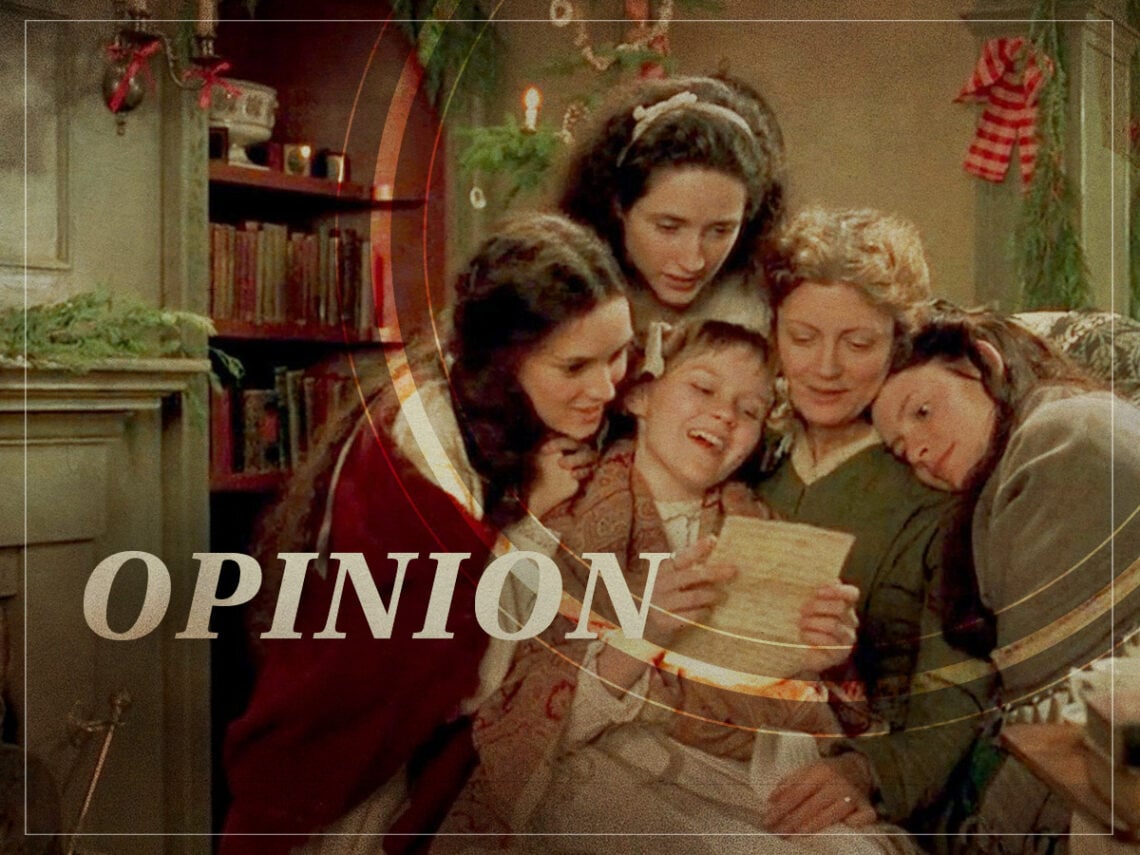
Hear Me Out: Gillian Armstrong created the definitive ‘Little Women’ adaptation

For decades, girls have been given copies of Little Women, perhaps by a relative hoping that the young reader will learn some valuable lessons about sisterhood and family, love and relationships, independence and strength, and what it means to be a woman. As a result of the book’s popularity, there have been various cinematic adaptations throughout the years, starting with the now-lost silent version made in 1917.
Two popular versions followed: George Cukor’s black-and-white version starring Katharine Hepburn, released in 1933, and a Technicolor interpretation by Mervyn LeRoy, which debuted in 1949. While these movies were successful, for anyone born a few decades later, Gillian Armstrong’s 1994 adaptation became the new go-to.
Featuring Winona Ryder as Jo, Trini Alvarado as Meg, Claire Danes as Beth, Kirsten Dunst as young Amy, Christian Bale as Laurie, and Susan Sarandon as Marmee, the story likely felt more accessible to viewers, especially young audiences of the time who were familiar with stars like Ryder. For years, this version remained a favourite for many fans of the novel, enrapturing viewers with its warm charm. Yet, in 2019, a new cinematic adaptation was released, threatening to usurp the movie’s throne.
Greta Gerwig, director of Lady Bird, made Little Women as her sophomore film, employing Saorise Ronan as Jo, Emma Watson as Meg, Eliza Scanlen as Beth, Florence Pugh as Amy (both young and adult), Timothée Chalamet as Laurie, and Laura Dern as Marmee. Casting some of cinema’s current most popular actors to play the March sisters was certainly a smart choice from Gerwig and one that attracted a lot of Academy Award buzz as a result.
So, while a new generation of Little Women fans might have claimed Gerwig’s version as the best, we’re here to suggest that there’s a strong argument to be made for the ‘90s version standing as the more faithful, cosy, realistic, and well-cast adaptation.
Let’s start with the casting decisions. As we know, there are four March sisters, with the youngest being 12-year-old Amy and the oldest being 16-year-old Meg. So, why was the then-23-year-old Pugh playing her character as both a 12-year-old and a young woman? The ‘90s version instead casts two different actors, with 12-year-old Dunst playing young Amy and 24-year-old Samantha Mathis playing the older version. It’s hard to see Pugh’s Amy as the character she’s meant to be – a selfish child yet to learn the ways of being a mature young woman. Pugh simply looks too old to play the role of Amy convincingly, which is best demonstrated by the manuscript-burning scene.
When Pugh’s Amy angrily burns a novel Jo has been writing, she explains to her sister that “the only thing you care about is your writing, and it’s not as if I could have hurt you by ruining one of your dresses – and I really did want to hurt you.” She says it with a composed matter-of-factness, as though she is wise beyond her years; yet, at this point in the story, Amy is meant to be a brattish 12-year-old.
Thus, the power of the scene doesn’t work as well as the ‘90s version, where a young Dunst begins screaming and burying her head in her bed once she’s caught red-handed, with the film showing both Jo and Amy being comforted separately. A timid Amy then mutters a sad “I’m sorry, Jo” by the doorway before walking away, her childishness emphasised by her inability to properly face Jo and explain her actions.
The overall casting of the March sisters in the 2019 version feels as though Gerwig was consciously assembling a cast that would attract viewers rather than picking actors who worked best as the characters and who also looked like a real family. The choice to have Watson use a dodgy American accent to play 16-year-old Beth was a questionable one, and while she plays the character just fine, Alvarado arguably makes her so much more likeable.
Of course, casting had to take into consideration the several years that pass over the course of the story, but the ‘90s version manages to present the girls as teenagers and adults seamlessly, while the 2019 adaptation leaves the ages of the characters as its most glaring fault. Gerwig’s film just doesn’t present the sisters convincingly enough, and you can’t help but see straight through the actors. It all feels too modern, as though the film is depicting 21st-century actors doing their best to pretend it’s the 19th-century, whereas the ‘90s version really does feel more faithful to the time in which Little Women is set. This is subsequently aided by the glow of the dimly lit rooms, the gorgeous oranges of the leaves, and the bright, snowy landscapes, giving the film a visually authentic appeal.
The ‘90s version feels much more faithful to Louisa May Alcott’s story, too, using a linear fashion to show the girls’ transformations into young women, which is the main point of the book’s narrative. Gerwig’s film instead jumps back and forth between the past and the present, and while a non-linear narrative can often be useful, in this case, it feels like more of a hindrance to the story.
Still, Gerwig’s movie is by no means a bad adaptation of the book, which has been interpreted and envisioned in different ways by so many readers over the years. Everyone is going to have different ideas of how they see the characters and how they think they should act, and some viewers will simply prefer the directorial choices of one film over the other. However, if we’re talking about faithfulness to the book and its characters and the cosy atmosphere it evokes, Armstrong’s 1994 version of Little Women is certainly our winner.
