


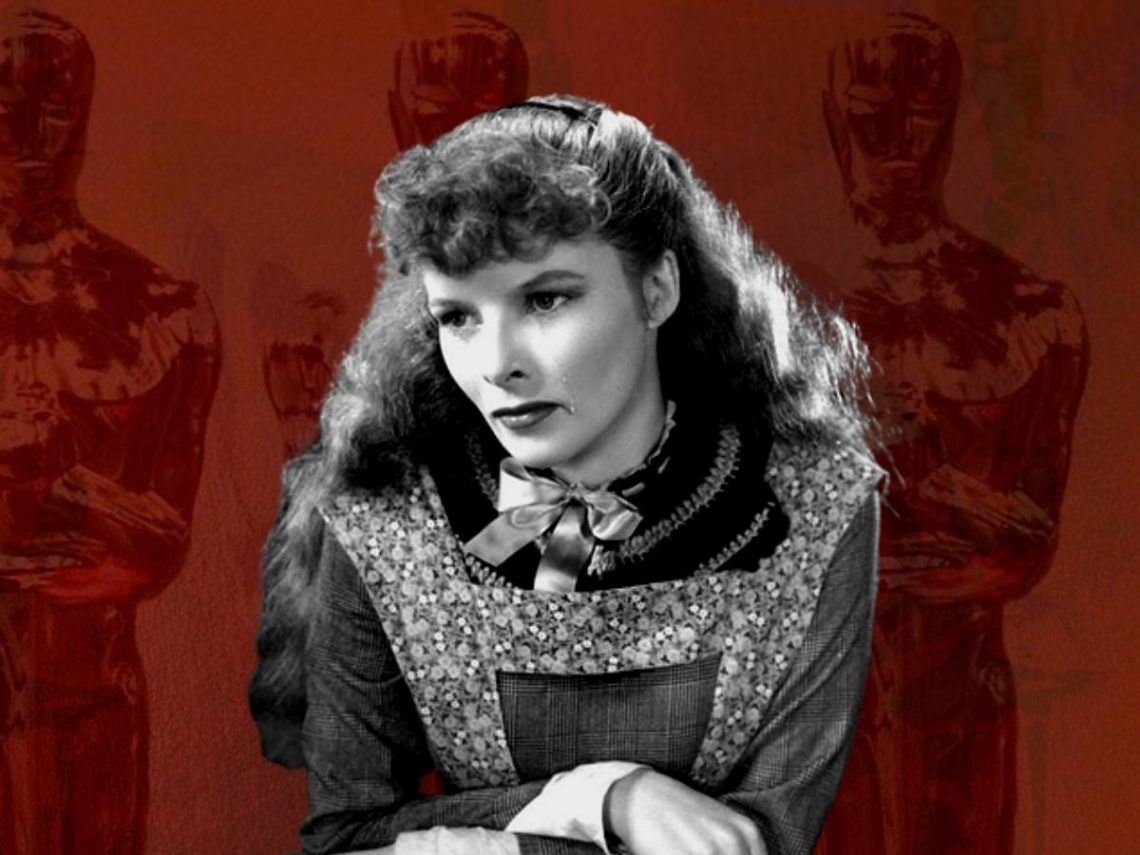
Katharine Hepburn’s finest role, according to Katharine Hepburn

In a career that’s held in such esteem as that of Katharine Hepburn, there’s a number of roles that could be considered her best. It’s a testament to the sheer esteem of her career that it is difficult to land one single role on her resume and label it as the defining one. Jack Nicholson, another worthy Academy Award winner, maintains a similar quality, whereby Hepburn’s visage is applied to several different characters from the golden age of cinema.
Starting her rise to icon status in the mid-1930s, Hepburn is famed for roles in some of the more formative films of early Hollywood, including Morning Glory, Alice Adams and The Philadelphia Story, all of which earned Hepburn Academy Award nominations for ‘Best Actress’.
It’s her portrayal in the 1933 adaptation of Little Women that Hepburn regards most fondly of her own work, however. At the time of release, it was one of the most successful film releases in the burgeoning industry, winning the Academy Award for ‘Best Adaptation’. Despite only being Hepburn’s fourth film, it also won her the Best Actress prize at the Venice Film Festival. Little Women showed early the success that Hepburn would go on to garner.
The book that the film is based on, published in the late 1800s, has been adapted seven times. Hepburn’s portrayal of Jo March was the first to appear outside of silent films, followed by an Oscar-winning version, filmed in colour, in 1949.
It would be 45 years until we’d see another adaptation, starring Winona Ryder as Jo in 1994, a further contemporary retelling released in 2018 to mark 150 years since the book’s publication, and a year later, director Greta Gerwig would lend her talents to a star-studded adaptation that would garner six Academy Award nominations including a Best Picture nomination and starred Saoirse Ronan as Jo.
Despite being one of seven actors to play the role, Katharine Hepburn says of her turn as the protagonist of a story about the transition from childhood to womanhood – ‘I defy anyone to be as good [as Jo] as I was’. And it seems that during the 1930s, that was very much the consensus – ‘Miss Hepburn’s characterization will stand alone on a pedestal of flaming brilliance’, the New York American wrote in a review at the film’s release.
Perhaps that’s the reason, then, why it took over 15 years for anyone else to attempt a portrayal of Jo, with June Allyson taking the reins from Hepburn to a mixed reception “she can’t hold a bayberry candle to the Jo of Katharine Hepburn of fifteen years ago” said one review at the time. With comparisons like that, it’s easy to see why Katharine Hepburn holds her performance in Little Women in such high regard.
With a career that will make most film stars blush, and a resume that is heavier than her award shelf, Hepburn can be perhaps most pleased with the notion that hers is a face connected with some of the greatest characters in cinema history.
