


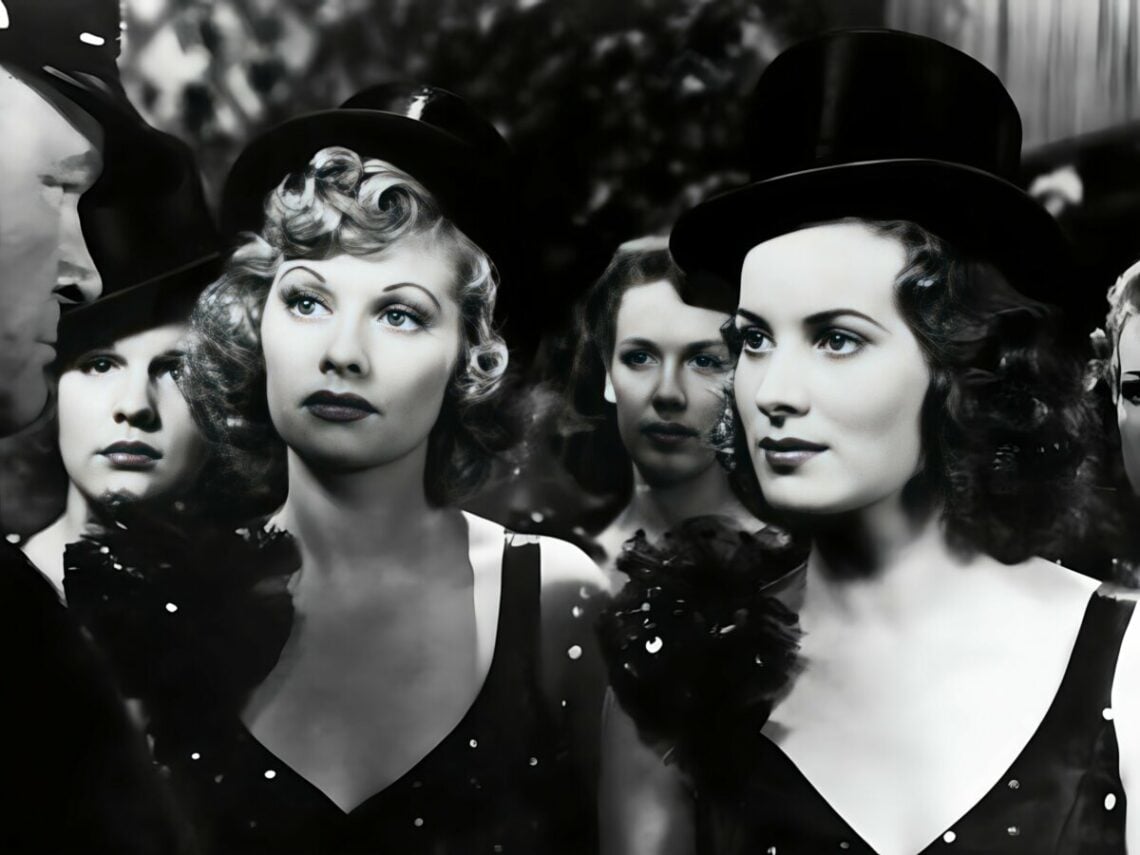
‘Dance, Girl, Dance’: the 1940 comedy that confronted the male gaze head-on

Decades before film scholar Laura Mulvey coined the term ‘male gaze,’ director Dorothy Arzner took aim at it in a film that stands the test of time. Released in 1940 and starring Maureen O’Hara and Lucille Ball, Dance, Girl, Dance is a comedy about women trying to earn a living as dancers only to discover that money is reserved for those who are willing to be objectified rather than celebrated. Toward the end of the film, one of them decides to turn the tables.
Struggling with unemployment and down to their last pennies, Judy (O’Hara) and Bubbles (Ball) are forced to break away from their dance troupe and find their own way. Judy searches for work as a ballerina, and Bubbles strikes gold as a burlesque dancer. Soon, she brings Judy into the show to perform a ballet routine. The goal is to make the male patrons so annoyed at the genteel, fully-clothed performance that they are practically burning the stage down by the time Bubbles returns for the striptease they signed up for. It works like a charm, and the show sells out every night.
One evening, however, Judy has had enough with men. She’s just had her heart broken by a man who turned out to be a liar, and the whole routine of dancing for a hoard of lecherous patrons and being booed for keeping her clothes on is more than she can bear. To add insult to injury, she is tired of being manipulated and bullied by Bubbles. She stumbles her way through the first part of her routine with the crowd jeering and heckling her. Just as she’s about to storm off stage, she gets a better idea. Narrowing her eyes, Judy stalks to the front of the stage and stares right back at the audience.
“Go ahead and stare, I’m not ashamed,” she says, arms crossed. “I know you want me to tear my clothes off so as you can look your fifty cents worth. Fifty cents for the privilege of staring at a girl the way your wives won’t let you. What do you suppose we think of you up here? [W]hat’s it for? So as you can go home when the show is over and strut before your wives and sweethearts and play at being the stronger sex for a minute? I’m sure they see through you just like we do.”
As she says this, the camera switches from her face to the audience, literally shifting the gaze from the male perspective to the female perspective. They fidget in their seats, looking away from her and appearing deeply uncomfortable. But when the camera is trained on her face again, she is also looking directly at the other audience–us. Staring straight down the camera lens, she is breaking the fourth wall, confronting the cinema audience who is there to watch Maureen O’Hara and Lucille Ball dance.
Arzner was the first woman to direct a feature film for a Hollywood studio. She got her start the way most aspiring female filmmakers did at the time, typing up scripts. However, her ambition and skill soon got her a position as an editor and then as a director in the late-1920s. She made close to two dozen films, including ones that helped launch the careers of Katharine Hepburn and Rosalind Russell. She stopped abruptly in 1943, however, making just one film after Dance, Girl, Dance. She later became a lecturer at UCLA and mentored a young Francis Ford Coppola.
Dance, Girl, Dance was ahead of its time, but it was also an urgent appeal to its time. Women in Hollywood may have been bigger box office draws than their male counterparts, but they were built by the studios to be figures of goddess-like proportions – pinup girls to be leered and worshipped in equal measure. Arzner’s film not only subverts this by levelling its script and its gaze at the audience, but by focusing on the challenging relationship between two women.
Judy and Bubbles have love interests in the story, but the men are peripheral at best. The friendship and competitiveness between the women drive the story, and it’s the part of the film that has the most nuance. It’s no coincidence that Ball gives the best pre-I Love Lucy performance of her career as the sardonic, uninhibited Bubbles, and O’Hara also turns in a career-defining role as a woman with a passion for her art who can only compromise so far. She was never as naturalistic as she is in this film, and their performances play off each other with the chemistry that you might expect of a romantic duo.
On a basic level, Dance, Girl, Dance is an expertly crafted, supremely entertaining movie that highlights its actors at their finest. It would take years for Arzner’s contributions to cinema to be fully appreciated, but luckily, this movie is just as enjoyable from a 21st-century perspective as it would have been for contemporary audiences.
