


Was 1927 the most revolutionary year for cinema?

From its inception in the late 1800s, cinema has enjoyed rapid spree of innovation, becoming one of the most popular forms of visual art in the process. The oldest surviving film, Roundhay Garden Scene, dates back to 1888. It was filmed by French inventor Louis Le Prince in Leeds, England. By 1893, the Edison Company’s Kinetoscope was created, which allowed one person at a time to watch moving pictures. However, in 1895, the Lumiere brothers became the first to present projected motion pictures to paying audiences, using their own invention, the Cinématographe.
Film began as a spectacle, often shown in music halls and fairgrounds, usually consisting of short clips of people or landscapes. French illusionist Georges Méliès led advancements in narrative cinema with his short films inspired by theatre. He popularised the use of special effects, creating short science-fiction, fantasy and horror films that experimented with hand-painted colour, dissolves, multiple exposures and time-lapse. Over the following years, narrative film became incredibly popular, and by 1914, multiple national film industries were established. The early 1900s was a key period of technological and narrative advancement, with movements such as German Expressionism flourishing in the 1910s and early 1920s.
By the ’20s, Hollywood had established itself as a key player in cinema. The popularity of filmmaker D.W Griffith, paired with the success of comic actors like Charlie Chaplin and Buster Keaton, were significant figures in the development of cinema as a popular medium, despite the fact their films had no sound. Yet, in 1927, cinema changed forever with the invention of synchronised sound, demonstrated in the first ‘talkie’, The Jazz Singer. Alan Crosland’s musical drama was the first to use this invention, with both a recorded musical score and lip-synchronised singing and talking. Its release marked the end of the silent era, introducing audiences to a wealth of cinematic possibilities.
The film used Warner Brothers’ Vitaphone system, which quickly proved to be unreliable, leading to the dominance of the ‘sound-on-film’ method instead. Regardless, The Jazz Singer was a huge hit, and by the early 1930s, silent cinema was already referred to as the ‘old medium’. With that, Sunrise: A Song of Two Humans was also released in 1927, becoming one of the first films to use a synchronised score with a soundtrack that featured sound effects. Although the movie still used silent actors, it marked an important step towards sound cinema innovation.
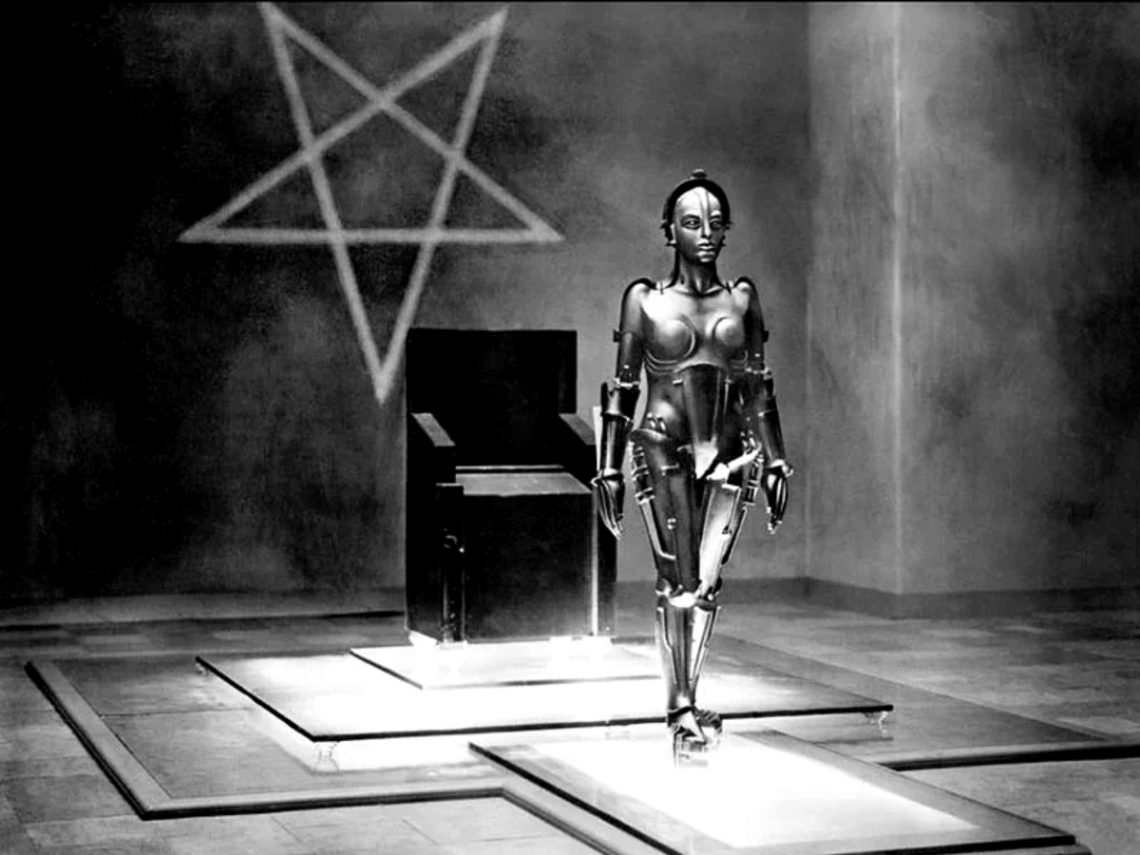
But that’s not the only major cinematic advancement that took place in 1927. The first science-fiction feature film debuted that year, Fritz Lang’s Metropolis. The German Expressionist film, made during the creatively prosperous Weimar period, is one of the silent era’s most significant achievements. Exploring themes of technological advancement, industrialisation and capitalism, the impact of Metropolis on popular culture cannot be understated. The film’s influence can be seen in major science-fiction works such as Blade Runner and Star Wars, as well as practically any film with a futuristic cityscape setting.
Of course, another significant moment in film history took place in 1927, given that the formation of The Academy of Motion Picture Arts and Sciences took place. Metro-Goldwyn-Mayer’s Louis B. Mayer set out to create an organisation for labour dispute mediation without the need for a union. Although an annual banquet for the elite group was discussed, the formation of the Academy did not initially include the idea of an awards ceremony. Instead, thirty-six industry giants were invited to a private dinner, which included Cecil B. DeMille, Mary Pickford, Harold Lloyd and Frank Lloyd.
By May 11th, Douglas Fairbanks Sr was elected the first president of the Academy, and the first honorary membership was awarded to Thomas Edison. However, it wasn’t until 1928 that the Academy decided to award filmmakers, actors and technicians for their cinematic achievements, with the first official ceremony taking place in 1929. Since then, the awards ceremony has been held annually, and winning an accolade from the Academy is considered the most prestigious feat in cinema.
It’s safe to say that 1927 was a mighty year for cinema that completely transformed the medium for the better. It’s hard to imagine how different our world would be if sound cinema had never been invented, which is now such a cornerstone in our lives.
