


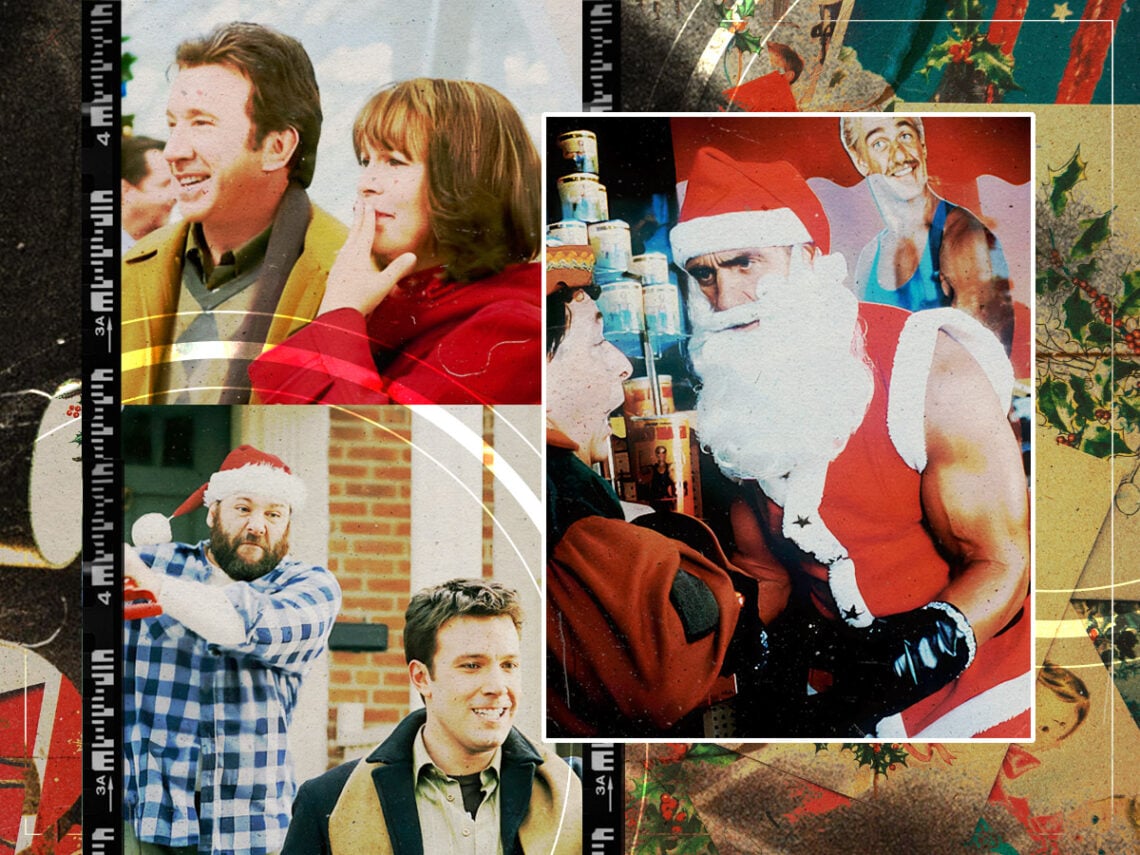
The 10 worst Christmas movies of all time

One person’s trash can often be another’s treasure, but when it comes to the worst Christmas movies of all time, any reasonable person would struggle to pick out any positives.
Each and every year, without fail, a deluge of brand new festive-themed titles emerge with an eye on not just finding an audience right out of the gate but eventually joining the pantheon of classics that find themselves being revisited en masse annually from almost the second December begins.
While there are sure to be defenders of several terrible Yuletide features, for the sake of cinema as an art form, it would be reasonable to expect – or hope – that they’d be in the minority. Anybody can make a Christmas movie, and a massive amount of filmmakers have, but the ratio of those who have made a good one – never mind a great one – is concerningly skewed towards the negative.
That’s not to say anything that doesn’t get greeted as an all-time great isn’t without its highlights, but the following ten titles are nonetheless about as unforgivable as it gets.
The 10 worst Christmas movies:
Black Christmas (Glen Morgan, 2006)
Horror remakes continue to be all the rage – and have been for the last two decades – but even the novelty of a cult classic festive slasher getting a fresh coat of blood-red paint couldn’t save Black Christmas from being deservedly pilloried for its voluminous shortcomings.
Nowhere near scary enough to serve its purpose as a horror movie and far too self-serious to embrace the shoddiness of its writing, directing, editing, and acting, everything about the film falls abysmally flat. Even the kills are poorly staged, dimly lit, and executed in formulaic fashion, not that it stopped yet another remake emerging in 2019. It was better, but still terrible, which pretty much says it all.
Christmas with the Kranks (Joe Roth, 2004)
Tim Allen proved such a goldmine for Yuletide cinema that The Santa Clause got a trilogy and a small-screen sequel series, but Christmas with the Kranks is proof that lightning can rarely be relied upon to strike twice. The Toy Story star is at his most grating, but even more egregious is the presence of the typically-reliable Jamie Lee Curtis.
The pair’s titular spouses celebrate the fact they’ve finally got a Christmas to themselves and plan to take a trip to mark the occasion. For whatever reason, their neighbours decide this is the pretext to turn the Kranks into social pariahs, and by the time the cloying climax rolls around and they’ve inevitably re-embraced the spirit of the season, the underlying message that conforming to societal norms is the best course of action regardless of personal preference becomes inadvertently and concerningly dystopian in its sentiment.
A Karate Christmas Miracle (Julie Kimmel, 2019)
With almost 700 credits to his name, it’s a well-accepted fact of life that Eric Roberts has always placed quantity over quality, with his descent into nonsensical Christmas storytelling rather remarkably one of the most insane movies he’s ever appeared in.
Predicated on a mass shooting of all things in a premise that instantly raises alarm bells, a child convinces himself that if he creates and completes a ’12 Tasks of Christmas List’, his father, who disappeared during a shooting incident on Christmas Day the year before will return, and all will be right with the world.
Given that one of the bullet points is securing a black belt, the essence of A Karate Christmas Miracle essentially posits that mastering the art of karate could potentially resurrect the dead, replete with several poorly judged flashbacks to the aforementioned incident. Created in bad taste and executed with no semblance of competence or tact, some pitches are better off not being given the green light.
Surviving Christmas (Mike Mitchell, 2004)
Early-to-mid-2000s Ben Affleck was hardly the best version of the since-resurgent actor and filmmaker, with Surviving Christmas just one of several examples that painted the picture of somebody who’d simply given up trying.
That extended to the studio as well, apparently, considering Surviving Christmas was released into cinemas before the end of October, where it proceeded to tank at the box office on its way to richly-deserved Golden Raspberry nominations for ‘Worst Picture’, ‘Worst Screenplay’, and ‘Worst Actor’ for Affleck.
Relentlessly mean-spirited for no justifiable reason, the prospect of seeing Affleck on autopilot as a materially-driven malcontent who pays James Gandolfini and Catherine O’Hara to pretend to be his parents – for the sole reason they live in his childhood home – is more depressing than whimsical, with a cavalcade of unlikeable characters firing jaded barbs on the way to discovering that family was the real present all along.
Santa with Muscles (John Murlowski, 1996)
When asked about her experience co-starring with Hulk Hogan in the risible Christmastime comedy by GQ, Mila Kunis’ instant response neatly encapsulated a feeling to have been shared by many over the years: “Jesus, you didn’t watch Santa with Muscles, did you?”
Unfortunately, people genuinely have, with the self-explanatory title arguably the smartest thing on display across the entirety of its mind-numbing 97 minutes. Making it eminently clear why he never reached the same on-screen heights as fellow wrestlers-turned-actors Dwayne Johnson, Dave Bautista, and John Cena, Hogan appears to operate under the assumption that his innate muscularity and perma-tanned exterior can compensate for a startling lack of screen presence, charisma, or acting ability.
The grappler plays a nefarious millionaire who puts on a Santa costume and flees for the police, cracking his head so hard he gets amnesia and wakes up thinking he’s the real deal. That’s the entire setup in a nutshell, in addition to a villain who wants to bulldoze an orphanage for the sake of acquiring some magic crystals, because why not?
Kirk Cameron’s Saving Christmas (Darren Doane, 2014)
Kirk Cameron starring as Kirk Cameron in a movie executive produced by Kirk Cameron certainly sounds like a vanity project, but the star ends up playing second fiddle to messaging so strong that it almost leaps out from the screen and bludgeons its unwitting audience half to death.
Trying to rediscover what Christmas really means, Cameron is shambolic from a tonal perspective, railing against the consumerisation of the occasion despite trying to convince the characters within the context of its fictional narrative on how the very symbols used to monetise December 25th that originated from outside the Bible are secretly Christian iconography in disguise.
It makes absolutely no sense, holds no value as either a motion picture or a parable, and spends its whole running time relaying one message that it regularly undercuts with another in the exact same scene.
Jack Frost 2: Revenge of the Mutant Killer Snowman (Michael Cooney, 2000)
Obviously, nobody had been conditioned to expect cinematic greatness from a movie called Jack Frost 2: Revenge of the Mutant Killer Snowman, but at least its 1996 predecessor placed its tongue so far into its cheek that it developed cult status for its unhinged insanity.
The second time around – and clearly operating with a much smaller budget – it just comes across as cheap and nasty shlock precision-engineered to capitalise on the original movie, finding an unexpectedly lengthy shelf life. Cult status is something that needs to be earned and not manufactured, although Jack Frost 2 should at least be awarded points for giving its murderous snowman created from human DNA harvested from its subject a banana allergy and then turning it into a plot point.
Deck the Halls (John Whitesell, 2004)
Friendly rivalries have been the bread and butter of the suburban comedy since time immemorial, so drenching the familiar subgenre in the bells and whistles of Christmas should have realistically yielded something that was less than execrable in its final form.
Danny DeVito and Matthew Broderick had other things in mind, though, declaring war on each other in an effort to earn the title of being the most disconcertingly crazed celebrator of all things festive on their block. Why? There’s no discernible reason provided other than Yuletide d*ck-measuring of a figurative sense, although the fact it cratered at the box office and was lambasted by critics and crowds alike does mercifully indicate the number of people to have fallen for its complete, utter, and egregious lack of charm is minimal.
Elves (Jeffrey Mandel, 1989)
Most level-headed folks will know precisely where they fall on the merits of Elves when they discover it involves a pagan ritual giving rise to the return of murderous elves who were originally roped into servitude by Adolf Hitler with the goal of creating a half-human and half-elf “master race” that would allow him to take over the world, by ensuring the little critters who inhabited Santa’s workshop would be bred with blonde-haired, blue-eyed virgins.
Incredibly, that’s the thinking behind a movie that actually got made, including a lengthy expositional sequence that laboriously explains the secret history shared between elves and Nazis, complete with a breakdown of just how important their magically-enhanced sperm was to Hitler’s masterplan.
Sure, the potential may have been there for a slice of demented “so bad it’s actually entertaining” spectacle, but that’s a long way away from being the case in Elves, which is nothing more than straight-up horrendous.
The Nutcracker in 3D (Andrei Konchalovsky, 2010)
In a jarring coincidence, Elves isn’t the only repugnant Christmas movie to have come under scrutiny for its heavy-handed use of Nazi imagery, with Andrei Konchalovsky’s three-dimensional (literally, if nothing else) adaptation of The Nutcracker following suit two decades later and coming under sustained fire for doing so.
The interweaving elements of the story pinball between high fantasy, light-hearted comedy, and intense war drama on a whim and without warning, so much so that you’ll be conditioned not to bat an eyelid when John Turturro conjures an entire brass band out of nowhere before electrocuting a shark to death while belting out a big number espousing the positives of being a despicable human being.
Made for the quite frankly ludicrous cost of $90 million, The Nutcracker in 3D sank without a trace during its run in cinemas, secured a Razzie nomination for ‘Worst Eye Gouging Misuse of 3D,’ and didn’t manage to score a solitary positive review on Rotten Tomatoes from any critic unfortunate enough to waste their time on it.
